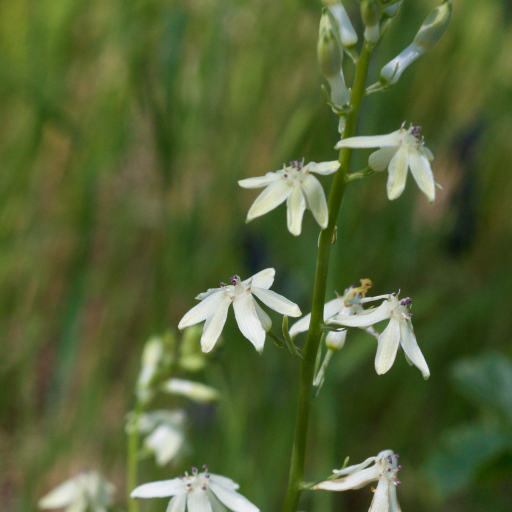
Plant Overview
Known as Hartweg’s Tooth-tongue, this rare California native is a botanical treasure often found hiding in plain sight on sun-drenched, grassy slopes. Despite its fierce-sounding name, it is a delicate, star-flowered beauty that belongs to the small Tecophilaeaceae family, most of whose members live thousands of miles away in the Southern Hemisphere. Seeing one of these in the wild is a true "win" for any native plant enthusiast.
🔍 How to Identify
- 🌼 Reflexed Petals: The flowers feature six dainty, creamy-white tepals that curve sharply backward, similar to a shooting star, making the central parts of the flower stand out.
- 🦷 The "Tooth": If you look closely at the flower's center, you’ll see small, tooth-like appendages where the stamens meet the petals—this unique feature gives the plant its name (Odontostomum literally means "tooth-mouth").
- 🌱 Slender Foliage: The leaves are long, narrow, and grass-like, usually emerging from an underground corm (a bulb-like structure) well before the flower stalk rises.
🏡 In Your Garden
- 🧱 Clay Lover: While most garden plants demand perfect drainage, Hartweg’s Tooth-tongue actually thrives in heavy, "sticky" clay soils that would suffocate other species.
- 💤 Summer Dormancy: This plant is a drought-evader. Once it finishes blooming in late spring, it retreats entirely underground. It is vital to stop watering it during the summer; if the soil stays wet while the corm is dormant, the plant will likely rot.
⚠️ Safety & Toxicity
- 🌿 Low Risk: This plant is not known to be toxic to humans or common garden visitors.
- 🐾 Pet Watch: While not listed as a poisonous species, it is always a good idea to prevent pets from digging up and snacking on wild bulbs or corms, as they can cause mild digestive upset if consumed in large quantities.
✨ Fun Fact
Odontostomum hartwegii is a "monotypic" genus. This means it is a botanical "only child"—there is only one single species in its entire genus, making it a unique and lonely branch on the evolutionary tree of life!

Detailed Care Instructions

Some plants require more regular watering than others, which should be done every few days. It's critical to maintain the soil moist all of the time. The water requirements of the same plant placed in pots with varying sizes will differ. Because the water in the smaller pot evaporates faster than the water in the larger pot, it will require more watering. Regardless of pot size, the surface should constantly be maintained moist.








