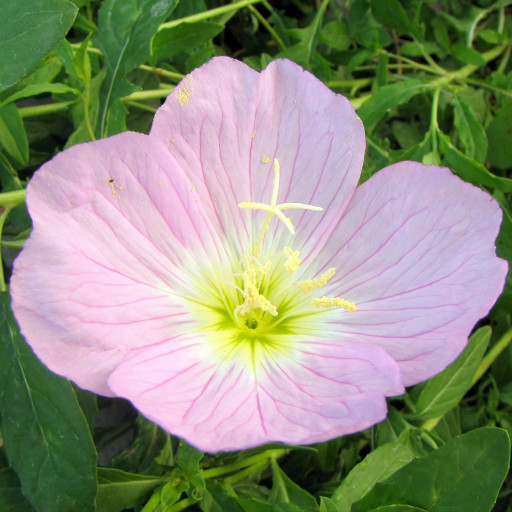
Plant Overview
Often called "Pink Ladies" or the "Showy Evening Primrose," this enchanting wildflower looks like it belongs in a fairytale meadow. Native to the grasslands of North America and Mexico, it is a resilient pioneer that creates a shimmering, silky carpet of pink wherever it settles. While it looks delicate, this plant is a tough survivor, often seen nodding gracefully along dusty roadsides and sunny prairies.
🔍 How to Identify
- 🌸 The Bloom: Large, four-petaled flowers that are cup-shaped. They usually transition from a pale white center to a soft, glowing pink with delicate darker veins.
- 🌿 The Foliage: Slender, lance-shaped leaves that are medium green. They often have slightly wavy or "toothed" edges and can take on a reddish tint during colder months.
- 📏 The Growth: A low-growing, sprawling perennial that rarely exceeds 1.5 feet in height but spreads wide to form a dense, lush groundcover.
🏡 In Your Garden
- 🏃 A Friendly Invader: Be aware that this plant spreads aggressively via underground runners (rhizomes). While it’s perfect for filling large empty spaces or preventing erosion on slopes, it can easily "bully" smaller, weaker plants in a tidy flower bed.
- ☀️ Sun Seeker: It thrives in full sun and poor soil. Its deep taproot allows it to survive intense summer heat and droughts that would wither other flowers. In fact, it often blooms more prolifically when it’s not pampered with too much fertilizer.
- 🌓 Timing is Key: Depending on your local climate, the flowers may open in the evening to greet the moon or stay open all day during cooler, cloudy periods.
⚠️ Safety & Toxicity
- ✅ Status: Generally Non-Toxic.
- 🐾 Details: Oenothera speciosa is considered safe and non-toxic for humans, dogs, and cats. It is a worry-free choice for gardens where curious pets or toddlers might wander.
✨ Fun Fact
Unlike many garden flowers that rely on bees, the Pink Evening Primrose has a special relationship with the night. Because its blooms often open at dusk, it is a vital nectar source for nocturnal visitors like the large, hovering Sphinx Moth, often mistaken for a hummingbird in the twilight.

Detailed Care Instructions
Pink evening primrose, like other species in the genus, is a vigorous native plant that can take over a perennial garden with rich fertile soil. For this reason, it is best grown in rocky, barren soils where it tends to be better behaved, remaining in a disciplined clump.
Is this species edible?
Yes. The roots have a peppery flavor and can be prepared in a similar fashion to other root vegetables. The leaves are also popular for consumption and are eaten as salad greens. However, these are best harvested before the plant begins to bloom—otherwise, they may turn bitter.The seeds of the evening primrose plant are frequently harvested as a natural source of Omega-6 fatty acids—but birds love them too, so you’ll have competition for gathering them.
How long does this plant live?
Individual plants are not especially long-lived, but pink evening primrose spreads so readily that a colony of plants can achieve near eternal status.
| Color | White To Pale Pink |
| Soil Ph | Slightly Acidic To Neutral |
| Humidity | Normal |
| Lighting | Full Sun |
| Soil Type | Loose, Well-Draining |
| Bloom Time | Summer To Fall |
| Difficulty | Easy |
| Plant Type | Perennial |
| Hibernation | Cold Period |
| Mature Size | 12 To 18 Inches Tall |
| Native Area | Central To Southwestern United States |
| Sun Exposure | Full Sun |
| Hardiness Zones | 4-9 |
To grow Oenothera speciosa, also known as the Pink Evening Primrose or Mexican Evening Primrose, follow these steps:
- Choose a suitable location: Oenothera speciosa grows well in full sun to partial shade. It prefers well-drained soil, so make sure the planting area doesn't become waterlogged.
- Soil preparation: Amend the soil by adding organic matter like compost to improve its fertility and drainage. The pH level of the soil should be between 6.0 and 8.0.
- Planting: Dig planting holes that are slightly larger than the root ball of the plant. Space multiple plants about 12 inches apart. Gently place the plant in the hole and backfill with soil, firming it around the base of the plant.
- Watering: Water the newly planted Oenothera speciosa deeply to settle the soil and help the roots establish. Afterwards, water the plants regularly, providing about 1 inch of water per week. Avoid overwatering, as it can lead to root rot.
- Mulching: Apply a layer of organic mulch, such as wood chips or straw, around the plants to help retain moisture, suppress weed growth, and regulate soil temperature.
- Pruning: Oenothera speciosa doesn't require extensive pruning. However, you can remove faded or dead flowers to encourage more blooms and maintain an attractive appearance.
- Fertilizing: Oenothera speciosa usually doesn't require fertilization if the soil is rich in organic matter. However, if your soil is poor, you can feed the plants with a balanced slow-release fertilizer during the spring.
- Controlling pests and diseases: Monitor your plants for common pests like aphids and control them with organic insecticides if necessary. Oenothera speciosa is generally resistant to diseases, but good maintenance practices, such as proper watering and adequate spacing, can help prevent issues.
- Propagation: Oenothera speciosa can be propagated by collecting seeds from mature plants in the late summer or fall. Sow the seeds in well-drained soil or store them in a cool, dry place until spring. Alternatively, you can propagate through division by separating the roots of established plants and replanting them.
By following these guidelines, you should be able to successfully grow Oenothera speciosa and enjoy its beautiful pink flowers.

Place in a bright room that is sun drenched almost all day. Or directly in a south-facing window.

In order to water this particular plant, it is important to ensure that the soil surrounding it has been adequately moistened. This can typically be accomplished by using a watering can or hose to apply water directly to the soil around the base of the plant. It is recommended to avoid getting the leaves or flowers of the plant wet, as this can contribute to issues such as fungal growth or damage to the delicate plant parts.
Furthermore, it is important to monitor the moisture level of the soil on a regular basis, as over- or under-watering can be detrimental to the health and growth of the plant. This can be done by inserting a finger or small tool into the soil to assess its moisture level; if it feels dry to the touch, it is likely time to water the plant. Finally, it is important to note that watering requirements may vary depending on factors such as the size of the plant, the weather, and the type of soil it is planted in, so it is always a good idea to do additional research on the specific needs of this plant.
To fertilize this plant, use a balanced fertilizer with equal amounts of nitrogen, phosphorus, and potassium. Apply the fertilizer in early spring and again in mid-summer. Follow the manufacturer's instructions for the amount to apply, but be careful not to over-fertilize as this can harm the plant. Water the plant thoroughly after fertilizing to help distribute the nutrients evenly in the soil.
The best type of soil to use for the Oenothera Speciosa plant is a well-draining soil that is nutrient-rich and has a pH level between 6.0 and 7.0. The soil should be loose and friable to allow for good root growth and should not be too compacted. The plant prefers a moderately fertile soil that is not too acidic or alkaline and does not like wet feet. A mix of compost, peat moss, and sand or perlite can be added to the soil to improve drainage and provide nutrients. It is important to ensure that the soil is not too compacted as this can impede root growth and cause the plant to struggle to obtain water and nutrients. Overall, a well-draining, nutrient-rich soil that is loose and friable, with a neutral pH, is best for this plant.
Propagation of the plant scientifically called Oenothera Speciosa can be done in several ways. One way of propagating this plant is through division. The root ball can be carefully divided into 2 or more sections using a sharp knife. Each section should have some healthy roots and leaves. The divided sections can be then planted in a suitable location or container.
Another way of propagating this plant is through stem cuttings. Take a cutting of 4-6 inches from the stem of the plant. Remove the lower leaves from the cutting and dip the cut end in rooting hormone. Plant the stem cutting in a well-drained potting mix and keep it moist. Place the pot in a warm, bright location. After a few weeks, the cuttings should start developing roots.
Seeds can also be used for propagation. Collect ripe seeds from the plant and sow them in a seed tray filled with moist soil. Cover the seeds with a thin layer of soil and keep the tray in a warm, bright location. Keep the soil moist and the seeds should germinate in a few weeks. Once the seedlings are big enough to handle, they can be transplanted in a larger container or in the ground.
Whatever method is used, it is important to provide appropriate care to the newly propagated plants. They should be kept in a location with appropriate light and moisture. With proper care, the newly propagated Oenothera Speciosa plants will grow and thrive.
Common pests of the white evening-primrose include Spider mites, aphids. Make a habit of checking your white evening-primrose frequently for pests so that any infestations can be caught and managed early.








