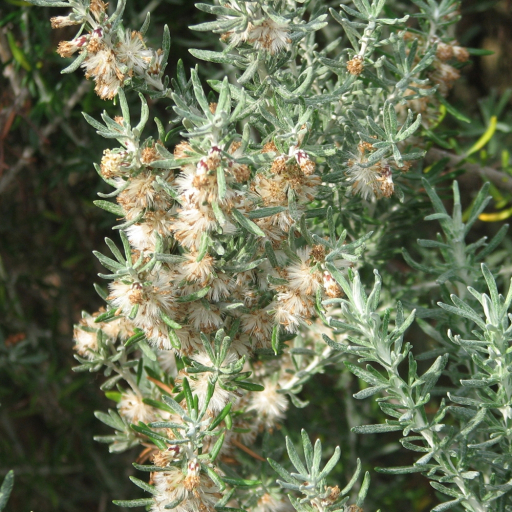
Plant Overview
Often called the "Wild Rosemary" or "Coast Daisy-bush," this hardy Australian native is the ultimate survivalist of the shoreline. With its shimmering silver foliage and incredible resistance to salt spray, it acts as a soft, aromatic buffer between the crashing waves and the inland garden. It is a staple for coastal restoration and windbreaks, prized for its ability to thrive where other plants would wither.
🔍 How to Identify
- 🌿 Silvery Foliage: The leaves are small, narrow, and grey-green, often appearing white or silver due to a dense layer of fine, woolly hairs that protect the plant from the harsh sun and salt.
- ☁️ Woolly Stems: The young branches are distinctly white and felt-like to the touch, adding a soft, cloudy texture to the shrub’s overall structure.
- 🌼 Hidden Blooms: Unlike showy daisies, its flowers are tiny, creamy-yellow, and tucked away in the "axils" (the angle between the leaf and the stem), giving the plant its species name axillaris.
🏡 In Your Garden
- 🌊 The Salt Specialist: This plant doesn't just tolerate salt; it thrives in it. It is the perfect choice for front-line coastal planting, helping to stabilize sand and shield more sensitive plants from the wind.
- ✂️ Structural Versatility: While it can grow into a tall, slightly "scraggly" bush in the wild, it responds beautifully to regular pruning. You can shape it into a tight, silvery hedge that provides a sophisticated backdrop for more colorful garden residents.
- 🐦 Wildlife Haven: Its dense, twiggy interior provides an essential sanctuary for small birds, such as wrens and silvereyes, protecting them from predators and harsh weather.
⚠️ Safety & Toxicity
- ✅ Generally Non-Toxic: Olearia axillaris is considered safe and is not known to be poisonous to humans, cats, or dogs.
- ✋ Skin Sensitivity: Because of the dense, fine hairs on the leaves and stems, some individuals with very sensitive skin may experience mild mechanical irritation if handling the plant extensively. Wearing gloves during heavy pruning is a good practice.
✨ Fun Fact
Despite the nickname "Wild Rosemary," this plant is actually a member of the Daisy family (Asteraceae) and isn't related to the culinary herb at all. It earned the name because its crushed leaves release a familiar, spicy-pine scent that has fooled many hikers into thinking they've found a kitchen garden in the middle of the dunes!

Detailed Care Instructions
Olearia Axillaris, also known as the coastal daisy bush, is a hardy and low-maintenance plant that is relatively easy to grow. Here are some tips on how to successfully grow Olearia Axillaris:
- Light: Olearia Axillaris prefers full sun to partial shade. Make sure to plant it in a location where it will receive at least 6-8 hours of sunlight per day.
- Soil: This plant prefers well-draining soil that is slightly acidic to neutral. Sandy or loamy soil is ideal for Olearia Axillaris.
- Watering: Olearia Axillaris is drought-tolerant once established, but it prefers regular watering during its initial growth phase. Water deeply and infrequently to encourage deep root growth.
- Fertilizing: Olearia Axillaris does not require much fertilization, but you can feed it with a balanced fertilizer in the spring if necessary.
- Pruning: Prune Olearia Axillaris in the spring to maintain its shape and size. Remove any dead or damaged branches to encourage new growth.
- Propagation: Olearia Axillaris can be propagated from cuttings taken in the spring or summer. Strip the lower leaves from the cutting and place it in a pot with well-draining soil. Keep the cutting moist until roots form.
- Pests and diseases: Olearia Axillaris is relatively pest and disease-resistant. However, keep an eye out for aphids, mealybugs, and powdery mildew, and treat as necessary.
By following these tips, you should be able to successfully grow Olearia Axillaris in your garden or landscape.

Place in a bright room that is sun drenched almost all day. Or directly in a south-facing window.

Olearia Axillaris is a plant that requires regular watering, especially during periods of extended dryness. The amount of water required by this plant will depend on several factors such as the size of the container, humidity levels, and the outdoor temperature.
To water the plant, first, check the soil moisture level by inserting a finger about two inches deep into the soil. If the soil feels dry, it is time to water the plant. The best time to water the plant is either early in the morning or early in the evening when the sun is less intense.
Use a watering can or a garden hose with a gentle nozzle to avoid damaging the plant. Slowly pour water into the container, starting from the sides and avoiding the plant's leaves, which can encourage fungal growth. Be sure to water the soil evenly around the plant, and once the water starts running out of the drainage holes, stop watering.
Avoid overwatering the plant, as this can lead to root rot and other diseases. It is also essential to ensure that the plant is grown in well-draining soil, as this allows excess water to drain away quickly. Finally, pay attention to the plant's leaves, which can wilt if the plant is either under or over-watered.
To fertilize the plant, use a balanced, slow-release fertilizer in the spring before new growth appears. Water the plant thoroughly before applying the fertilizer to prevent burning the roots. Follow the package instructions for the appropriate amount of fertilizer to use based on the size of the plant. Avoid over-fertilizing, as this can lead to nutrient imbalances and potential harm to the plant. Repeat the fertilization process in early summer if necessary. Water the plant after fertilizing to help the nutrients soak into the soil and reach the roots effectively.
When planting the Olearia Axillaris plant, it is important to choose a suitable soil type for optimal growth and health. The ideal soil type for this plant is a well-draining, sandy soil that is slightly acidic to neutral in pH. The soil should also be enriched with organic matter such as compost or manure to provide necessary nutrients for the plant's growth. It is important to avoid heavy clay soils, as these can lead to waterlogged conditions that can cause root rot and other diseases. To further improve soil quality and drainage, it may be necessary to add perlite or coarse sand to the soil mix. By choosing the right soil, you can help ensure that your Olearia Axillaris plant thrives and remains healthy for years to come.
To propagate Olearia Axillaris, you can collect seeds from the plant by allowing the flowers to mature and produce seed pods. Once the pods are dry and brown, you can gently open them to collect the seeds.
Another method of propagation is through softwood cuttings. Take a cutting from a healthy branch of the plant, making sure it is around 5-10cm long. Remove the lower leaves and dip the cut end in a rooting hormone powder. Plant the cutting in a pot with well-draining soil and keep it in a warm, humid environment until roots begin to form.
You can also propagate Olearia Axillaris through division. Carefully dig up the plant and separate the root ball into smaller sections, making sure each section has some roots attached. Replant the divided sections in pots or directly into the garden, keeping the soil moist until new growth appears.








