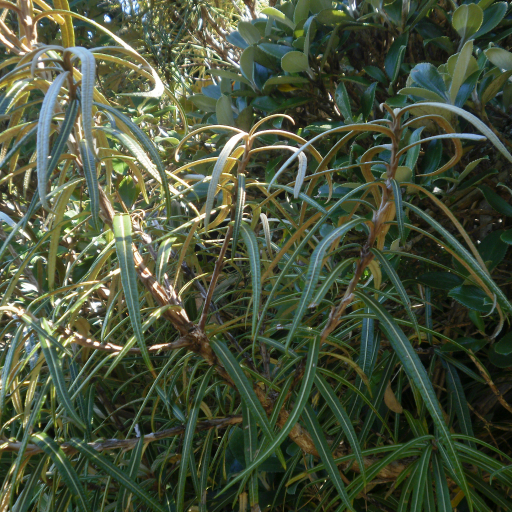
Plant Overview
Often called the Lancewood Daisy-tree, Olearia lacunosa looks like a prehistoric survivor from a lost world. Native to the rugged subalpine regions of New Zealand, this architectural shrub is famous for its long, narrow, "wrinkled" leaves that mimic the look of rusty metal or ancient leather. While most people think of daisies as small garden flowers, this species turns that idea on its head by growing into a sturdy, woody tree.
🔍 How to Identify
- 🍃 The "Lacunose" Leaves: The name comes from the Latin word for "hollows." The leaves are long and sword-like, featuring a deeply sunken midrib and veins that create a striking quilted or pitted texture.
- 🍂 Rusty Undersides: If you flip a leaf over, you’ll find a dense, velvety coating of brownish-orange "tomentum" (fine hairs) that protects the plant from harsh mountain winds.
- 🌼 Clustered Blooms: In late spring and summer, it produces small, fragrant white daisy-like flowers with yellow centers, gathered in dense bunches at the ends of the branches.
🏡 In Your Garden
- 🏔️ Mountain Roots: Because it originates from high-altitude forests, it craves cool, moist, and well-drained soil. It struggles in sweltering humidity or stagnant air, so give it a spot with plenty of "breathing room."
- 🛡️ Wind Resistance: This plant is a champion of exposed sites. Its leathery foliage is built to withstand gusts that would shred softer garden plants, making it an excellent choice for coastal or hillside gardens.
⚠️ Safety & Toxicity
- ✅ General Safety: Olearia lacunosa is not known to be toxic to humans or common household pets like cats and dogs.
- 🧤 Skin Sensitivity: While not poisonous, the fine hairs on the undersides of the leaves can occasionally cause mild skin irritation for sensitive gardeners. Wearing gloves during heavy pruning is a smart move.
✨ Fun Fact
Evolutionary biologists believe the "lancewood" shape of these leaves was a defense mechanism against the Moa, a giant, extinct flightless bird that used to roam New Zealand. The long, tough, serrated leaves were much harder for the birds to grab and swallow!

Detailed Care Instructions

Place in a bright room that is sun drenched almost all day. Or directly in a south-facing window.

The presence of a dry surface layer of soil does not indicate that the plant requires water. Instead, stick your finger 1-2" (3-5 cm) deep in the soil to feel dampness or moisture content. If the soil seems dry, it's time to water your greens. If the soil is still moist, however, it is better not to water your plant and instead wait a day or two. Overwatering or waterlogging raises the risk of root rot. So if the soil takes longer than a week to dry, check the light conditions because it's likely that the plant isn't getting enough light. It's fine if the upper layer of soil is dry between waterings, but the deeper soil layer should always have some moisture.








