Plant Overview
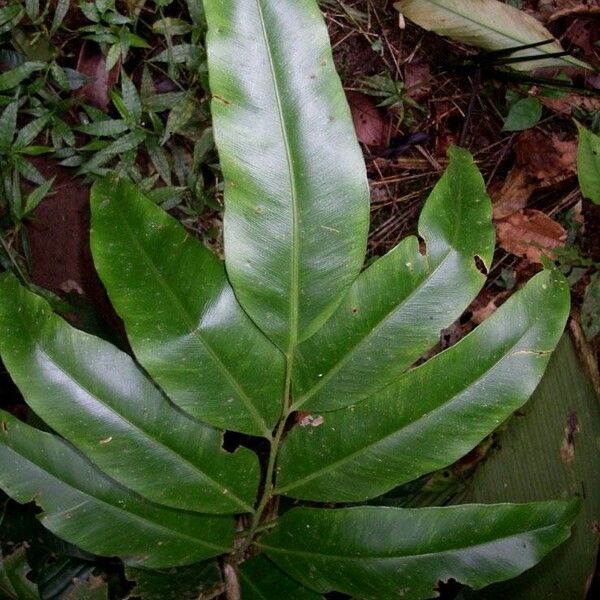
Known as the "Deer-leaf Fern," Olfersia cervina is a tropical treasure hailing from the humid forests of the Caribbean and Central America. Its name, derived from the Latin word cervinus, refers to its striking, antler-like fertile fronds that rise dramatically above the greenery. This elegant species is a favorite for collectors who want the "Staghorn" aesthetic but with the structured growth of a terrestrial fern.
🔍 How to Identify
- 🌿 Dual-Frond Nature: This plant is dimorphic, meaning it grows two distinct types of leaves. The sterile fronds are wide, glossy, and deep green, while the fertile ones are narrow, tall, and specialized for reproduction.
- 🦌 The "Antlers": The fertile fronds stand more upright and are covered in dark spore cases (sporangia), giving them a fuzzy, sculptural appearance reminiscent of a deer's velvet antlers.
- 🧶 Creeping Rhizome: Look at the base; you’ll see a thick, scaly, creeping stem that allows the plant to slowly spread across the soil or climb up damp surfaces.
🏡 In Your Garden
- ☁️ Humidity is Non-Negotiable: Because its ancestors lived in tropical cloud forests, this fern thrives in high-humidity environments. If you’re growing it indoors, a bathroom or a spot near a humidifier is ideal to prevent the tips from browning.
- 🪵 Versatile Mounting: While it grows well in a pot with airy, organic soil, Olfersia cervina is also an epiphyte. This means you can get creative and mount it onto a piece of cedar or cork bark with sphagnum moss, mimicking its natural life on tree trunks.
⚠️ Safety & Toxicity
- ✅ Pet & Human Safe: This fern is generally considered non-toxic to cats, dogs, and humans. It is a "friendly" addition to a household with curious pets.
- 🧤 Skin Sensitivity: While not poisonous, the brown scales on the creeping rhizomes can be slightly irritating to those with very sensitive skin. It’s always a good idea to wear gloves if you are dividing or repotting the plant.
✨ Fun Fact
Olfersia cervina is a master of the "division of labor." By producing separate leaves for photosynthesis (the green ones) and reproduction (the brown ones), the plant can optimize its energy—the green leaves catch every bit of dim forest light, while the tall fertile stalks reach higher to catch the breeze and spread their spores!

Detailed Care Instructions
To properly water this plant, it is important to first understand its unique watering needs. In general, Olfersia Cervina prefers to be kept evenly moist, but not waterlogged. The soil should be moist to the touch, but not saturated or dripping wet.
To water this plant, begin by checking the soil moisture level. You can do this by sticking your finger into the soil up to the first knuckle. If the soil feels dry at this depth, it is likely time to water.
When watering, use room temperature water and pour it slowly and evenly over the soil surface until it begins to drain out of the bottom of the pot. Avoid getting water on the foliage, as this can lead to fungal issues.
It is important to not let this plant dry out completely between waterings, but also be careful not to overwater. It is better to underwater slightly than to overwater, as overwatering can lead to root rot and other issues.
In general, it is a good idea to water Olfersia Cervina plant once per week, but this may vary depending on factors such as humidity, temperature, and light levels. Keep an eye on the soil moisture level and adjust your watering schedule as needed.
For the Olfersia Cervina plant, it is best to use a well-draining soil mix that is rich in nutrients. The soil should have a pH level that is slightly acidic to neutral, typically ranging between 6.0 and 7.0.
The ideal soil mix for this plant should include a combination of organic matter, such as peat moss or compost, along with coarse sand or perlite to improve drainage. It is also recommended to add some garden lime or dolomite to the soil mix to help maintain a consistent pH level.
Overall, the soil should be loose and light, allowing air and water to penetrate easily. It should also be able to retain moisture without becoming waterlogged or compacted. Regular fertilization and proper watering practices are also important for the health and growth of the plant.








