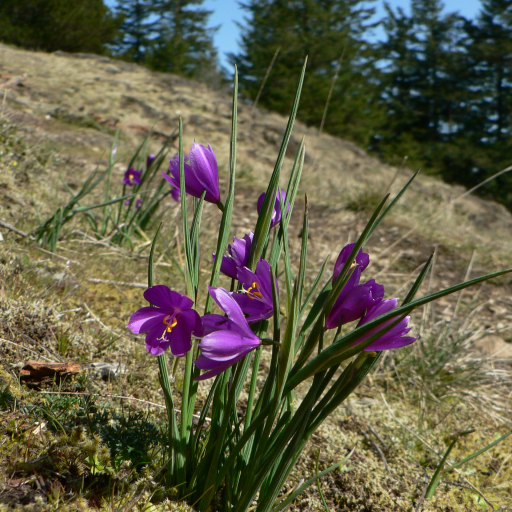
Plant Overview
Affectionately known as the Satinflower or Douglas's Grass-widow, this delicate beauty is one of the earliest harbingers of spring in the Pacific Northwest. Its nodding, bell-shaped blooms often appear while the ground is still thawing, pushing through the cold earth like a vibrant pink promise. In regional folklore, its arrival is a celebrated sign that the harshest days of winter have finally retreated.
🔍 How to Identify
- 🌸 The Bloom: Six satiny, pointed tepals (petals and sepals that look identical) form a downward-facing bell. They typically glow in shades of deep magenta or royal purple, though rare white variants exist.
- 🌿 The Foliage: True to its "Grass-widow" name, the leaves are long, narrow, and upright. They look so much like common field grass that the plant is nearly invisible until the flowers emerge.
- 📏 The Stature: This is a petite perennial, usually reaching only 6 to 12 inches in height. It grows from a cluster of thickened, fleshy roots rather than a traditional bulb.
🏡 In Your Garden
- 🪨 Rocky Requirements: In the wild, this plant thrives on rocky outcrops and in mossy meadows. If you bring it into your garden, it requires "sharp" drainage—meaning the water must move through the soil quickly. It is an excellent candidate for a dedicated rock garden.
- 💤 Summer Slumber: This species is an "ephemeral." Once it finishes flowering in late spring, the entire plant will turn yellow and disappear underground. It is vital not to overwater the site during its summer dormancy, as the roots are prone to rotting in warm, wet soil.
⚠️ Safety & Toxicity
- ✅ Low Risk: Olsynium douglasii is not known to be toxic to humans or common household pets.
- 🐾 Mild Irritation: While it lacks dangerous toxins, the fibrous, grass-like leaves can cause minor digestive upset if consumed in large quantities by curious cats or dogs. It is best treated as an ornamental rather than an edible plant.
✨ Fun Fact
The "Douglas" in its name honors David Douglas, a legendary Scottish botanist who explored the American West in the 1820s. He was so prolific that more than 80 species of plants and animals—including the famous Douglas Fir—are named after him!

Detailed Care Instructions
Olsynium douglasii, commonly known as Douglas' grasswidow, is a beautiful flowering plant that can be grown in your garden with proper care. Here are some tips on how to grow Olsynium douglasii:
- Climate: Olsynium douglasii thrives in full sun to partial shade and prefers mild to cool temperatures. It is native to California and the Pacific Northwest, so it is best suited for USDA hardiness zones 6-9.
- Soil: Make sure the soil is well-draining and slightly acidic to neutral pH. You can improve the soil by adding organic matter such as compost or peat moss.
- Planting: Plant Olsynium douglasii bulbs in the fall or early spring, about 2-3 inches deep and 4-6 inches apart. Water the bulbs after planting to help them establish roots.
- Watering: Water the plants regularly, keeping the soil moist but not waterlogged. Olsynium douglasii is drought-tolerant once established, but it benefits from consistent moisture during the growing season.
- Fertilizing: Fertilize the plants with a balanced fertilizer in the spring when new growth appears. Avoid using high-nitrogen fertilizers, as they can promote leafy growth at the expense of flowers.
- Mulching: Mulch around the plants to help retain moisture and suppress weeds. Mulch can also protect the bulbs from extreme temperature fluctuations.
- Pruning: Trim off dead flower heads to encourage more blooms and tidy up the plant. Cut back the foliage after it dies back naturally in the fall.
- Pests and diseases: Olsynium douglasii is relatively pest and disease resistant. However, watch out for snails, slugs, and aphids, as they may occasionally feed on the foliage.
By following these tips, you can successfully grow Olsynium douglasii and enjoy its beautiful flowers in your garden.

Place in a window with dappled sun or a spot in the middle of a room. Or directly in a window facing west or east.

Olsynium douglasii plants should be watered regularly to keep the soil consistently moist but not waterlogged. It is best to water the plant at the base to avoid getting water on the foliage, which can lead to disease. The frequency of watering will depend on the climate and the growing conditions, but generally, in the growing season, the plant may need watering every 7-10 days. During the dormant season, reduce watering to once every 2-4 weeks. Be sure to check the soil moisture level before watering to avoid overwatering. Additionally, using a well-draining soil mix can help prevent waterlogging and root rot.
Fertilize Olsynium Douglasii plants in early spring with a balanced, slow-release fertilizer. Water the plant thoroughly before applying the fertilizer to prevent burning the roots. Follow the instructions on the fertilizer packaging for proper application rates. Feed the plant again in late summer to promote healthy growth and flowering. Avoid over-fertilizing as this can harm the plant.
Olsynium douglasii plants thrive in well-draining soil with a neutral to slightly acidic pH level. A sandy loam or loamy soil with good organic matter content is ideal for these plants. It is important to ensure the soil is not too compacted or heavy, as this can lead to poor drainage and potentially cause root rot.
Adding perlite or sand to the soil can also help improve drainage and prevent waterlogging. Additionally, incorporating organic matter such as compost or well-rotted manure can provide essential nutrients for the plants to thrive.
Regularly amending the soil with organic matter and ensuring proper drainage will help create a suitable growing environment for Olsynium douglasii plants to flourish and produce their colorful blooms.
Olsynium douglasii can be propagated through division of its bulbs. This process involves carefully separating individual bulbs or bulb offsets from the parent plant and replanting them in suitable soil. It is important to ensure that each divided bulb has some roots attached to increase the chances of successful propagation. The newly divided bulbs should be planted at the same depth as they were previously growing and kept in a well-draining soil mix. Regular watering and monitoring of the newly propagated plants are essential to promote healthy growth.








