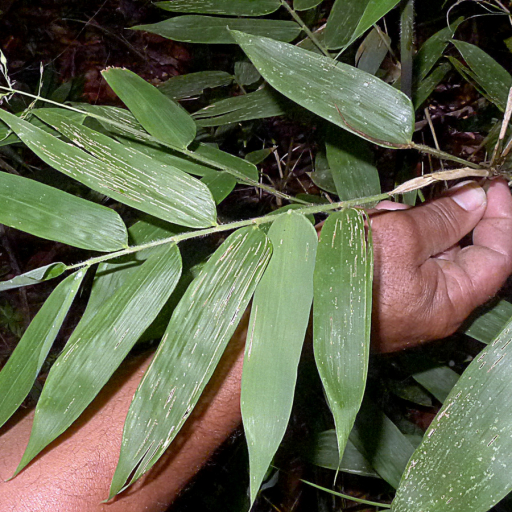
Plant Overview
Known affectionately as Carry-all Grass or Bamboo Grass, Olyra latifolia is a sophisticated forest dweller that bridges the gap between a delicate lawn grass and a sturdy bamboo. Native to the tropical regions of the Americas and Africa, this perennial grass spends its life tucked away in the dappled light of jungle understories. It is a favorite among collectors who want the "bamboo look" without the invasive growth habits or massive height of true timber bamboo.
🔍 How to Identify
- 🌿 The Foliage: Unlike the needle-like blades of common grass, these leaves are broad, lance-shaped, and remarkably glossy.
- 🎋 The Stems: It grows on slender, cane-like stalks (culms) that can reach several feet high, giving it a distinctive "miniature forest" appearance.
- 🌸 The Bloom: Look for terminal clusters where the female flowers sit proudly at the top, while the smaller male flowers dangle below on the same branch.
- 📐 Asymmetric Base: If you look closely at where the leaf meets the stem, the leaf base is often slightly uneven or lopsided, a key botanical giveaway.
🏡 In Your Garden
- ☁️ The Jungle Floor Effect: Because its natural home is the forest floor, it thrives in partial shade. Direct, harsh afternoon sun will scorch its broad leaves, so think of it as a "shady nook" specialist.
- 💧 Thirsty Roots: This plant hates to dry out completely. It prefers consistently moist, well-draining soil and high humidity; if your home is dry, it will appreciate a pebble tray or a frequent misting.
- 🪴 Container Queen: Unlike many wild grasses that spread uncontrollably, Olyra latifolia is well-behaved in large pots, making it an excellent structural plant for patios or indoor sunrooms.
⚠️ Safety & Toxicity
- ✅ Status: Generally considered non-toxic to humans and common household pets.
- 🧤 Leaf Texture: While not "poisonous," the edges of the leaves and the stems contain silica. This can make them slightly abrasive, potentially causing mild "grass cuts" or skin irritation if handled roughly without gloves.
✨ Fun Fact
Despite its delicate appearance, Olyra latifolia is a member of the "woody grasses." It is evolutionarily closer to the giant bamboos used to build houses than it is to the grass growing on a golf course!

Detailed Care Instructions
Here are some steps to help you grow Olyra Latifolia plant:
- Choose a suitable location: Olyra Latifolia plant prefers partial shade or indirect sunlight. Select a spot in your garden or indoor space with bright but filtered light.
- Soil preparation: Olyra Latifolia prefers well-draining soil. Prepare the soil by mixing organic matter like compost or well-rotted manure to improve its fertility and drainage.
- Sowing seeds: Olyra Latifolia plants are typically propagated from seeds. Sow the seeds directly into the prepared soil at a depth of about 1/4 inch (0.6 cm). Alternatively, you can start seeds indoors in pots or trays and transplant them later.
- Watering: Keep the soil consistently moist but not waterlogged. Avoid over-watering as it may cause root rot. Water the plants deeply when the top inch of soil feels dry.
- Temperature and humidity: Olyra Latifolia prefers warm and humid conditions. Maintain the temperature between 70-85°F (21-29°C) and humidity levels around 60-70%.
- Fertilizing: Apply a balanced, slow-release fertilizer every 4-6 weeks during the growing season. Follow the package instructions for dosage.
- Pruning: Trim any dead or damaged leaves to maintain the plant's appearance and health. Regular pruning helps promote new growth.
- Pests and diseases: Watch out for common pests like aphids, mealybugs, or spider mites. Treat any infestations promptly with organic insecticides or insecticidal soap. Monitor the plant for any signs of disease and take appropriate action if necessary.
- Transplanting: When the Olyra Latifolia plants have grown a few inches tall and have 2-3 true leaves, they can be transplanted outdoors or into larger pots. Handle the delicate roots gently while transplanting.
- Maintenance: Regularly check for any weeds and remove them to prevent competition for nutrients. Keep an eye out for any signs of stress or nutrient deficiencies and address them accordingly.
Remember to research specific growing conditions and requirements for Olyra Latifolia in your region, as they may differ based on climate and location.

Place in a window with dappled sun or a spot in the middle of a room. Or directly in a window facing west or east.
To water this particular plant, you should first check the soil for dryness by inserting your finger about an inch into the soil. If it feels dry, water the plant until the excess drains out of the bottom of the pot. Be sure not to let the plant sit in standing water for too long. It's best to water the plant in the morning so the foliage has time to dry out before evening. Aim to keep the soil consistently moist but never waterlogged. During the winter months, reduce watering and allow the soil to dry slightly between waterings.
To fertilize Olyra latifolia plant, use a balanced fertilizer with equal parts nitrogen, phosphorus, and potassium. Apply the fertilizer twice a year, once in the spring and once in the fall. Use a granular slow-release fertilizer and apply it around the base of the plant. Water thoroughly after fertilizing to ensure the nutrients are absorbed by the roots. Avoid over-fertilizing, as this may cause burning or damaging of the plant.
For optimal growth and development of the Olyra Latifolia plant, it is recommended to use a well-draining soil that is rich in organic matter. The soil should be slightly acidic, with a pH range between 5.5 and 7.5. A mixture of loamy soil, peat moss, and sand would be suitable. It is also important to ensure that the soil is regularly watered, but not overwatered, to prevent root rot. Additionally, adding a slow-release fertilizer or organic matter to the soil can provide the plant with essential nutrients for growth and health.
To propagate this plant, you will need to carefully remove small sections of the plant's stem with some leaves attached. These sections can be planted in a pot with well-draining soil and kept moist until they develop roots. It is best to do this in the spring or summer when the plant is actively growing. Once the new plants have rooted and started to grow, they can be transplanted to their permanent location. It is important to keep the new plants in a warm, humid environment until they are established.








