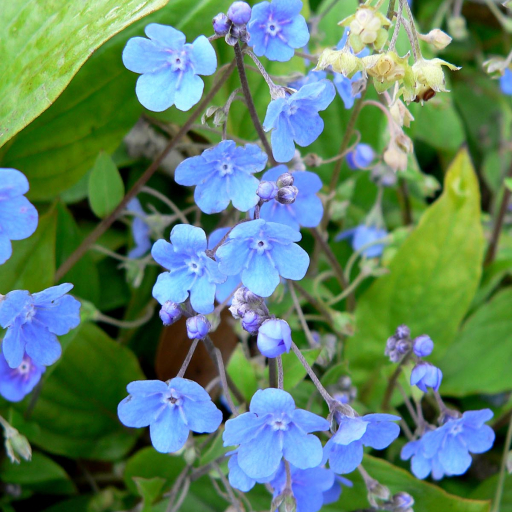
Plant Overview
Often called the "Cappadocian Navelwort," this woodland gem is like a persistent, ground-hugging version of the Forget-me-not. Hailing from the cool, shaded forests of Turkey and the Caucasus, it brings a splash of deep, starry blue to those difficult dark corners of the garden where other plants struggle. It is a favorite for gardeners looking to create a romantic, "secret garden" aesthetic.
🔍 How to Identify
- 🌸 The Blooms: Small, five-petaled flowers in a piercing azure blue, often featuring a tiny white "eye" or star in the center. They appear in delicate sprays during mid-to-late spring.
- 🍃 The Foliage: Rich green, heart-shaped (ovate) leaves that are slightly textured and pointed. In milder climates, the foliage remains semi-evergreen throughout the winter.
- 🌱 Growth Form: It grows in low, neat clumps that gradually spread via underground runners to create a lush, leafy carpet.
🏡 In Your Garden
- 🌥️ Shade Specialist: This plant is a master of the "woodland edge." It thrives in dappled or full shade, making it the perfect solution for planting under the canopy of large trees or on the north side of a fence.
- 💧 Moisture Balance: While it can tolerate "dry shade" once established, it truly flourishes in soil that mimics the forest floor—cool, organic, and consistently moist. It does not handle extreme drought or scorching afternoon sun well.
⚠️ Safety & Toxicity
- ✅ General Safety: Omphalodes cappadocica is not known to be toxic to humans or common household pets like dogs and cats.
- 👐 Handling: The leaves are slightly hairy; while not dangerous, those with very sensitive skin might experience mild mechanical irritation if handling large quantities without gloves.
✨ Fun Fact
The name Omphalodes comes from the Greek word omphalos, which means "navel." This refers to the plant's unique seeds, which are shaped like tiny belly buttons!

Detailed Care Instructions

Place in a window with dappled sun or a spot in the middle of a room. Or directly in a window facing west or east.

The presence of a dry surface layer of soil does not indicate that the plant requires water. Instead, stick your finger 1-2" (3-5 cm) deep in the soil to feel dampness or moisture content. If the soil seems dry, it's time to water your greens. If the soil is still moist, however, it is better not to water your plant and instead wait a day or two. Overwatering or waterlogging raises the risk of root rot. So if the soil takes longer than a week to dry, check the light conditions because it's likely that the plant isn't getting enough light. It's fine if the upper layer of soil is dry between waterings, but the deeper soil layer should always have some moisture.








