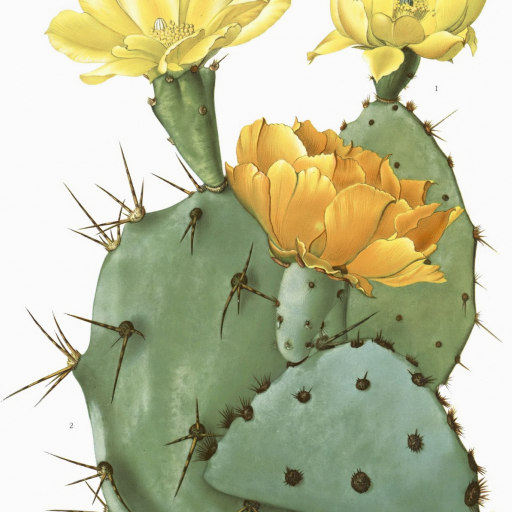
Plant Overview
Often called the Chenille Prickly Pear or Cowboy’s Red Whiskers, this stunning cactus is a favorite for desert landscaping and xeric gardens. Unlike many of its cousins that sport long, intimidating spikes, this Opuntia is covered in dense, velvety-looking clusters of copper-colored bristles. It is a native of the Chihuahuan Desert, prized for its symmetrical growth and its ability to produce a "sunset" of colors in a single cluster.
🔍 How to Identify
- 🌵 Pads (Cladodes): The plant consists of flat, oval to rounded blue-green pads that grow in a branching, bushy habit, eventually reaching about 3 feet in height.
- 🧶 Glochids: It is distinguished by its lack of long central spines; instead, it features prominent, circular clusters of short, reddish-brown or golden-orange bristles called glochids.
- 🌺 Flowers: In late spring and early summer, it produces large, saucer-shaped blooms that are typically golden-yellow or bright orange, often with a deep red center.
🏡 In Your Garden
- 🏜️ Drainage is King: This cactus is a master of drought but a victim of moisture. It requires gritty, fast-draining soil—ideally a cactus mix with added perlite or gravel—to prevent the pads from softening and rotting at the base.
- ☀️ Sun for Color: To maintain the vibrant "red whiskers" and prevent the pads from stretching (etiolation), place it in the brightest spot possible. High light intensity encourages more frequent and colorful flowering.
⚠️ Safety & Toxicity
- 🩹 The "Hidden" Danger: While it looks soft and fuzzy, this plant is "touch-me-not" in the extreme. The tiny glochids are barbed and detach at the slightest breeze or touch, embedding themselves painfully into the skin or clothing.
- 🐾 Pets and Kids: It is not chemically toxic, but the mechanical irritation from the bristles can cause severe discomfort, skin rashes, or eye irritation. It should be planted away from walkways or areas where children and pets play.
✨ Fun Fact
🏆 Award-Winning Beauty: The Opuntia aciculata is so visually striking and easy to maintain that it has received the prestigious Award of Garden Merit from the Royal Horticultural Society, a rare feat for a prickly pear!

Detailed Care Instructions
To grow Opuntia aciculata, follow these steps:
- Choose a suitable location: Opuntia aciculata is a desert plant and requires full sunlight. Select a well-draining spot with sandy or rocky soil.
- Propagation: Opuntia aciculata can be propagated through seeds or cuttings. If using seeds, sow them in a pot filled with well-draining cactus soil mix. Keep the soil moist until germination occurs. Cuttings can be taken from healthy, mature plants. Allow the cut ends to dry for a few days before planting them in a well-draining soil mix.
- Planting: If starting from seeds, transplant the seedlings into individual pots once they have grown a few inches tall. If using cuttings, plant them directly in the desired location or in pots.
- Watering: Opuntia aciculata is drought-tolerant and can withstand extended periods without water. Water sparingly and allow the soil to dry out between waterings to prevent root rot.
- Soil conditions: Opuntia aciculata prefers well-draining soil. You can amend heavy clay or compacted soil with pumice, perlite, or coarse sand to improve drainage.
- Fertilization: Opuntia aciculata does not require frequent fertilization. You can apply a balanced, slow-release cactus fertilizer once or twice a year during the growing season.
- Pruning: Prune Opuntia aciculata in late winter or early spring to remove any dead or damaged pads. Be cautious while handling the pads due to their spines.
- Protection from frost: Opuntia aciculata is frost-sensitive. If you live in a region with cold winters, provide protection in the form of blankets or frost cloths during freezing temperatures.
- Pest and disease control: Opuntia aciculata is relatively resistant to pests and diseases. However, monitor for common cactus pests like mealybugs and scale insects. Treat any infestations promptly with appropriate insecticides or insecticidal soaps.
Remember to research specific requirements and growing conditions of Opuntia aciculata to ensure optimal growth and care for your plant.
Opuntia Aciculata plant is a type of cactus that is native to North America. To water this plant, it is important to understand its specific watering needs.
Firstly, it is important to note that Opuntia Aciculata is a drought-tolerant plant, meaning it can survive long periods of time without water. However, this does not mean that it should be completely neglected.
When watering Opuntia Aciculata, it is important to avoid overwatering as this can lead to root rot and other issues. The best way to water this plant is to wait until the soil is completely dry before watering again. This can be determined by inserting a finger into the soil to check for moisture.
When watering, it is important to water deeply, allowing the water to soak all the way down to the roots. This can be done by watering slowly and evenly around the base of the plant. It is also important to avoid getting water on the leaves and stem, as this can cause damage and increase the risk of disease.
During the winter months, when Opuntia Aciculata is in its dormant phase, it requires even less water. In fact, it is best to limit watering during this time to prevent the soil from becoming too damp.
Overall, a good rule of thumb for watering Opuntia Aciculata is to water deeply but infrequently, allowing the soil to dry out between waterings.
To fertilize this plant, use a slow-release, balanced fertilizer with an NPK ratio of 10-10-10 or 20-20-20. Apply the fertilizer at the beginning of the growing season and again in mid-summer, following the manufacturer's instructions for application rates. Water thoroughly after fertilizing to help distribute the nutrients evenly. Avoid applying fertilizer during periods of drought or extreme temperatures.
Opuntia Aciculata plants prefer sandy loam or well-draining soil with a neutral pH level. The soil should be relatively dry, so avoid over-watering the plant. It is recommended to mix sand or perlite into the soil to improve drainage. Make sure the soil is not too heavy or compacted to prevent root rot. Additionally, Opuntia Aciculata plants are adapted to arid climates and can tolerate drought, so avoid using soil that retains too much moisture.
Opuntia Aciculata is a type of cactus that can be propagated through several methods. One of the easiest methods is to take stem cuttings.
To propagate Opuntia Aciculata using stem cuttings, follow these steps:
- Choose a healthy stem that is at least 4 inches long and has no signs of disease or damage.
- Use a clean, sharp knife to cut the stem at an angle.
- Allow the cut end of the stem to dry out for a couple of days in a warm and dry location. This will help prevent rot when you plant it.
- Once the stem end has dried out, plant it in a well-draining soil mix. Make a small hole and gently insert the stem, covering the bottom third of the cutting with soil.
- Water the soil lightly to settle it around the stem cutting.
- Place the container or pot in a warm, bright location, but avoid direct sunlight.
- Water the soil sparingly as the plant establishes roots, usually after a few weeks.
- Once the plant is established and growing well, you can transplant it to a larger container or outdoors in a sunny location in warmer climates.
Overall, propagating Opuntia Aciculata through stem cuttings is a simple and effective way to grow new plants from existing ones. It's an ideal method for gardeners of all skill levels, and you'll have beautiful new cacti in no time.








