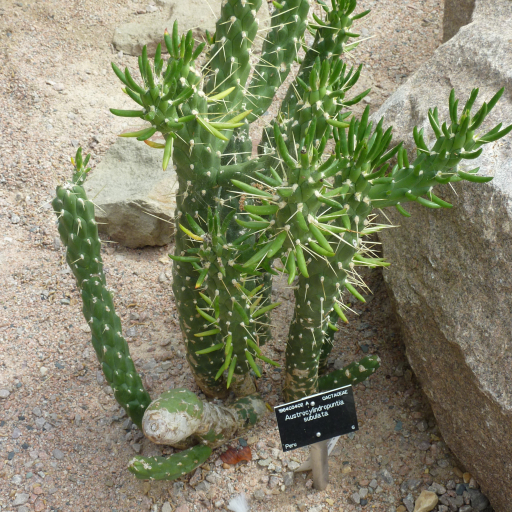
Plant Overview
Often referred to by the elegant nickname "Eve’s Needle," Opuntia subulata (now scientifically classified as Austrocylindropuntia subulata) is a striking, primitive cactus native to the high altitudes of the Peruvian Andes. Unlike the flat-padded Prickly Pears most people recognize, this species grows tall, cylindrical stems adorned with fleshy, needle-like green leaves. It is a rugged survivor that brings a prehistoric, architectural vibe to any succulent collection or xeric landscape.
🔍 How to Identify
- 🌵 Cylindrical Stems: Unlike flat-pad cacti, this species features elongated, bright green stems that can grow quite thick and tree-like over time.
- 🍃 Persistent Leaves: It is famous for its long, awl-shaped succulent "leaves" that sprout from the stems. While these eventually drop off as the plant ages or experiences drought, they give young plants a soft, fringed appearance.
- ⚔️ Yellow Spines: Emerging from the bumpy tubercles on the stem are long, grayish-yellow spines that can reach up to 3 inches in length, standing out against the deep green skin.
🏡 In Your Garden
- ☀️ Light Hungry: This cactus is a sun-worshiper. If kept indoors, it must be placed in the brightest window possible; otherwise, the stems will stretch (etiolate) and become weak and pale.
- 🏜️ The "Wet Feet" Rule: Because it evolved in rocky mountain soil, it is highly susceptible to root rot. Use a gritty, fast-draining cactus mix and ensure the pot has ample drainage holes. It prefers the "soak and dry" method—only water when the soil is bone-dry to the touch.
- 🌳 Growth Potential: In its natural habitat, it can reach heights of 13 feet. In a home setting, it remains much smaller, but it can still outgrow its neighbors quickly if given plenty of warmth and light.
⚠️ Safety & Toxicity
- 🌵 Physical Hazard: While not chemically toxic if ingested, this plant is physically dangerous. The long spines are very sharp, but the real "villains" are the glochids—tiny, nearly invisible barbed hairs that cause intense skin irritation and are difficult to remove.
- 🐾 Pets & Kids: This is not a "pet-friendly" plant due to the mechanical injury it can cause. Keep it on a high shelf or in a protected corner where it won't be accidentally brushed against by curious noses or hands.
✨ Fun Fact
The "leaves" on Eve's Needle are actually vestigial structures. Most cacti evolved to lose their leaves entirely to conserve water, but this species is considered a "primitive" cactus because it still grows these fleshy green appendages to help with photosynthesis!

Detailed Care Instructions
To grow an Opuntia Subulata plant, also known as the Eve's needle cactus or climbing cactus, follow these steps:
- Purchase or obtain a healthy Opuntia Subulata plant or cuttings from a reputable nursery or garden center.
- Select a suitable location for your plant. Opuntia Subulata, being a desert plant, prefers full sun with at least six hours of direct sunlight each day. Choose an area with well-draining soil, as this cactus does not tolerate overwatering.
- Prepare the soil by loosening it and removing any rocks or debris. Opuntia Subulata prefers slightly acidic to neutral soil conditions. If your soil is alkaline, you may need to amend it with organic matter or peat moss to make it more acidic.
- Dig a hole slightly larger than the plant's root ball and gently place the plant or cutting into the hole. Ensure that the plant is positioned upright and its roots are spread out.
- Backfill the hole with soil, gently tamping it around the plant to remove any air pockets. Do not over-pack the soil.
- Water the plant sparingly after planting, allowing the soil to dry out between waterings. Opuntia Subulata is a succulent plant, and overwatering can cause root rot or other problems.
- Monitor the plant regularly for any signs of pests or diseases. Common pests for Opuntia Subulata include aphids, mealybugs, and scale insects. Treat infestations immediately using organic insecticidal soap or insecticides suitable for cacti and succulents.
- Prune the plant as needed to maintain its shape. Opuntia Subulata can produce long and sprawling branches, which can be pruned to control its growth and maintain an attractive appearance.
- In colder regions, protect the plant from frost. Opuntia Subulata is not very cold-tolerant and may require the use of frost cloth or other protective measures during winter.
- Optionally, you can fertilize the plant once a year during the growing season with a balanced cactus fertilizer or a fertilizer specifically formulated for succulent plants. Follow the package instructions for proper application.
With proper care and attention to its specific needs, Opuntia Subulata can grow into a beautiful and unique addition to your garden or indoor plant collection.

Place in a bright room that is sun drenched almost all day. Or directly in a south-facing window.

Opuntia Subulata plant belongs to the cactus family and is native to South America. It is a drought-tolerant plant that has adapted to survive in arid conditions. To water this plant, it is important to note that it does not require frequent watering and over-watering can lead to root rot.
The best way to water Opuntia Subulata is to wait until the soil is completely dry before watering again. This can be determined by using a moisture meter or by inserting your finger into the soil to feel for moisture. When watering, pour water directly onto the soil at the base of the plant. Avoid getting water on the leaves or stem as this can lead to rotting.
It is recommended to water this plant deeply, so that the roots are fully saturated, and then allow the soil to dry out completely before watering again. During the winter months, it is important to reduce watering frequency as the plant enters a state of dormancy.
In summary, Opuntia Subulata plant should be watered deeply but infrequently, with a focus on keeping the soil dry between watering. Care should be taken to avoid getting water on the leaves or stem, as this can lead to rotting.
To fertilize this plant, it is best to do so during the growing season, typically from spring to late summer. Use a balanced fertilizer with equal amounts of nitrogen, phosphorus, and potassium. Apply the fertilizer at half the recommended strength every two weeks during the growing season. Be sure to water the plant thoroughly before and after fertilizing to prevent salt buildup in the soil. Avoid fertilizing in the winter when the plant is dormant.
Opuntia Subulata plant prefers a well-draining soil that is sandy and rocky in texture. It can tolerate soil with low fertility and pH levels ranging from acidic to alkaline. It is recommended to mix the soil with coarse sand or gravel to improve drainage and prevent the roots from sitting in water. Additionally, adding organic matter to the soil can help improve soil structure and retain moisture. Overall, the ideal soil for Opuntia Subulata should be lean, well-draining, and have a sandy, rocky texture.
Opuntia Subulata is a desert plant that belongs to the family Cactaceae. It is commonly known for its paddle-like flattened stems that are covered in spines. The plant produces vibrant flowers that bloom in the summer. Propagating Opuntia Subulata can be done by using cuttings which can be rooted easily.
To propagate Opuntia Subulata, use gloves to protect your hands from the plant's spines. Cut a stem of the plant that is at least 3-4 inches long using a clean pair of sharp scissors. Make sure that the cutting has no damage from pests or diseases and is healthy.
Irecommend leaving the cuttings to dry for a few days in a shady spot. This will allow the cutting to heal and prevent it from rotting when planted. Once the cutting has dried, plant it in well-draining soil and water it thoroughly.
Make sure the soil is moist but not soaking wet, as the cutting can rot. Keep the cutting in a warm and bright spot, but away from direct sunlight. It usually takes around 2-3 weeks for the cutting to root. Once roots have formed, transplant the new plant to a larger pot or to outdoors.
It's important to know that Opuntia Subulata is susceptible to root rot, so it's important not to overwater the plant. Also, make sure the plant is low-maintenance and can be easily cultivated with the right conditions.
Common pests of the eve's needle cactus include Scale insect, mealybugs, spider mites. Make a habit of checking your eve's needle cactus frequently for pests so that any infestations can be caught and managed early.








