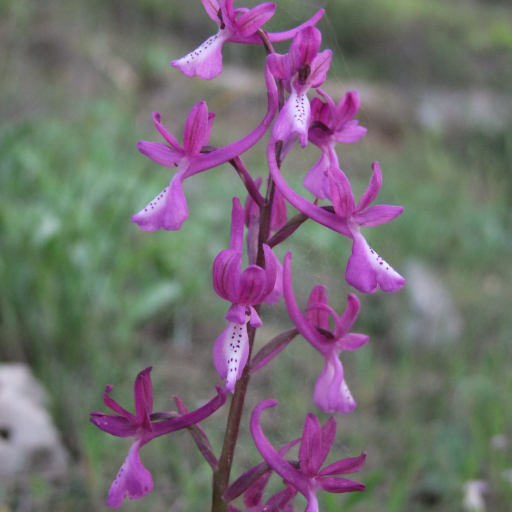
Plant Overview
Known as the Anatolian Orchid, this delicate beauty is a hallmark of Mediterranean springs. In regions like Turkey, Cyprus, and the Aegean Islands, it appears like a whisper of pink among pine needles and ancient olive groves. While it looks like a fragile jewel, it is a hardy survivor of the rocky, sun-drenched landscapes of the East.
🔍 How to Identify
- 🌸 The Bloom: Small flowers ranging from pale pink to deep magenta, arranged in a "lax" or loose, airy cluster rather than a dense spike.
- 🎨 The Lip: The lower petal (the lip) features a pale white or yellow center dusted with distinct dark purple spots, which act as a "landing strip" for pollinators.
- 🍃 Spotted Foliage: Before the flowers even appear, you can spot the plant by its base. It has a rosette of lance-shaped leaves that are almost always decorated with bold, dark chocolate-colored blotches.
- 🦄 The Long Spur: If you look at the flower from the side, you’ll notice a long, slender "tail" or spur that curves upwards—a key feature that distinguishes it from many of its orchid cousins.
🌲 Habitat & Ecology
- 🍄 The Fungal Handshake: Like most wild orchids, the Anatolian Orchid is a "specialist." It relies on a complex relationship with specific underground fungi to germinate and grow. This makes it incredibly difficult to cultivate in a standard garden setting.
- ☀️ Mediterranean Soul: It thrives in the dappled shade of Pine and Cedar forests or in open "phrygana" (scrubland). It loves limestone-rich soil and requires the cool, damp winters and hot, dry summers characteristic of its native home.
⚠️ Safety & Toxicity
- 🌿 Non-Toxic: Orchis anatolica is generally considered non-toxic to humans, dogs, and cats.
- 🚫 A Legal Warning: While not poisonous, this plant is strictly protected in many countries. Digging it up or picking it is often illegal. Because of its specific soil requirements, a wild orchid moved to a pot will almost certainly die within a year.
✨ Fun Fact
The tubers of this orchid (and its relatives) were traditionally ground into a fine flour to create Salep, a famous, creamy hot drink in the Middle East. However, because it takes thousands of wild orchids to produce a small amount of flour, many species are now endangered, leading to a shift toward using artificial flavorings to protect these "pearls of the forest."

Detailed Care Instructions
Orchis Anatolica is a terrestrial orchid native to regions in Turkey, Greece, and Cyprus. Here are some general tips on how to grow and care for Orchis Anatolica:
- Climate: Orchis Anatolica thrives in Mediterranean climates with hot, dry summers and mild, wet winters. It prefers well-draining soil and indirect sunlight.
- Soil: Plant Orchis Anatolica in well-draining soil that is slightly acidic. You can also add organic matter to improve soil quality.
- Watering: Water the plant regularly during the growing season, but allow the soil to dry out between waterings. Avoid overwatering, as this can lead to root rot.
- Fertilizing: Feed the plant with a balanced fertilizer once a month during the growing season to promote healthy growth and flowering.
- Propagation: Orchis Anatolica can be propagated through division of the rhizomes or by sowing seeds. Divide the plant in early spring before new growth appears, or sow seeds in the fall.
- Pests and diseases: Keep an eye out for pests such as aphids and spider mites, and treat them promptly with insecticidal soap. Orchis Anatolica is also susceptible to fungal diseases, so avoid overhead watering and provide good air circulation.
- Winter care: In colder climates, protect Orchis Anatolica from frost by covering the plant with a layer of mulch or moving it indoors during the winter months.
By following these tips, you can successfully grow and care for Orchis Anatolica in your garden or indoor space.

Place in a bright room that is sun drenched almost all day. Or directly in a south-facing window.

Orchis Anatolica plants require regular watering to keep the soil consistently moist, but not waterlogged. It is important to water the plant at the base rather than overhead to avoid causing any damage to the delicate flowers and leaves.
To water Orchis Anatolica plants, fill a watering can with room temperature water and pour it gently onto the soil around the base of the plant. Allow the water to soak in and then check the soil moisture level before watering again.
It is important to avoid letting the soil dry out completely between waterings, as this can stress the plant and lead to wilting or stunted growth. However, overwatering can also be detrimental, causing root rot and other issues.
Monitor the plant regularly and adjust your watering schedule as needed based on the plant's specific needs and environmental conditions. Additionally, consider using a well-draining potting mix to help prevent waterlogged soil and ensure healthy root growth.
To fertilize Orchis Anatolica plants, use a balanced fertilizer with an N-P-K ratio of 10-10-10. Apply the fertilizer to the soil around the plant during the growing season, from spring to fall. Avoid feeding the plant during the dormant winter months. Water the plant well after fertilizing to help the nutrients penetrate the soil and reach the roots. Be careful not to over-fertilize, as this can damage the plant. Follow the instructions on the fertilizer package for the appropriate amount to use based on the size of your plant.
Orchis Anatolica plants prefer well-draining, sandy or loamy soil with a slightly acidic to neutral pH. It is important to use a soil mixture that is rich in organic matter and provides good aeration for the roots. Avoid using heavy clay soils or soils that retain too much moisture, as this can lead to root rot and other issues. Adding perlite or sand to the soil mixture can help improve drainage. Additionally, fertilize the soil with a balanced, slow-release fertilizer to provide essential nutrients for the plant's growth.
To propagate Orchis Anatolica plants, one can use a few different methods such as division, seed sowing, or tissue culture.
- Division: Divide the plant clumps in early spring or autumn. Carefully dig up the plant clump, separate it into smaller sections with roots attached, and replant them in well-draining soil.
- Seed sowing: Collect mature seed pods from the plants and sow them in a seed-starting mix in a warm and bright location. Keep the soil moist and wait for the seeds to germinate. Transplant the seedlings into individual pots once they have developed a few leaves.
- Tissue culture: This method involves taking a small piece of tissue from the plant and placing it in a sterile growth medium to promote new growth. This process requires a controlled lab environment and specialized equipment, so it is best left to experienced growers.
Regardless of the propagation method used, make sure to provide the newly propagated plants with the right growing conditions such as well-draining soil, adequate sunlight, and regular watering to ensure their successful establishment.








