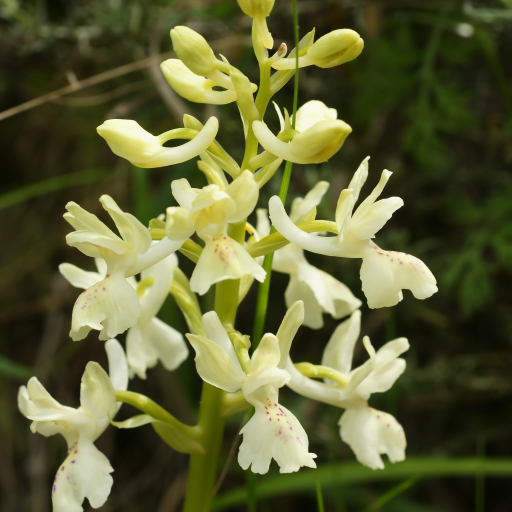
Plant Overview
Known as the Provence Orchid, this delicate beauty is a herald of spring across the Mediterranean and Southern Europe. It carries an air of quiet elegance, featuring creamy, butter-yellow blossoms that look like tiny, sun-drenched lanterns suspended in the air. While it lacks the flashy neon colors of tropical orchids, its subtle charm has made it a favorite for wildflower hikers and nature photographers.
🔍 How to Identify
- 🎨 The Blooms: Features a loose spike of 5 to 20 pale yellow or straw-colored flowers. Each flower has a distinct "spur" pointing upwards or backwards.
- 💜 The Lip: The central part of the flower (the labellum) is three-lobed and typically decorated with a cluster of tiny, reddish-purple dots that guide pollinators toward the nectar.
- 🍃 The Foliage: Long, lance-shaped leaves emerge from the base. Most specimens feature striking dark brown or blackish spots on the leaf surface, though unspotted versions do exist.
🏡 In Your Garden
- 🍄 The Hidden Connection: This orchid is a "wild spirit" that relies on a complex, invisible "handshake" with specific soil fungi (mycorrhiza) to survive. Because of this delicate symbiosis, it is notoriously difficult to grow in a traditional garden setting and almost never survives being moved.
- 🌲 Natural Preference: In the wild, you’ll find it hiding in the dappled shade of open oak and pine forests or nesting in scrublands. It prefers limestone-rich soils that stay moist in the spring but dry out during the hot Mediterranean summer.
⚠️ Safety & Toxicity
- 🟢 General Safety: Orchis provincialis is not known to be toxic to humans, cats, or dogs. Touching the plant is safe, though its beauty is best appreciated with a camera rather than hands.
- 🚫 Conservation Status: The primary safety concern is for the plant itself! It is a protected species in many regions. Digging it up is often illegal and usually results in the plant’s death because its root system cannot adapt to new soil without its fungal partners.
✨ Fun Fact
The name Orchis comes from the ancient Greek word for "testicle," referring to the shape of the plant’s twin underground tubers. Because of this resemblance, ancient herbalists once believed these orchids could influence fertility and romantic energy!

Detailed Care Instructions

Place in a window with dappled sun or a spot in the middle of a room. Or directly in a window facing west or east.

Some plants require more regular watering than others, which should be done every few days. It's critical to maintain the soil moist all of the time. The water requirements of the same plant placed in pots with varying sizes will differ. Because the water in the smaller pot evaporates faster than the water in the larger pot, it will require more watering. Regardless of pot size, the surface should constantly be maintained moist.








