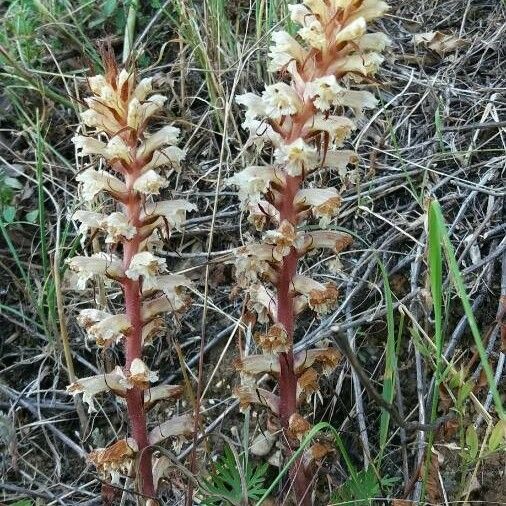
Plant Overview
The Amethyst Broomrape is a botanical phantom that defies the typical "green" rules of the plant kingdom. Lacking chlorophyll entirely, this striking species lives as a holoparasite, meaning it derives all its nutrients by siphoning them from the roots of its neighbors—most specifically the Field Eryngo (Eryngium campestre). Often called a "vampire plant," it spends most of its life hidden underground, only sending up its ghostly, amethyst-tinted spikes when it is ready to bloom.
🔍 How to Identify
- 🟣 The Flowers: The plant features tubular, two-lipped flowers that are a pale lilac or cream color, heavily streaked and flushed with a deep amethyst violet, particularly on the upper lip.
- 🚫 Lack of Greenery: You will never see a green leaf on this plant. Instead, the stem is covered in small, scale-like structures that are brownish or purple, as it has no need for photosynthesis.
- 📏 Growth Habit: It grows in a single, unbranched upright spike, reaching about 10 to 40 cm in height. The stem is often slightly swollen at the base where it attaches to its host.
🏡 In Your Garden & Nature
- 🔗 Host Dependency: You won't find this plant growing alone. It is an "obligate parasite," meaning it cannot survive without a host. If you see it in the wild, look closely at the surrounding plants—you will almost certainly find a member of the Eryngo or Carrot family nearby.
- ☀️ Preferred Terrain: It thrives in dry, sunny grasslands and stony pastures, particularly in Mediterranean and temperate European climates. Because it doesn't rely on its own energy production, it is often found in nutrient-poor soils where other plants might struggle, as long as its host is present.
⚠️ Safety & Toxicity
- 🌿 Status: Generally considered non-toxic.
- 🐾 Details: While the Amethyst Broomrape is not known to be poisonous to humans or pets, it is not considered edible. Most Broomrape species contain high levels of tannins and bitter compounds that make them unpalatable and potentially irritating to the digestive system if consumed in large quantities.
✨ Fun Fact
The name "Broomrape" comes from the Latin rapum, meaning tuber or turnip, and refers to the plant's swollen, bulbous base. Historically, it was thought that these plants "raped" (seized or choked) the broom plants they were often found growing on!

Detailed Care Instructions

Place in a bright room that is sun drenched almost all day. Or directly in a south-facing window.

Some plants require more regular watering than others, which should be done every few days. It's critical to maintain the soil moist all of the time. The water requirements of the same plant placed in pots with varying sizes will differ. Because the water in the smaller pot evaporates faster than the water in the larger pot, it will require more watering. Regardless of pot size, the surface should constantly be maintained moist.








