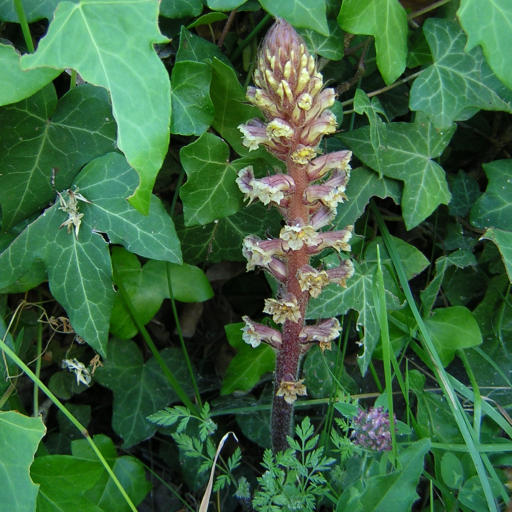
Plant Overview
Often called the Ivy Broomrape, this plant is a fascinating botanical vampire. Unlike most plants that bask in the sun to create food, this species has abandoned photosynthesis entirely, instead living a clandestine life by siphoning nutrients directly from the roots of Ivy (Hedera species). It appears suddenly like a ghostly, leafless orchid, rising from the soil where its host resides.
🔍 How to Identify
- 🎨 The Color Palette: The entire plant lacks green. It is typically a ghostly pale yellow, tan, or a deep, dusty purple-brown.
- 🔔 The Flowers: Crowded spikes of tubular, two-lipped flowers. They are usually creamy-white with distinct purple veins or a reddish-brown tint.
- 🍂 The Stem & Scales: The stem is stiff and fleshy, covered in small, pointed scales rather than true leaves, as it has no need to capture sunlight.
🏡 In Your Garden
- 🌱 The Host Relationship: You won’t find this plant unless there is Ivy nearby. It attaches itself to the host’s roots underground using a specialized organ called a haustorium.
- 🧱 Urban Presence: It is frequently found in old gardens, churchyards, or along ivy-covered stone walls. While it is a parasite, it rarely causes significant damage to its host; consider it a sign of a mature, complex ecosystem in your backyard.
- ⏳ A Brief Appearance: It spends most of its life hidden underground. The flower spikes only emerge in early summer to be pollinated by wasps and bees before turning into dry, brown seed heads.
⚠️ Safety & Toxicity
- 🟢 Non-Toxic Status: Ivy Broomrape is not known to be toxic to humans, cats, or dogs.
- 🚫 Not for Consumption: While not "poisonous" in the traditional sense, it is not an edible plant and should be left alone to play its unique role in the garden's ecology.
- 🧤 Skin Sensitivity: Like many wild plants, some individuals with sensitive skin might experience mild irritation if the sap is handled, though this is uncommon.
✨ Fun Fact
Because it doesn't need to photosynthesize, Ivy Broomrape can grow in the deepest, darkest shade where other plants would wither. It "hunts" for its host by sensing specific chemicals (strigolactones) released by Ivy roots into the soil, triggering the Broomrape seeds to germinate only when a meal is within reach.

Detailed Care Instructions
To grow Orobanche hederae (ivyleaf broomrape), here are some steps you can follow:
- Seed collection: Collect mature seeds from the Orobanche hederae plants. Seeds are usually available after the flowering period, usually in the summer or fall. Make sure the seeds are fully developed and dry.
- Preparing the soil: Orobanche hederae is a parasitic plant that attaches itself to the roots of its host plants. Therefore, it is essential to have suitable host plants to ensure proper growth. Prepare the soil by cultivating it and incorporating organic matter to improve fertility.
- Planting: While Orobanche hederae does not directly require planting as it is a parasitic plant, ensure that the host plants (preferably ivy) are established in the soil before introducing the broomrape seeds.
- Seed germination: To help germinate the Orobanche hederae seeds, you can mimic the natural process by treating them with a stimulant. This can be done by soaking the seeds in water for 24 hours or exposing them to smoke or smoke-like substances. After treatment, ensure the seeds remain moist and keep them in a warm location, preferably under grow lights.
- Nurturing the plants: Once the Orobanche hederae seeds have germinated, they will search for a host plant to attach themselves to. Ensure that the host plants are healthy and provide sufficient nutrients for both the host and the parasite. Regularly water and fertilize the host plants to ensure their vitality and the ongoing growth of the broomrape.
- Monitoring and control: Since Orobanche hederae is a parasitic plant, you need to monitor its growth to prevent it from overwhelming the host plants. If you notice excessive growth, remove the broomrape plants manually to prevent them from depleting the resources of the host plants.
Remember that Orobanche hederae is a specialised plant and may require specific conditions to grow successfully. It is always a good idea to consult with local horticultural experts or botanists to get specific guidance based on your region and climate.

Place in a bright room that is sun drenched almost all day. Or directly in a south-facing window.

To water this plant, it is important to note its natural habitat and watering requirements. This plant is typically found in areas with moderate to high rainfall, so it prefers consistent moisture in the soil. It is important to avoid overwatering, as this can lead to root rot and other issues. When watering, ensure that the soil is evenly moist but not waterlogged. It is best to water in the morning or evening when temperatures are cooler to prevent water evaporation and stress to the plant. Additionally, it is important to avoid getting water on the plant's leaves or stem, as this can lead to disease and other issues.
To fertilize this plant, apply a balanced fertilizer to the soil around the base of the plant during the growing season. Be careful to avoid direct contact with the plant itself, as this can cause burn or damage to the foliage. Water the plant well after fertilizing to help the nutrients penetrate the soil. Monitor the plant's growth and adjust fertilization as needed to promote healthy growth and avoid overfeeding.
The ideal soil for the Orobanche Hederae plant should have a good drainage capacity and be relatively nutrient-poor. The plant is capable of parasitizing the roots of other plants, so it does not require many nutrients from the soil. A mixture of coarse sand, perlite, and peat moss can be used as a suitable growing medium for the plant. It is important to avoid using soil that is too rich in organic matter or fertilizers, as this can stimulate excessive growth and decrease the plant's parasitism ability. Additionally, the soil pH should be maintained between 6.0 and 7.5 to ensure optimal growth.
One way to propagate this plant is through seed. The seeds can be gathered from the dried flower heads and sown in a well-draining soil mix. The seeds should be lightly covered with soil and kept moist until they germinate.
Another method of propagation is through vegetative propagation. This can be done by taking cuttings from the plant and rooting them in a rooting hormone and in a well-draining soil mix. The cuttings should be kept moist and warm until they take root.
A third method of propagation is through division. Mature plants can be carefully dug up and divided into smaller sections, ensuring that each section has enough roots and shoots to survive. These sections can then be replanted in a well-draining soil mix and kept moist until they establish themselves.
Propagation of this plant can be a bit challenging, but with the right care and attention, it is possible to successfully increase the number of plants.








