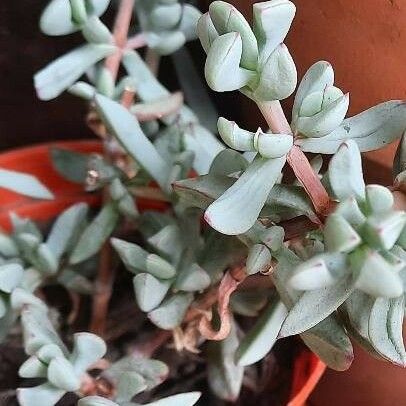
Plant Overview
Often called the Teardrop Mesemb or Creeping Shrubby Mesemb, this South African native looks like a collection of living, geometric jewels. It is a hardy, low-growing succulent that forms a dense mat of blue-grey "teeth," making it a favorite for rock gardens and "spillover" displays in containers. In the spring, it transforms into a sea of shimmering pink petals that can almost hide the foliage entirely.
🔍 How to Identify
- 💎 The Leaves: Thick, three-sided, and distinctly triangular. They are a dusty blue-grey color, often tipped with tiny reddish "teeth" along the edges.
- 🍷 The Stems: Unlike many green-stemmed succulents, this plant features wiry, dark reddish-purple stems that provide a striking contrast to the pale leaves.
- 🌸 The Blooms: Small, daisy-like flowers in shades of pale pink to lavender with bright yellow centers. These usually appear in late winter to spring.
🏡 In Your Garden
- ☀️ Sun-Kissed Colors: While it survives in partial shade, the "teardrop" leaves only develop their beautiful reddish-pink margins when exposed to plenty of direct sunlight. This is the plant's natural way of protecting itself from UV rays.
- 🪨 Rocky Origins: In the wild, it grows in sandstone crevices. Because of this, it has a very low tolerance for "wet feet." If your soil doesn’t feel like a gritty desert mix, the roots may succumb to rot quickly.
- ✂️ Pruning Habits: It is a vigorous grower. If it starts to look "leggy" or woody, don't be afraid to trim it back; it responds well to pruning and will grow back thicker and more compact.
⚠️ Safety & Toxicity
- ✅ Safe for All: Oscularia pedunculata is generally considered non-toxic to humans, cats, and dogs.
- 🌵 Physical Touch: While not "spiny" like a cactus, the leaves are firm and the stems can be brittle. It’s best placed where it won't be stepped on or frequently bumped by curious pets.
✨ Fun Fact
The flowers of the Teardrop Mesemb are surprisingly fragrant! On a warm spring afternoon, a large patch of these blooming succulents can fill the air with a sweet scent reminiscent of almonds or vanilla.

Detailed Care Instructions
To grow Oscularia pedunculata, also known as the pink ice plant, follow these steps:
- Climate and sun requirements: Choose a location that receives full sun or partial shade. Oscularia pedunculata prefers warm temperatures, with a minimum temperature of 50°F (10°C). It is suitable for USDA hardiness zones 9-11.
- Soil: Prepare well-draining soil that is sandy or gravelly. Oscularia pedunculata prefers a pH level between 6.0 and 8.0.
- Planting: If you are growing from seeds, sow them in a seed-starting mix in early spring. Sprinkle the seeds on the surface of the soil and lightly cover them. Keep the soil moist but not saturated until germination occurs. Transplant the seedlings to their permanent location once they have reached a size of 2-4 inches.
- Watering: Once established, pink ice plants are drought-tolerant and should be watered sparingly. Water deeply but infrequently, allowing the soil to dry out between watering sessions. Overwatering can lead to root rot, so it's crucial to avoid excessive moisture.
- Fertilization: Pink ice plants are not heavy feeders, but you can apply a balanced, slow-release fertilizer once or twice a year, following the manufacturer's instructions.
- Pruning: Prune back any dead or leggy growth to maintain a compact and tidy appearance. If the plant becomes overgrown, cut it back in early spring to promote bushier growth.
- Propagation: Oscularia pedunculata can be propagated through stem cuttings. Take a 2-4 inch cutting from a healthy plant, remove the lower leaves, and allow it to callus for a few days. Then, insert the cutting into well-draining soil, mist lightly, and keep the soil slightly moist until roots develop. Provide bright, indirect light during the rooting process.
- Pests and diseases: Generally, pink ice plants are relatively pest and disease-resistant. However, root rot can occur if the plant is overwatered. Monitor for common pests such as aphids or mealybugs and treat as needed.
By following these steps, you should be able to grow and enjoy your Oscularia pedunculata plant.
When it comes to watering this particular plant, it is important to keep in mind a handful of key factors that will help ensure that it thrives. First and foremost, it is important to make sure that the soil is evenly moist but not overly saturated or waterlogged. To achieve this balance, it is best to water the plant slowly and deeply, allowing the water to be absorbed fully before adding more.
Additionally, it is best to use water that is at room temperature to avoid shocking the plant's root system. It is also important to avoid getting water on the foliage of the plant, as this can lead to fungal growth or other issues.
Finally, it is a good idea to water the plant early in the morning or late in the evening to avoid water evaporation during the hottest part of the day. Overall, by following these guidelines, you can help ensure that your plant receives the water it needs to grow strong and healthy.
To fertilize this plant, mix a balanced fertilizer at half strength and apply it once a month during the growing season. Avoid fertilizing during the winter dormancy period. It is best to water the plant before fertilizing to prevent root burn. Make sure to only apply the fertilizer to the soil and not onto the leaves or stem.
When it comes to selecting soil for Oscularia Pedunculata plants, it is important to ensure that the soil is well-draining and aerated. It should have a sandy texture and be able to retain moisture without becoming waterlogged. A good soil mix for this plant would include a blend of coarse sand, perlite, and peat moss or coconut coir to provide the necessary drainage and structure. The pH level of the soil should be slightly acidic to neutral, with a range of 6.0 to 7.0. It is also important to avoid using heavy, clay-based soils that could lead to root rot and other issues. Adding some organic matter, such as compost or leaf litter, can help to improve the soil's nutrient content and texture. Overall, choosing the right soil mix is key to ensuring that Oscularia Pedunculata thrives and remains healthy over time.
First, identify a healthy and mature Oscularia Pedunculata plant from which to take cuttings. Select a stem that is at least 4-6 inches long and has several sets of healthy leaves. Using a sharp and clean pair of scissors or pruning shears, make a clean cut just below a set of leaves.
Remove the leaves from the bottom 1-2 inches of the stem to create a bare area for planting. Dip the cut end of the stem into rooting hormone powder, which will help encourage the growth of new roots. Shake off any excess powder.
Next, prepare a pot or container with well-draining potting soil. Create a hole in the center of the soil using a pencil or other pointed object. Insert the cut end of the stem into the hole, making sure that the bare area is touching the soil.
Water the cutting thoroughly and place it in a bright location with indirect sunlight. Keep the soil moist but not waterlogged. After a few weeks, new roots should begin to form, and small leaves will appear. Once the cutting has established roots and at least 2-3 sets of leaves, it can be transplanted into its own pot or into a larger container with other plants.








