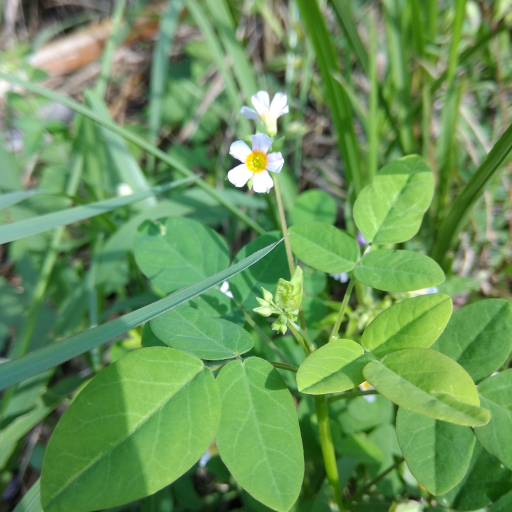
Plant Overview
Often referred to as the Lavender Sorrel, Oxalis barrelieri is a charming tropical perennial that breaks the mold of the typical low-creeping woodsorrel. Instead of hugging the ground, this elegant plant grows upright like a miniature shrub, showing off soft, heart-shaped leaves and delicate clusters of pinkish-purple blooms. While it is native to the Caribbean and South America, it has traveled the globe as a curious garden guest and a persistent wild wanderer.
🔍 How to Identify
- 🍃 The Foliage: Look for the classic "clover" look, but with a twist. The leaves are trifoliate (divided into three leaflets), heart-shaped, and have a soft, velvety texture due to fine hairs.
- 🌸 The Blooms: It produces small, five-petaled flowers that are usually a pale lavender or rosy-pink with a distinct bright yellow center, or "throat."
- 📏 The Growth Habit: Unlike many common weeds, this species grows on erect, hairy stems that can reach up to 12–20 inches in height, giving it a branched, bushy appearance.
🏡 In Your Garden
- 🌱 Soil & Drainage: This sorrel loves "moist but not messy" conditions. It thrives in loamy soil but will quickly suffer from root rot if left in standing water, so ensure your pots or garden beds drain freely.
- 🎋 A Prolific Spreader: Be mindful of where you tuck this plant. It is a champion at self-seeding; once the small seed capsules ripen, they can "explode" and toss seeds several feet away, leading to a surprise colony the following season.
⚠️ Safety & Toxicity
- 🐾 Caution for Pets: Like all members of the Oxalis family, this plant contains oxalic acid. While it has a sour, pleasant taste that might tempt a nibble, it can be toxic to cats, dogs, and horses if consumed in large quantities.
- 🚫 Kid-Friendly Check: While not deadly in small amounts, ingestion can lead to stomach upset or mouth irritation. It is best kept out of reach of curious toddlers and pets with a habit of grazing on greenery.
✨ Fun Fact
🌙 The Sleepers: Oxalis barrelieri exhibits a fascinating behavior called nyctinasty. As the sun sets, the plant's leaflets fold downward against the stem as if it’s going to sleep, only to "wake up" and expand again the moment the morning light hits them!

Detailed Care Instructions
To grow Oxalis Barrelieri, also known as Barrelier's woodsorrel, you can follow these steps:
- Choose a location: Select a spot that receives partial shade to full sun. This plant can tolerate different light conditions but prefers indirect sunlight.
- Soil preparation: Prepare a well-draining soil mix. Barrelier's woodsorrel prefers slightly acidic to neutral soil with a pH range of 5.5-7.0. You can amend the soil with organic matter like compost to improve drainage and fertility.
- Planting: Sow the seeds or plant small bulbs in the prepared soil. Sow seeds about 1/8 inch deep and space them 4-6 inches apart. If using bulbs, plant them at a depth of about 2-3 inches. Water the soil lightly.
- Watering: Water the plant moderately, keeping the soil moist but not waterlogged. Avoid overwatering, as excessive moisture can lead to root rot.
- Fertilization: Fertilize the plant once a month during the growing season with a balanced, water-soluble fertilizer. Follow the package instructions for the appropriate dosage.
- Mulching: Applying a layer of organic mulch around the plants can help retain moisture and suppress weed growth.
- Pruning: If the plant becomes leggy or untidy, you can trim it back in early spring to encourage new growth and maintain a compact shape.
- Pests and diseases: Oxalis Barrelieri is relatively resistant to pests and diseases. However, keep an eye out for common issues like aphids, spider mites, or fungal infections. If detected, treat with appropriate insecticides or fungicides.
- Overwintering: Barrelier's woodsorrel is hardy in USDA zones 6-11. In cooler regions, protect the plant from frost by covering it with a layer of mulch or moving it to a sheltered location.
- Propagation: You can propagate Oxalis Barrelieri through seeds, bulbs, or division. Bulb division is the easiest method. Lift the bulbs in spring or fall and separate the offsets from the main bulb, ensuring each division has some roots. Replant the divisions, providing them with proper care.
Remember that Oxalis Barrelieri has a natural dormant period during which it may die back or decrease in growth. This is normal, and the plant should regrow with proper care.

Place in a bright room that is sun drenched almost all day. Or directly in a south-facing window.

To properly water this plant, you should first ensure that the soil is completely dry before watering it again. This can be determined by sticking your finger about an inch into the soil - if it feels dry, it is time to water. When watering, do so thoroughly, ensuring that the water reaches all areas of the soil and drains out of the bottom of the pot. Avoid letting the plant sit in standing water as this can lead to root rot. Depending on the size of your pot and the specific climate conditions, you may need to water anywhere from once a week to every few weeks. It is important to note that overwatering can be just as harmful as underwatering, so be sure to strike a balance and adjust your frequency accordingly.
To fertilize this plant, use a water-soluble fertilizer with balanced N-P-K ratios of 10-10-10 or 20-20-20. Mix 1 teaspoon of fertilizer per gallon of water and apply it to the soil once a month during the growing season. Be sure to water the plant thoroughly before and after fertilizing. Avoid over-fertilizing as it can cause leaf burn and damage to the roots.
The ideal soil for the plant is well-draining, loamy soil with a slightly acidic pH level between 5.5 and 6.5. The soil should be rich in nutrients and organic matter to promote healthy root growth and overall plant growth. The plant prefers soil that is moist but not waterlogged, and it does not tolerate standing water. It is recommended to mix some sand or perlite into the soil to enhance its drainage and prevent waterlogging. It is also important to avoid using soil that is heavily compacted or contains heavy clay, as this can inhibit root growth and lead to poor plant performance.
- Start by selecting a mature, healthy plant from which you want to propagate.
- Gently remove the plant from its pot or ground, being careful not to damage the roots.
- Use a clean, sharp knife or pruning shears to make a clean cut through the stem, just below a leaf node.
- Remove all of the leaves from the bottom 2-3 inches of the stem.
- Dip the cut end of the stem in rooting hormone (if desired) to encourage faster root growth.
- Fill a small container with well-draining soil, such as a mixture of peat moss and perlite, and moisten it.
- Use a pencil or similar object to create a hole in the soil, deep enough to accommodate the length of the cutting.
- Gently place the cutting into the hole and pat the soil firmly around it to hold it in place.
- Water the cutting thoroughly and place it in a warm, bright location with indirect sunlight.
- Keep the soil moist but not waterlogged, and mist the cutting occasionally to keep the humidity high.
- After several weeks, new growth should begin to emerge from the stem, indicating that roots have formed.
- Once the new plant has grown several sets of leaves, it can be transplanted into a larger pot or back into the ground.








