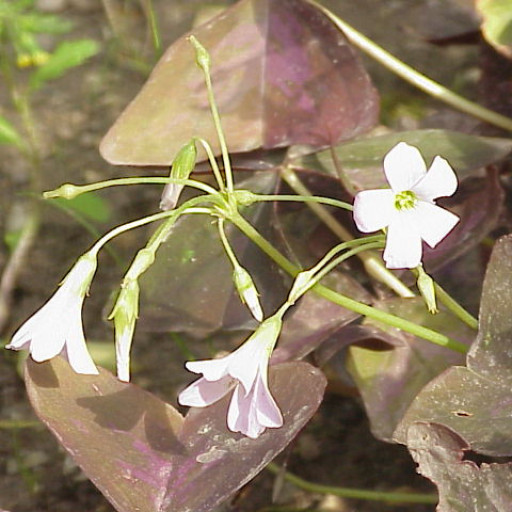
Plant Overview
Often called the "Purple Shamrock" or "False Shamrock," Oxalis triangularis is a showstopper that looks more like a cluster of fluttering butterflies than a typical houseplant. Originating from Brazil, this plant is famous for its "nyctinastic" movements, meaning its leaves fold up like tiny umbrellas at night and reopen to greet the morning sun. It is a favorite for those who want a plant that feels truly alive and responsive to its environment.
🔍 How to Identify
- 🦋 The Foliage: Triangular, deep-violet leaflets that grow in sets of three. They have a velvety texture and often feature a lighter, geometric magenta pattern in the center of each leaf.
- 🌸 The Blooms: Dainty, five-petaled flowers that are usually pale pink or white. They grow on slender, tall stems that rise above the canopy of purple leaves.
- 🪴 The Base: Unlike plants with traditional root systems, this Oxalis grows from small, scaly orange bulbs (rhizomes) clustered beneath the soil.
🏡 In Your Garden & Home
- 💡 Light Sensitivity: This plant is a light-seeker. If it isn't getting enough brightness, the leaves will stay closed or "leggy." However, harsh direct afternoon sun can scorch its delicate tissue, so bright, filtered light is the sweet spot.
- 😴 The Dormancy Cycle: Don't panic if your plant suddenly withers and stops growing. It is a bulb-based plant that occasionally needs a "nap." If the leaves turn brown, simply cut them back and stop watering for a few weeks; it will eventually emerge with fresh, vigorous new growth.
- 💧 Bulb Care: Because it grows from corms, it is very sensitive to "wet feet." Overwatering can lead to bulb rot quickly. It prefers to dry out significantly between drinks.
⚠️ Safety & Toxicity
- 🐾 Status: Toxic to pets (Cats, Dogs, and Horses).
- 👅 Details: The plant contains calcium oxalate crystals. While it has a very bitter "lemon-like" taste that usually discourages animals from eating much of it, ingestion can lead to drooling, vomiting, or, in large quantities, kidney issues. Keep it on a high shelf away from curious nibblers.
✨ Fun Fact
The Oxalis triangularis doesn't just move for light; it moves for protection! Scientists believe its "sleeping" habit at night helps shed excess water from the leaves, preventing fungal growth and protecting the delicate flowers from being damaged by nighttime dew or rain.

Detailed Care Instructions
| Color | Deep Burgundy Color With Delicate White Flowers |
| Soil Ph | Alkaline, Neutral |
| Humidity | Normal |
| Lighting | Part Sun |
| Toxicity | Toxic |
| Soil Type | Rich Humus Soil |
| Bloom Time | Mid Fall – Late Summer |
| Difficulty | Medium |
| Plant Type | Perennial Plant |
| Hibernation | Cold Period |
| Mature Size | Grows To 6–12 Inches In Height, Spreads To 1-2 Feet Wide |
| Native Area | South Africa And South America |
| Temperature | 18°C - 25°C |
| Sun Exposure | Partial Sun/Light Shade |
| Hardiness Zones | 8-11 |
To grow an Oxalis Triangularis plant, follow these steps:
- Select a suitable location: Choose a spot indoors that receives bright, indirect sunlight or low light. Avoid direct sunlight as it can scorch the leaves.
- Choose a container: Select a pot with drainage holes to ensure proper drainage. The pot should be deep enough to accommodate the root system and wide enough for the plant to spread out.
- Prepare the potting mix: Oxalis Triangularis prefers well-draining soil. You can create a potting mix by combining equal parts of peat moss, perlite, and potting soil.
- Planting the bulbs: If you have bulbs, plant them about 1-2 inches deep into the potting mix. Ensure that the pointed end of the bulb faces upwards. If you have an already established plant, skip this step.
- Watering: Water the plant thoroughly after planting or potting. Keep the soil consistently moist but not waterlogged. Avoid letting the soil dry out completely between watering. Oxalis Triangularis prefers slightly moist conditions.
- Temperature and humidity: The ideal temperature range for this plant is between 60-75°F (15-24°C). Provide moderate humidity levels by misting the leaves occasionally, especially during dry periods or in heated indoor environments.
- Fertilization: Feed the plant with a balanced liquid fertilizer every 2-4 weeks during the growing season (spring and summer). Follow the package instructions for proper dilution ratios.
- Pruning and maintenance: Trim off any yellow or dead leaves to maintain the plant's appearance. Oxalis Triangularis goes dormant during the winter months. At this time, reduce watering and stop fertilizing until new growth emerges in spring.
- Propagation: You can propagate Oxalis Triangularis by dividing the bulbs or by taking stem cuttings. Divide the bulbs during the plant's dormant period or take stem cuttings during active growth.
- Pests and diseases: Monitor the plant for pests like aphids or spider mites. If infested, treat with an insecticidal soap according to the instructions on the product label. Ensure good air circulation to prevent fungal diseases.
By following these steps, you should be able to successfully grow and care for your Oxalis Triangularis plant.

Place in a window with dappled sun or a spot in the middle of a room. Or directly in a window facing west or east.

To water this plant, you should first check the moisture level of the soil by sticking your finger about an inch deep into the soil. If the soil feels dry, it is time to water. When watering, pour water slowly and evenly around the base of the plant, until the water starts to drain out of the bottom of the pot. Avoid letting the plant sit in standing water, as this can lead to root rot. The frequency of watering will depend on the climate and conditions in your home, but generally, this plant should be watered about once a week.
To fertilize this plant, use a balanced fertilizer with equal amounts of nitrogen, phosphorus, and potassium. Dilute the fertilizer in water according to the manufacturer's instructions and apply it to the soil every two weeks during the growing season. Be careful not to over-fertilize as this can harm the plant. It is recommended to use a fertilizer that is specifically designed for indoor plants.
When growing Oxalis Triangularis, it is important to use a well-draining potting soil that is rich in nutrients. The soil should also have a pH level between 5.5 and 6.5 for optimal growth. A mixture of standard potting soil and perlite can be used to improve drainage. Avoid using heavy soils that may cause waterlogging, as this can lead to root rot. Additionally, it is recommended to change the soil of the plant every year to ensure that it continues to receive the nutrients it needs.
Propagation of this plant can be achieved through a variety of methods, including division of rhizomes, leaf cuttings, stem cuttings, and seed propagation. Division of rhizomes is a commonly used method, as it allows for the development of multiple new plants from a single parent plant. To do this, carefully dig up the parent plant and separate the rhizomes into smaller sections, each containing at least one healthy shoot and root system. Replant these sections in well-draining soil in pots or directly in the ground. Leaf and stem cuttings are also possible, but will require the use of rooting hormones and careful attention to moisture levels to ensure successful rooting. Seed propagation is the least common method and should be done with fresh seed and a sterile growing medium.
Common pests of the purple shamrock include Spider mites, fungus gnats, aphids, thrips. Make a habit of checking your purple shamrock frequently for pests so that any infestations can be caught and managed early.








