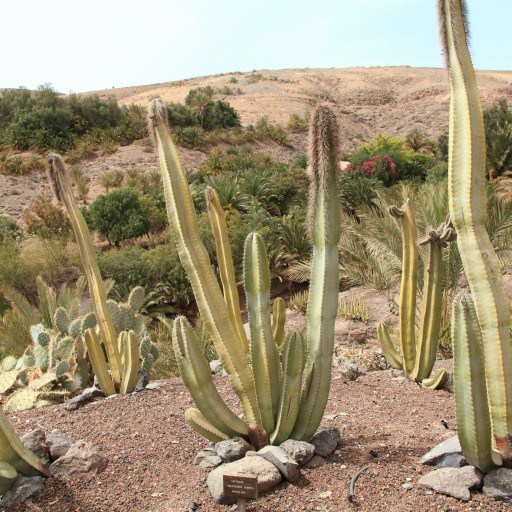
Plant Overview
Known affectionately as the "Senita Cactus" or the "Whisker Cactus," this stoic desert dweller is a hallmark of the Sonoran landscape. With its gray, hair-like bristles that appear on older stems, it looks like a wise, bearded elder watching over the rocky plains. It is a slow-growing masterpiece of evolution, perfectly adapted to survive for over a century in some of the harshest environments on Earth.
🔍 How to Identify
- 🌵 Columnar Stems: It grows in tall, vertical columns that branch out from the base, eventually forming a massive, multi-stemmed shrub that can reach 15 feet in height.
- 🧔 The "Beard": The most striking feature is the dense cluster of long, gray, flexible bristles at the top of mature stems, which look remarkably like a coarse beard.
- 🌸 Nocturnal Blooms: It produces small, pinkish-white, funnel-shaped flowers that open only at night to hide from the desert heat.
🏡 In Your Garden
- ☀️ Sun Worshipper: This cactus requires intense, direct sunlight to thrive. In indoor settings, it often struggles unless placed in the brightest south-facing window or under high-output grow lights.
- 🏜️ Drainage Specialist: Like most desert succulents, it "breathes" through its roots. It hates "wet feet" and requires a gritty, sandy soil mix that allows water to pass through almost instantly to prevent root rot.
- 🌡️ Heat Tolerance: While it can handle extreme heat, it is sensitive to frost. If you live in a cooler climate, it should be kept in a container and moved indoors when temperatures drop toward freezing.
⚠️ Safety & Toxicity
- 🌵 Physical Hazard: The Senita is not chemically toxic to humans, cats, or dogs. However, its spines—especially the sharp ones found on younger stems—can cause painful puncture wounds or skin irritation.
- 🐾 Placement: Because of the physical risk, it is best placed in low-traffic areas of the home or garden where curious pets or toddlers won't accidentally brush against it.
✨ Fun Fact
The Senita Cactus has a "secret deal" with the Senita Moth. It is one of the very few plants in the world involved in a "specialized pollination mutualism." The moth pollinates the flower and, in exchange, lays its eggs there so its larvae can eat a small portion of the developing seeds—a perfect biological trade-off!

Detailed Care Instructions

Place in a bright room that is sun drenched almost all day. Or directly in a south-facing window.

When the top few inches of soil dry out, water your plants. If the top few inches of soil are still moist, do not water your plant. Wait a few days, then poke your finger into the soil to see if anything has changed. Overwatering poses a disease risk, such as the development of fungal diseases in the roots. These plants have adaptations in there leaves that allow them to survive in low water supply.
These plants can thrive without taking help from any fertilizer. However, if the medium of growth is something other than soil for instance sand then you may need to add little fertilizer. The best way to know if your plants need fertilizer or not is to check for yellowing of leaves. If the leaves start to turn yellow it’s fertilizing time.
You may use Cactus Fertilizer for your Senita Cactus
The ideal soil for Pachycereus Schottii is well-draining with good aeration. It should not retain too much moisture as this can lead to root rot and other fungal diseases. You can use a mixture of coarse sand, perlite, and peat moss in equal parts or a commercial cactus mix with added perlite. The soil pH should be slightly acidic, between 6.0 and 7.0, and rich in organic matter. Avoid using heavy clay soils or soils with high salt content, as they can cause harm to the plant.
Common pests of the senita cactus include Scale insect, mealybugs, spider mites. Make a habit of checking your senita cactus frequently for pests so that any infestations can be caught and managed early.







