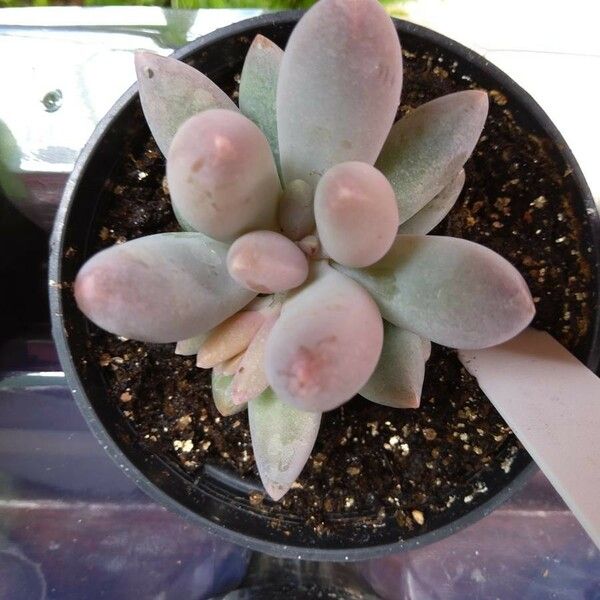
Plant Overview
Known affectionately as "Baby Fingers," Pachyphytum machucae looks like it jumped straight out of a clay animation. This Mexican native is famous for its incredibly plump, cylindrical leaves that resemble smooth river stones or tiny, chubby digits. Its soft, pastel palette of lavender, mint, and powdery blue makes it a must-have for succulent collectors seeking a "cute" aesthetic.
🔍 How to Identify
- 💅 The "Fingers": The leaves are short, thick, and rounded at the tips, growing in a dense rosette that eventually forms a small, trailing shrub-like structure.
- ❄️ Farina Coating: The plant is covered in a thick layer of epicuticular wax (farina), giving it a soft, matte, "frosted" appearance that glows under bright light.
- 🌸 Bell-Shaped Blooms: In the spring, it sends out long, arching stalks bearing tiny, nodding flowers that are usually dark red or orange on the inside.
🏡 In Your Garden
- 🚫 Look, Don't Touch: The powdery coating is the plant’s natural sunscreen and raincoat. If you touch the leaves, your fingerprints will leave permanent marks on the wax that don't go away until new leaves grow!
- ☀️ The Stress Blush: To get those beautiful pink and purple tints, the plant needs "environmental stress"—specifically lots of bright, indirect sunlight and cool (but not freezing) nights. In low light, it will turn a plain, pale green and stretch out.
- 💧 Thirsty Roots, Dry Feet: Because the leaves are so thick, they store a massive amount of water. Only water when the leaves feel slightly soft to a gentle squeeze; overwatering is the fastest way to turn this plant into mush.
⚠️ Safety & Toxicity
- ✅ Pet Friendly: Pachyphytum machucae is generally considered non-toxic to cats, dogs, and horses, making it a safe choice for low-shelf displays.
- 👶 Choking Hazard: While not poisonous, the leaves are very fragile and pop off easily. Keep it out of reach of curious toddlers who might be tempted to taste the "candy-like" leaves.
✨ Fun Fact
The genus name Pachyphytum literally translates from Greek to "Thick Leaf." These plants have evolved such dense leaves that they can survive months of drought in the rocky cliffs of Mexico by drinking their own internal water reserves!

Detailed Care Instructions
To grow Pachyphytum Machucae, also known as Moonstone plant or "Machuca's Pachyphytum," you can follow these steps:
- Choose a suitable pot: Select a well-draining pot that is slightly larger than the root ball of your plant. Clay or ceramic pots are recommended as they help moisture evaporate faster.
- Soil: Use a well-draining succulent soil mix or create your own by combining equal parts of potting soil, perlite, and sand. This mix allows excess water to drain quickly, preventing root rot.
- Planting: Place the plant into the pot and gently pack the soil around it, ensuring that the roots are covered but not buried too deeply. Leave a small space between the soil surface and the pot's rim to prevent water from overflowing.
- Light and Temperature: Pachyphytum Machucae requires bright indirect light or partial sunlight. Place it near a sunny window, but avoid exposing it to intense direct sunlight. The optimal temperature range for the plant is between 60-80°F (15-27°C).
- Watering: Allow the soil to dry out completely between watering, as overwatering can lead to root rot. Pachyphytum Machucae is a typical succulent that can withstand periods of drought. When watering, thoroughly moisten the soil and let any excess water flow out of the drainage holes.
- Humidity: Pachyphytum Machucae does not require high humidity levels. Average room humidity should be sufficient for its growth.
- Fertilizer: Feed the plant with a balanced, water-soluble succulent fertilizer, following the instructions on the package. Apply the fertilizer during the growing season (typically spring and summer) every one to two months.
- Propagation: Pachyphytum Machucae can be propagated through leaf or stem cuttings. Allow the cuttings to callus for a few days, then place them on a well-draining soil mix and mist occasionally until new roots form.
- Pruning: Regularly prune any overgrown or leggy branches to maintain a compact and bushy shape. Use clean and sharp pruning shears to avoid damaging the plant.
- Pests and Diseases: Keep an eye out for common succulent pests like mealybugs or spider mites. If pests are present, treat them using appropriate organic or chemical pest control methods.
Remember, each plant may have specific needs, so closely monitor your Pachyphytum Machucae and adjust care accordingly.

Place in a bright room that is sun drenched almost all day. Or directly in a south-facing window.

The best way to water this plant is to wait until the top inch of soil is dry to the touch before watering thoroughly. Avoid getting water on the leaves as it can cause rot. Use a watering can with a narrow spout to direct the water to the base of the plant. Make sure to let excess water drain away and never let the plant sit in standing water. In the winter months, water sparingly as the plant goes into a dormant phase.
To fertilize the Pachyphytum Machucae plant, you should follow these instructions:
- Choose a balanced liquid fertilizer specifically formulated for succulents or cacti.
- Dilute the fertilizer according to the instructions provided on the packaging. Generally, a dilution ratio of 1:2 or 1:4 (fertilizer:water) is recommended.
- Water the plant thoroughly using the fertilizer solution. Ensure that the soil is completely moistened, allowing excess water to drain out through the drainage holes.
- Apply the fertilizer solution to the plant's soil once every two to four weeks during the growing season, which typically falls in spring and summer. Reduce or stop fertilizing in autumn and winter when the plant goes into a dormant period.
- Avoid applying fertilizer to the plant's leaves or stem, focusing primarily on the soil. Take care to prevent any fertilizer from coming into contact with the plant's sensitive parts, as it may cause burning or damage.
- Monitor the plant's response to fertilization. If it starts showing signs of stress or nutrient burn, such as discoloration or wilting, dilute the fertilizer further or reduce the frequency of application.
Remember, it's important not to over-fertilize succulent plants, as they require minimal nutrients compared to other houseplants. Always follow the instructions provided with your chosen fertilizer and adjust the application as necessary.
The ideal soil for this plant should be well-draining and rich in nutrients. The pH level of the soil should be slightly acidic to neutral, with a range between 6.0 and 7.5. A mixture of coarse sand, perlite, and peat moss is recommended. The sand and perlite create pockets of air in the soil, allowing for good drainage, while the peat moss provides valuable organic matter and moisture retention. It is important not to choose a heavy, clay-based soil, as this can trap water and lead to root rot. Additionally, the soil mixture should be loose and fluffy, allowing for the roots to spread out and grow easily without being cramped.
Pachyphytum Machucae is a type of succulent plant that can be propagated easily using several methods. Here is a detailed guide on how to propagate Pachyphytum Machucae:
- Leaf Propagation:
- Choose a healthy, mature leaf from the parent plant. Select a leaf that is plump, thick, and undamaged.
- Gently twist the leaf off the stem, ensuring that a small part of the leaf's base remains intact. This is crucial for successful propagation.
- Allow the detached leaf to dry out for a few days to form a callus. This will help prevent rotting when it is planted.
- Prepare a well-draining soil mix for planting. You can use a combination of cactus/succulent soil, coarse sand, and perlite.
- Place the calloused end of the leaf into the soil mix, burying it about a quarter-inch in the soil, with the intact base facing down.
- Water the leaf gently, ensuring that the soil is moist but not overly saturated.
- Place the potted leaf in a warm and bright location, away from direct sunlight. Maintain a temperature around 70-75°F (21-24°C).
- Mist the leaf occasionally to maintain a humid environment around it.
- Over time, small roots will develop from the base of the leaf, followed by tiny rosettes or offsets. This is an indication that the leaf has successfully rooted and a new plant is forming. Be patient, as this process can take a few weeks to a few months.
- Once the offsets have grown to a reasonable size, they can be carefully separated from the parent leaf and potted individually.
- Choose a healthy, mature leaf from the parent plant. Select a leaf that is plump, thick, and undamaged.
- Stem Cutting Propagation:
- Identify a healthy stem on the parent plant that is not flowering. Choose a stem that is at least 3-4 inches long.
- Using a clean, sharp pair of scissors or pruning shears, make a clean cut just below a leaf node. This is where the roots will eventually develop.
- Allow the cut end to dry out or callus for a few days.
- Prepare a well-draining soil mix as mentioned earlier.
- Insert the cut end of the stem about an inch into the soil mix.
- Water the cutting gently, ensuring that the soil is lightly moist but not waterlogged.
- Place the potted cutting in a warm and bright location, away from direct sunlight. Maintain a temperature around 70-75°F (21-24°C).
- Mist the cutting occasionally to maintain a humid environment.
- Over time, roots will start to grow from the cut end of the stem, while new leaves will emerge from the upper nodes. This indicates successful rooting and growth.
- Once the roots have developed sufficiently, the cutting can be potted into a separate container.
By following these propagation methods, you can easily propagate Pachyphytum Machucae and multiply your collection of this unique succulent plant.
- Identify a healthy stem on the parent plant that is not flowering. Choose a stem that is at least 3-4 inches long.
Common pests of the pachyphytum machucae include Mealybugs. Make a habit of checking your pachyphytum machucae frequently for pests so that any infestations can be caught and managed early.








