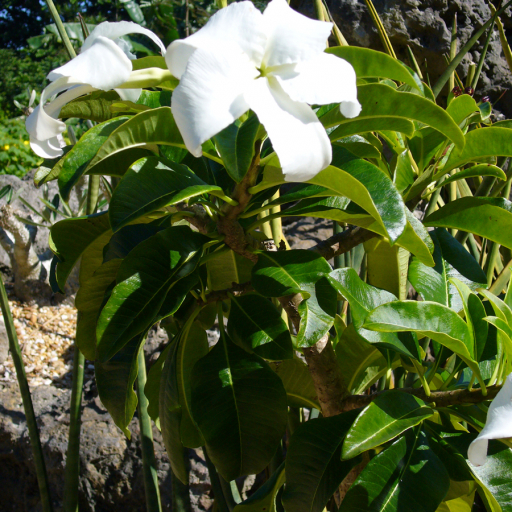
Plant Overview
Often called the Decary’s Bottle Tree, this rare succulent is a sculptural masterpiece native to the limestone forests of Madagascar. Unlike many of its prickly relatives, this species is prized for its elegant, smooth, silvery-gray trunk that swells like a bottle to store water during long droughts. It is a slow-growing survivor that transforms from a chubby seedling into a majestic, bonsai-like specimen that looks like it belongs in a prehistoric landscape.
🔍 How to Identify
- 🦴 The Caudex: A thick, bulbous, succulent base (pachycaul) that is remarkably smooth and lacks the dense, sharp spines found on most other Pachypodium species.
- 🍃 Large Foliage: Boasts broad, deep green, leathery leaves that cluster at the ends of the branches, providing a lush contrast to the metallic-looking bark.
- 🏳️ Snowy Blooms: Produces stunning, large white flowers that are trumpet-shaped and carry a delicate fragrance, typically appearing in late spring or early summer.
🏡 In Your Garden
- 🏜️ Drainage is Vital: Because the trunk is essentially a giant water tank, the plant is highly prone to root rot. It thrives in a "neglect-friendly" gritty mix with very little organic matter.
- ☀️ Sun & Stability: It craves bright, direct light to maintain its iconic bottle shape. It hates being moved once it settles, as it can be sensitive to changes in orientation and light intensity.
⚠️ Safety & Toxicity
- 🚫 Toxic Status: Highly toxic if ingested.
- 🐾 The Danger: The milky sap contains cardiac glycosides, which can be dangerous to pets and humans. Always wear gloves when pruning and keep the plant out of reach of curious cats, dogs, or children.
✨ Fun Fact
While most Pachypodiums are nicknamed "Madagascar Palms" and are covered in intimidating thorns to deter herbivores, Pachypodium decaryi is one of the rare "naked" members of the family, relying on its bitter sap rather than spines for protection!

Detailed Care Instructions
To grow a Pachypodium decaryi plant, also known as the elephant's foot, you can follow these steps:
- Choose a suitable location: Pachypodium decaryi plants prefer bright, indirect sunlight. Place the plant near a south-facing window or in a spot where it can receive at least 4-6 hours of indirect sunlight per day.
- Provide the right temperature: These plants thrive in warm temperatures ranging from 65-85°F (18-29°C). Avoid exposing them to temperatures below 50°F (10°C), as it can harm the plant.
- Select a well-draining pot: Use a pot with drainage holes to prevent waterlogged soil. Pachypodium decaryi plants prefer a slightly acidic to neutral soil pH level.
- Use a well-draining soil mix: Prepare a soil mix consisting of equal parts potting soil, perlite, and sand. This combination provides good drainage to prevent root rot.
- Watering: Allow the soil to dry out between waterings. Water the plant thoroughly when the top 1-2 inches of soil feel dry. Avoid overwatering, as it can cause root rot. During winter, decrease watering frequency, as the plant becomes relatively dormant.
- Fertilize sparingly: Use a balanced, water-soluble fertilizer diluted to half strength during the growing season (spring and summer) every 4-6 weeks. Avoid fertilizing during the winter months.
- Pruning: If your Pachypodium decaryi plant grows too tall or becomes leggy, you can prune the stems to maintain its shape. Use clean, sharp pruning shears to remove any unwanted growth.
- Repotting: Elephant's foot plants have a slow growth rate, so they only need to be repotted every 2-3 years. Repot the plant in fresh well-draining soil in a slightly larger pot.
- Pest control: Monitor your plant for pests such as spider mites or mealybugs. If infested, treat the plant with an appropriate insecticidal soap or neem oil following the product instructions.
- Be cautious with handling: Pachypodium decaryi plants have sharp thorns, so use gloves or tongs when handling them to avoid injuries.
By following these guidelines, you can successfully grow and care for a Pachypodium decaryi plant. Remember to be patient, as they have a slow growth rate and can take several years to reach their mature size.
Pachypodium Decaryi plant requires watering deeply but infrequently. The soil should be allowed to dry out completely before watering. When watering, pour water slowly and steadily around the base of the plant, avoiding getting water on the leaves or stem. The plant prefers well-draining soil, so make sure the pot or container has adequate drainage holes. During the winter months, reduce watering and allow the soil to dry out more thoroughly. Avoid overwatering as it can lead to root rot and ultimately kill the plant.
To fertilize a plant belonging to the Pachypodium Decaryi species, it is best to use a balanced slow-release fertilizer during the growing season. Apply the fertilizer once every two to three months, and follow the manufacturer's instructions for application rates. Avoid fertilizing during the winter months, when the plant is dormant. It is also recommended to supplement the fertilizer with occasional applications of a diluted liquid fertilizer during the growing season. Be sure to water the plant thoroughly after fertilizing to prevent fertilizer burn.
The recommended soil for this particular plant is a well-draining mixture that is low in nutrients. It should be composed of coarse sand, perlite, and a small amount of organic matter such as peat moss or coconut coir. The soil pH should be slightly acidic to neutral, around 6-7. It is important to avoid compacted soil as it can lead to root rot. Additionally, the plant prefers a slightly rocky soil with good aeration.
Propagation of this plant can be achieved through several methods, such as stem cuttings or by separating offsets from the mother plant. Stem cuttings should be taken during the active growing season, with the cuttings being at least 4 inches in length. The cuttings should then be left to callus over before being planted in a well-draining mixture, with high levels of sand or perlite. The plant should be kept in high humidity and bright, indirect sunlight until new growth is observed.
Offsets can also be separated from the mother plant and planted individually in a well-draining mixture. It is important to ensure that the offset has some of its own roots before planting in order to enhance the success of the propagation. The plant should be treated similarly to that of stem cuttings, with high humidity and bright, indirect sunlight.
Propagation can also be achieved through seed sowing, but this is a longer process with less guaranteed success rates. Seeds should be collected from mature, healthy plants and sown in a well-draining mixture, with high levels of sand or perlite. The plant should be kept in an area of high humidity and bright, indirect sunlight until they germinate and new growth is observed.








