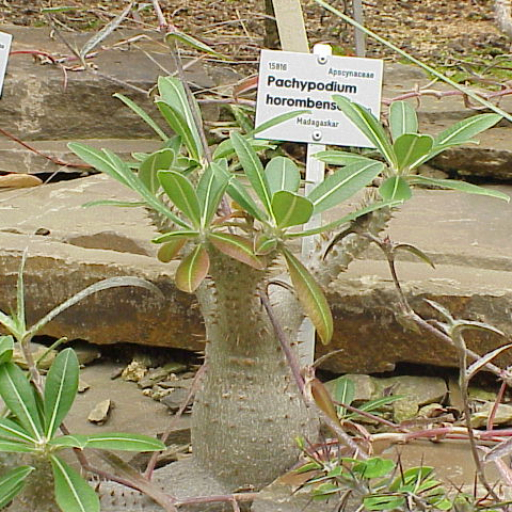
Plant Overview
Often called the "Horombe Star," this architectural succulent hails from the rocky, semi-arid plateaus of Madagascar. It is a pachycaul—a plant with a disproportionately thick trunk used for water storage—giving it the appearance of a miniature, spiny baobab tree. While it looks like something from a prehistoric era, its vibrant, oversized yellow blooms bring a sudden burst of cheerful color to any desert-scape or sunny windowsill.
🔍 How to Identify
- 🌵 The Caudex: It features a heavily swollen, silver-gray base that stays relatively low to the ground, branching into multiple thick, upright arms.
- ⚔️ Spiny Armor: The branches are densely covered in short, sharp triple-spines that emerge in a regular pattern, protecting the plant's precious water reserves.
- 🌼 Bell-Shaped Blooms: Unlike many of its cousins, this species produces large, bright yellow flowers that are notably wide and cup-shaped, perched on long stalks above the foliage.
- 🍃 Crown of Leaves: Small, dark green, paddle-shaped leaves grow in clusters only at the very tips of the branches, appearing primarily during the active growing season.
🏡 In Your Garden
- ☀️ Sun-Drenched Living: This plant is a true sun-worshipper; it requires high light intensity to maintain its compact, "fat" shape. Without enough sun, the branches will stretch and become weak, losing their sculptural charm.
- 💧 The "Dry Sleep": During the winter, this plant enters a strict dormancy and will often drop all its leaves. It is vital to nearly stop watering during this time, as the roots are highly susceptible to rot when the plant isn't actively growing.
- 🪨 Mineral-Rich Substrate: Because it grows in rocky crevices in the wild, it demands a very gritty, fast-draining soil. Using a standard potting mix is a recipe for disaster; think more along the lines of pumice, lava rock, and coarse sand.
⚠️ Safety & Toxicity
- 🚫 Toxic Sap: Like most members of the Apocynaceae family, the milky sap inside the plant contains cardiac glycosides. If ingested, it can cause serious illness in humans, cats, and dogs.
- 🧤 Physical Hazard: The spines are quite sharp and can easily puncture the skin. Always wear thick gardening gloves when repotting, and keep the plant out of reach of curious toddlers or pets who might bump into it.
✨ Fun Fact
The name Horombense refers specifically to the Horombe Plateau in southern Madagascar, the only place on Earth where this plant grows naturally among the ancient, weathered granite rocks.

Detailed Care Instructions
Pachypodium Horombense plants can be grown successfully with the right care and conditions. Here are some steps to help you grow a healthy Pachypodium Horombense plant:
- Choose the right location: Pachypodium Horombense plants thrive in bright, indirect light. Place your plant near a sunny window or in a location where it will receive plenty of sunlight throughout the day.
- Use well-draining soil: Pachypodium plants prefer well-draining soil to prevent root rot. A cactus or succulent mix is ideal for these plants.
- Water sparingly: Pachypodium Horombense plants are drought-tolerant and do not require frequent watering. Allow the soil to dry out completely between waterings, and be sure to avoid overwatering.
- Provide warmth: Pachypodium plants prefer warm temperatures and do not tolerate cold weather well. Keep your plant in a location where temperatures remain consistently above 60°F (15°C).
- Fertilize occasionally: During the growing season (spring and summer), you can fertilize your Pachypodium Horombense plant with a balanced, water-soluble fertilizer diluted to half strength. Avoid fertilizing during the winter months when the plant is dormant.
- Prune as needed: Pachypodium plants may benefit from occasional pruning to remove dead or damaged growth and maintain a tidy appearance.
By following these tips and providing the right care, you can successfully grow a healthy Pachypodium Horombense plant in your home or garden.

Place in a window with dappled sun or a spot in the middle of a room. Or directly in a window facing west or east.

Pachypodium Horombense plant should be watered deeply and thoroughly, allowing the water to penetrate the roots completely. It is important to water the plant directly at the base, avoiding getting water on the leaves to prevent rot and disease. The plant should be watered when the top inch of soil feels dry to the touch, typically every 1-2 weeks depending on the climate and environment. It is important to water less frequently during the winter months when the plant is dormant. Additionally, using a well-draining soil mix and a pot with drainage holes will help prevent waterlogged soil and root rot.
Pachypodium horombense should be fertilized twice a month during the growing season, using a balanced liquid fertilizer diluted to half strength. Avoid fertilizing during the dormant winter months. Water the plant before each fertilization to help prevent root burn. Diligently follow the recommended dosage on the fertilizer label to avoid over-fertilization, which can harm the plant.
Pachypodium Horombense plant should be planted in well-draining soil with a slightly acidic to neutral pH level. A mixture of sandy, loamy soil with added perlite or pumice is ideal to allow for proper drainage. Avoid heavy or compacted soils that retain too much moisture, as this can lead to root rot. Additionally, a good quality cactus or succulent soil mix can be used for planting to provide the necessary drainage and aeration for the plant's roots. It is important to ensure that the soil is kept consistently moist but not waterlogged to promote healthy growth and prevent issues such as root rot.
Propagation of Pachypodium horombense plants can be done through seeds or stem cuttings.
To propagate using seeds, collect ripe seeds from the plant and sow them in a well-draining potting soil mix. Keep the soil consistently moist and place the pot in a warm, sunny location. The seeds should germinate within a few weeks.
To propagate using stem cuttings, choose a healthy stem from the plant and cut it at a 45-degree angle using a sharp, sterile knife. Allow the cutting to dry and callous over for a few days before planting it in a well-draining potting mix. Keep the soil slightly moist and place the cutting in a warm, bright location. Roots should start to develop within a few weeks.
Regardless of the method used, it is important to provide proper care and maintenance to the new plants to ensure their health and growth. Regular watering, adequate sunlight, and appropriate fertilization will help the propagated plants thrive.
Common pests of the madagascar palm include Scale insect, mealybugs, spider mites. Make a habit of checking your madagascar palm frequently for pests so that any infestations can be caught and managed early.








