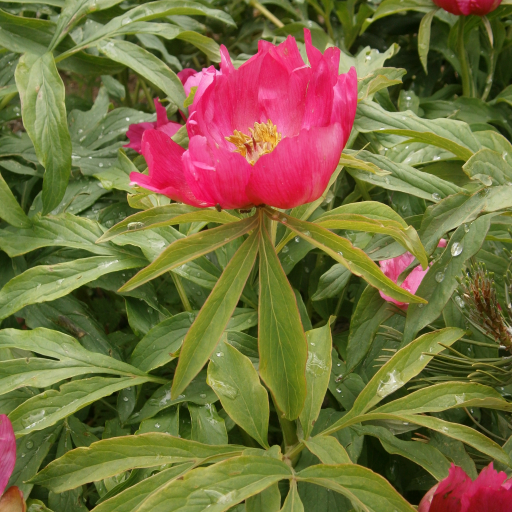
Plant Overview
Known as the "Common Peony" or the "Queen of the Herbs," Paeonia officinalis has been a staple of European gardens since the Middle Ages. Originally prized for its medicinal roots, it transitioned into a symbol of romance and luxury due to its massive, pillowy blooms. It is the quintessential "old-fashioned" garden plant that often outlives the person who planted it.
🔍 How to Identify
- 🌺 The Blooms: Features large, cup-shaped flowers that usually appear in deep crimson or rose-pink, often with a prominent cluster of yellow stamens in the center.
- 🌿 The Foliage: The leaves are "biternate," meaning they are deeply divided into nine or more elliptical segments, creating a lush, dark green backdrop.
- 🌱 Growth Habit: It forms a dense, shrub-like mound that stays tidy throughout the growing season, reaching about 2 to 3 feet in height.
🏡 In Your Garden
- 🏺 Root Sensitivity: This peony is famous for its "homesteader" attitude—it hates being moved. Because of its thick, fleshy tuberous roots, transplanting it often results in a "pout" where the plant refuses to bloom for several years.
- ❄️ The Winter Requirement: Unlike many garden favorites, this peony needs a cold winter. It requires a specific amount of "chill hours" during dormancy to successfully set its heavy flower buds for the spring.
- 🍰 Feeding the Giant: These are heavy feeders. Because they stay in the same spot for decades, they appreciate a top-dressing of organic compost every autumn to replenish the soil without disturbing the roots.
⚠️ Safety & Toxicity
- 🐾 Toxic to Pets: Paeonia officinalis is considered mildly to moderately toxic to dogs, cats, and horses.
- 🤢 Symptoms: The plant contains the toxin paeonol. If ingested, it can cause gastrointestinal distress, including vomiting, diarrhea, and lethargy. It is best kept away from curious nibblers.
✨ Fun Fact
🏛️ A Mythological Cure: The plant is named after Paeon, the Greek physician to the gods. Legend says Paeon used a peony root to heal a wound sustained by Pluto. When the god of medicine, Asclepius, became jealous of Paeon’s skill, Zeus saved Paeon from certain death by transforming him into this very flower.

Detailed Care Instructions
To grow Paeonia Officinalis, also known as Common peony or Garden peony, you can follow these steps:
- Choose the right location: Paeonia Officinalis prefers a location with full sun to light shade. Ensure the area has well-draining soil.
- Soil preparation: The soil should be fertile, rich in organic matter, and slightly acidic with a pH range of 6.5 to 7.5. Incorporate compost or well-rotted manure into the soil before planting.
- Planting time: The best time to plant Paeonia Officinalis is in the fall. This gives the plant enough time to establish its roots before winter.
- Planting depth: Dig a hole that is wide and deep enough to accommodate the plant's root system. Place the plant with its buds or eyes facing upwards and ensure that the topmost bud is covered with no more than 2 inches of soil.
- Watering: After planting, water the plant thoroughly. Provide regular watering throughout the growing season, especially during dry spells. However, avoid overwatering as it can lead to root rot.
- Mulching: Apply a layer of organic mulch around the plant to conserve soil moisture, suppress weed growth, and regulate soil temperature.
- Support: Paeonia Officinalis often benefits from staking to support the heavy flowers. Install a stake or support structure early in the growing season to prevent damage to the developing blooms.
- Fertilizing: Apply a balanced, slow-release fertilizer in early spring before new growth emerges. Follow the manufacturer's instructions for application rates.
- Pruning: Remove spent flowers to promote more blooms and prevent energy from going into seed production. In fall or early spring, cut back stems to ground level.
- Pest and disease management: Monitor the plant for pests like aphids, leaf spot, and botrytis blight. Use organic or chemical interventions accordingly.
- Divide and transplant: After a few years (usually every 4-5 years), you can dig up the plant in fall and divide it to create new plants. Replant them in a similar manner as mentioned above.
By following these steps, you can successfully grow Paeonia Officinalis and enjoy its beautiful flowers.

Place in a window with dappled sun or a spot in the middle of a room. Or directly in a window facing west or east.

The plant in question belongs to the family Paeoniaceae and has large, showy flowers with a pleasing fragrance. When it comes to watering, it is important to ensure that the soil remains consistently moist but not waterlogged. This can be achieved by watering deeply once or twice a week, rather than giving the plant frequent shallow waterings. It is also advisable to water the base of the plant rather than overhead, as wet foliage can lead to fungal diseases. During periods of hot weather or drought, additional watering may be necessary to prevent the soil from drying out completely. Overall, it is important to monitor the plant's moisture levels and adjust watering as needed to ensure healthy growth and blooming.
To fertilize this plant, apply a balanced fertilizer in early spring before new growth appears. Use a slow-release fertilizer to provide nutrients throughout the growing season. During the growing season, apply a liquid fertilizer every 3-4 weeks. Be careful not to apply fertilizer directly to the stem or foliage, as this could cause damage. Water the plant thoroughly after fertilization.
The ideal soil for this plant should have good drainage and be aerated. It should also have a neutral to slightly alkaline pH level, between 6.5-7.5. A sandy loam soil with a mix of organic matter is recommended, as it retains moisture while allowing excess water to drain away. It is important to avoid heavy clay soils as they can retain too much water, leading to root rot. Additionally, the soil should be well-fertilized with a balanced plant food containing all essential nutrients.
Paeonia officinalis can be propagated through seed or division. To propagate through seed, collect mature, viable seeds in late summer to early fall and sow them immediately in a seed tray filled with well-draining potting soil. Keep the soil moist and at a temperature of around 15-20°C. Seeds will germinate in about 2-4 weeks. Once seedlings are big enough, transplant them to individual pots and grow them in a sheltered area, protected from direct sunlight and strong winds.
To propagate through division, wait until the plant goes dormant in late fall. Dig up the entire plant and gently separate the root clumps into small sections, each with a few buds and roots. Replant these sections in soil mixed with compost, and water thoroughly. Keep the soil moist but not waterlogged, and place in a sheltered, semi-shaded location. The following spring, the propagated plants will emerge and begin to grow.
Common pests of the cottage peony include Spider mites, aphids, thrips, larvae, snails. Make a habit of checking your cottage peony frequently for pests so that any infestations can be caught and managed early.








