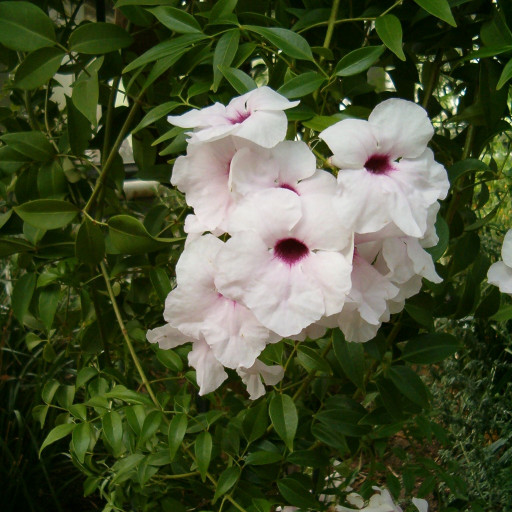
Plant Overview
Often called the Bower of Beauty or Bower Vine, this Australian native is the ultimate romantic climber for a secret garden. It is famous for its lush, evergreen foliage and trumpet-shaped blossoms that look like they belong in a Victorian painting. In its natural rainforest habitat, it scrambles up toward the canopy, creating a dense "bower" of shade and perfume.
🔍 How to Identify
- 🌸 Trumpet Blossoms: The flowers are elegant, funnel-shaped, and usually white or pale pink with a deep, ruby-magenta "throat" that draws the eye.
- 🍃 Glossy Foliage: The leaves are dark green, shiny, and divided into several leaflets (pinnate), giving the vine a dense, lacy appearance even when not in bloom.
- 🌿 Twining Stems: Unlike some vines that have "feet" to stick to walls, this plant has flexible, woody stems that wrap around fences, trellises, or arches.
🏡 In Your Garden
- 🧗 Structural Support: Because it is a vigorous grower, it needs a sturdy trellis or pergola. It is a "top-heavy" plant, meaning it will concentrate its flowers at the top where the sun is brightest.
- 💧 Cool Feet, Warm Head: Like many rainforest natives, it thrives when its roots are kept cool and mulched, while its foliage enjoys the warmth of the sun. It is surprisingly drought-tolerant once established but hates "wet feet" or soggy soil.
- ✂️ Pruning Strategy: It can become a bit wild if left alone. Pruning it back right after the flowering season helps maintain its shape and encourages more blooms for the following year.
⚠️ Safety & Toxicity
- 🟢 General Status: Pandorea jasminoides is generally considered non-toxic and safe for home gardens.
- 🐾 Pets & Kids: There are no known major toxic effects for cats, dogs, or horses. However, as with many plants, the milky sap may cause mild skin irritation in sensitive individuals, so wearing gloves while pruning is a good habit.
✨ Fun Fact
The name "Pandorea" is inspired by the Greek myth of Pandora’s Box. This refers to the plant’s large, bean-like seed pods which, when they finally burst open, release a massive "cloud" of winged seeds into the wind!

Detailed Care Instructions
To grow Pandorea jasminoides (also known as Bower Vine or Pandorea Vine), follow these steps:
- Choose an appropriate location: Pandorea jasminoides prefers a sunny spot with well-draining soil. It can tolerate some shade, but full sun is ideal.
- Prepare the soil: Ensure that the soil is well-draining and rich in organic matter. If the soil is heavy clay, consider adding compost or sand to improve drainage.
- Planting: Dig a hole slightly larger than the plant's root ball. Place the plant in the hole and backfill with soil, gently firming it around the roots. Water thoroughly after planting.
- Watering: Keep the plant consistently moist, especially during the first growing season. Water deeply but allow the soil to dry out slightly between waterings. Be careful not to overwater, as this can lead to root rot.
- Fertilization: Feed the plant during the growing season with a balanced, slow-release fertilizer. Follow the instructions on the fertilizer package for application rates. Avoid excessive fertilizer, as it can lead to excessive foliage growth and reduced flower production.
- Pruning: Pandorea jasminoides benefits from regular pruning to maintain its shape and promote bushier growth. Prune after flowering, cutting back overgrown or straggly stems. You can also prune lightly throughout the year to remove any dead or damaged growth.
- Support: Pandorea jasminoides is a climbing vine and will need support to grow. Provide a trellis, arbor, or other structure for the plant to climb on. As it grows, gently train the vine to attach itself to the support.
- Keep an eye out for pests and diseases: While Pandorea jasminoides is generally resistant to pests and diseases, it can occasionally be affected by aphids, scale insects, or powdery mildew. Monitor the plant regularly and take appropriate actions if any pests or diseases are observed.
By following these steps, you should be able to successfully grow your Pandorea jasminoides plant and enjoy its beautiful flowers.

Place in a bright room that is sun drenched almost all day. Or directly in a south-facing window.

When watering this plant, it is important to provide a moderate amount of water consistently. This can be achieved by allowing the top inch of soil to dry out before watering again. Overwatering can lead to root rot, so be sure not to let the soil become too waterlogged. When watering, do so slowly and evenly, making sure the water reaches the roots. Avoid getting water on the leaves as this can lead to fungal diseases. It is also important to make sure the soil has good drainage to prevent standing water.
To properly fertilize this plant, it is important to choose a balanced fertilizer with equal amounts of nitrogen, phosphorus, and potassium. Begin fertilizing the plant in early spring and continue monthly until the end of summer. Be sure to follow the instructions on the fertilizer package for the correct dosage and application method. Avoid over-fertilizing the plant, as this can lead to burnt leaves or stunted growth. It is also important to water the plant thoroughly after fertilizing to ensure proper distribution of the nutrients.
The ideal soil for Pandorea Jasminoides plant is well-draining, nutrient-rich, and slightly acidic soil. It should be loose and aerated, allowing for adequate air and water circulation. The soil should be able to retain moisture while not becoming waterlogged, as the plant does not tolerate waterlogged conditions. Gardeners should regularly add organic matter to the soil to improve its nutritional content. The pH level of the soil should be between 5.5 and 7.5, which is slightly acidic to neutral. The soil should be thoroughly watered, but any excess water should be drained off to prevent root rot. Additionally, the plant prefers a sunny location with some protection from strong winds.
To propagate this plant, you will need to start with a healthy mature plant that has a strong root system. The best time to take cuttings is in the spring or early summer when the plant is actively growing. To prepare for cutting, sterilize your pruning shears and select a healthy stem with several nodes (points where new growth emerges) that are at least 4-6 inches long. Make the cut at a 45-degree angle just below a node, and remove any leaves or flowers along the stem that may touch the soil.
Next, moisten a potting mix of equal parts peat moss, vermiculite, and perlite and make a hole in the middle of the soil mixture using a pencil. Dip the cut end of the stem in rooting hormone powder, gently tap off any excess, and insert the stem into the hole in the soil. Firmly pat the soil around the cutting and water it thoroughly. Put a clear plastic bag over the top of the cutting to maintain humidity around the foliage, and place the pot in a shaded area.
Check on the cutting every few days and mist as needed to keep the soil moist. After a few weeks, you should see new growth emerging from the stem, which indicates that the cutting has taken root. At this point, you can remove the plastic bag and begin to gradually expose the new plant to more sunlight and less humidity. Once the new plant is established, you can transplant it into a larger container or directly into the ground.








