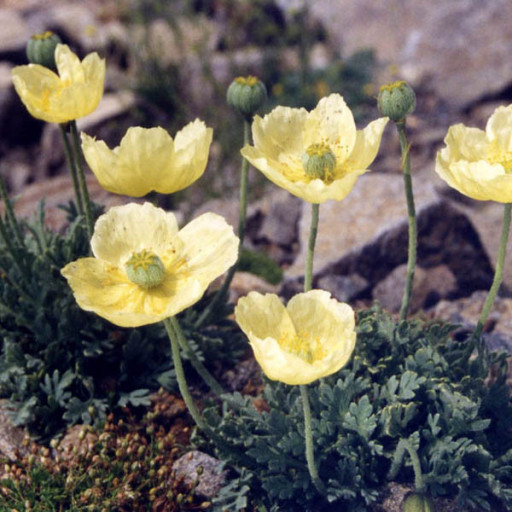
Plant Overview
Known as the Iceland Poppy, these whimsical blooms look as though they were crafted from delicate, crinkled crepe paper. Despite their name, they aren't actually native to Iceland; they are subarctic travelers hailing from the chilly regions of Northern Asia and North America. They are beloved by gardeners for their vibrant "citrus-bowl" colors—bright oranges, yellows, and whites—that seem to glow when the sun hits them.
🔍 How to Identify
- 🌸 The Bloom: Large, bowl-shaped flowers with four silky, translucent petals that look permanently wrinkled. They surround a tuft of golden-yellow stamens.
- 🦒 The Stem: The Latin name nudicaule translates to "naked stem." This refers to the long, leafless, and slightly hairy stalks that emerge directly from the base to hold the heavy flowers aloft.
- 🌿 The Foliage: A low-growing rosette of lobed, fern-like leaves. The foliage is a soft, blue-green color and stays close to the ground, never climbing the flower stems.
🏡 In Your Garden
- 🧊 Cool Weather Specialists: These poppies thrive in the chill of early spring. They are "heat-sensitive" beauties that will often stop blooming or go dormant once the sweltering days of summer arrive.
- 🚫 The "No-Touch" Root: Because they develop a singular, deep taproot to find water, they absolutely hate being moved. If you try to transplant them once they are established, they often wilt and fail, so it is best to sow them exactly where you want them to stay.
- 🌬️ Wind Dancers: Because their stems are so thin and "naked," they sway dramatically in the breeze. Planting them in groups helps them support one another and creates a stunning "moving" display.
⚠️ Safety & Toxicity
- 🐾 Toxic to Pets: Like most members of the poppy family, the Iceland Poppy contains alkaloids that are toxic to dogs, cats, and horses. Ingestion can lead to sedation, digestive upset, or respiratory distress.
- 🖐️ Skin Irritation: The milky sap found inside the stems can cause mild skin irritation or rashes for people with sensitive skin. It is a good idea to wear gloves if you are cutting them for a vase.
✨ Fun Fact
- 🦢 The Great Straightening: When the flower is still a bud, the stem hooks downward, making the bud look heavy and tired. However, the moment the flower is ready to open, the stem miraculously straightens up to stand tall and proud!

Detailed Care Instructions
| Color | Pink, Red, Orange, Yellow, White |
| Soil Ph | Neutral |
| Humidity | Normal |
| Lighting | Full Sun |
| Soil Type | Rich And Well-Draining |
| Bloom Time | Late Spring To Early Summer |
| Difficulty | Medium |
| Plant Type | Perennial |
| Hibernation | Cold Period |
| Mature Size | 1 To 2 Feet High And 1 To 2 Feet Wide |
| Native Area | Subarctic Regions Of North America, Canada, Europe, And Asia |
| Temperature | 11°C - 21°C |
| Sun Exposure | Full Sun To Partial Shade |
| Hardiness Zones | 2 To 7 |
To grow Papaver nudicaule (Iceland poppy), follow these steps:
- Choose a sunny location: Iceland poppies thrive in full sun to partial shade. Select a well-drained area for planting.
- Prepare the soil: Ensure that the soil is loose and well-drained. Improve it by incorporating organic matter, such as compost, to provide nutrients and enhance drainage.
- Sow seeds: You can start seeds indoors in late winter or early spring, or sow them directly in the garden after the last frost. Iceland poppies need a period of cold stratification to germinate successfully. To achieve this, place seeds in a sealed plastic bag and refrigerate them for about 2-3 weeks before sowing.
- Plant the seeds: Sow the seeds on the soil surface or barely cover them with a thin layer of soil. Space them about 8-10 inches apart. Lightly press the soil to ensure contact with the seeds.
- Water regularly: Keep the soil evenly moist but not waterlogged. Water the plants regularly, particularly during dry spells.
- Thin seedlings: Once the seedlings reach a few inches in height, thin them to a spacing of 10-12 inches to provide ample room for growth and air circulation.
- Mulch around plants: Apply a layer of mulch to conserve moisture, suppress weeds, and regulate soil temperature.
- Fertilize: Feed the plants with a balanced, slow-release fertilizer once or twice during the growing season. Follow the instructions on the fertilizer packaging for application rates.
- Deadhead spent flowers: Remove faded flowers promptly to encourage continuous blooming. This practice also prevents the plants from diverting energy into seed production.
- Protect from extreme heat: If you live in a region with hot summers, provide partial shade or use shade cloth to protect the plants from excessive heat. Iceland poppies prefer cooler temperatures.
- Overwintering: In areas with very cold winters, Iceland poppies might not survive. Consider planting them as annuals or providing protection with a layer of mulch.
By following these steps, you should be able to successfully grow Papaver nudicaule plants and enjoy their beautiful flowers.

Place in a bright room that is sun drenched almost all day. Or directly in a south-facing window.

The Papaver Nudicaule plant should be watered regularly and deeply to ensure that the soil is moist but not waterlogged or saturated. This can be done by using a watering can or hose to apply water directly to the base of the plant, taking care not to wet the leaves or stem. It is important to avoid overhead watering or spraying, which can increase the risk of fungal infections and diseases.
The frequency of watering will depend on the temperature, humidity levels, and soil conditions in your area. In general, the Papaver Nudicaule plant prefers moist soil and may require more frequent watering during hot weather or drought conditions. However, it is important not to overwater the plant, as this can lead to root rot and other issues.
To check the moisture level of the soil, you can use a soil moisture meter or simply insert your finger into the soil to test for moisture. If the soil feels dry, it is time to water the plant. In addition to regular watering, you can also mulch around the base of the plant to help retain moisture and prevent evaporation.
Overall, caring for Papaver Nudicaule plant involves providing adequate water and avoiding excess moisture or dryness. With proper watering and care, your plant can thrive and produce beautiful blooms.
- Choose a balanced, water-soluble fertilizer with equal amounts of nitrogen, phosphorus, and potassium.
- Dilute the fertilizer in water according to package instructions.
- Apply the fertilizer to the soil around the plant.
- Water the plant thoroughly after fertilizing to ensure that the nutrients reach the roots.
- Repeat the fertilization process once every four to six weeks during the growing season.
The ideal soil for Papaver Nudicaule plant is a well-draining, loamy soil that is rich in organic matter and nutrients. It should be slightly acidic with a pH level between 5.5 to 7.0. The soil should be moist but not waterlogged, as the plant does not tolerate standing water around its roots. It is also important that the soil is free from weeds and debris that could compete with the plant for nutrients. Proper soil preparation is critical for the plant's success, and incorporating organic matter such as compost or well-rotted manure before planting can help improve soil structure, drainage and fertility.
Propagation of this plant can be done by collecting the seeds which are formed in the capsules. The capsules should be allowed to dry out and then split open to collect the seeds. These seeds can then be planted directly into the soil in autumn or spring. The young plants should be kept moist during the early stages of growth. Mature plants can also be divided in autumn to create new plants. Dividing the plant involves carefully digging up the mature plant and gently pulling apart the roots into smaller sections. These smaller sections can then be replanted into new soil.
Common pests of the icelandic poppy include Aphids, larvae. Make a habit of checking your icelandic poppy frequently for pests so that any infestations can be caught and managed early.








