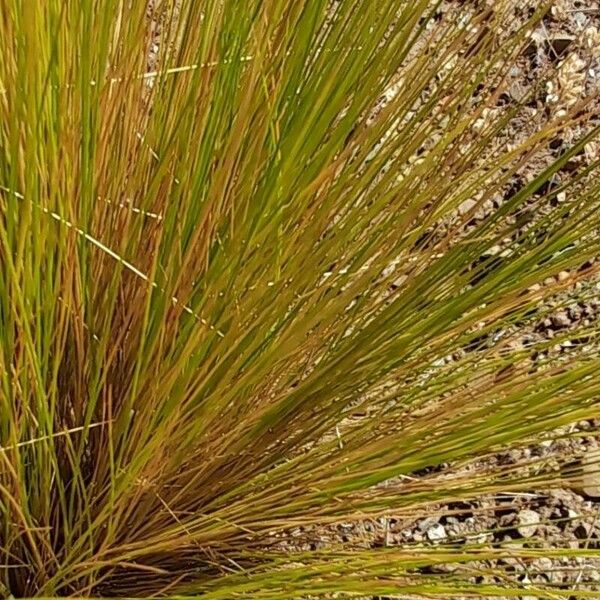
Plant Overview
Known as the Desert Needlegrass, Pappostipa speciosa is a rugged survivor of the Mojave and Sonoran deserts. Often resembling a shimmering, silvery fountain, this perennial bunchgrass creates a striking silhouette against the harsh, arid landscape. Historically, it was a vital resource for Indigenous peoples, who used its tough foliage for brushes and its seeds as a food source.
🔍 How to Identify
- 🌾 The Clump: It grows in dense, tidy tufts or "bunches," typically reaching about 1 to 2 feet in height.
- 🍃 Stiff Foliage: The leaf blades are narrow, stiff, and often rolled inward to conserve moisture, giving them a needle-like appearance.
- ✨ Feathery Awns: During its spring bloom, it produces spectacular silvery-white "tails" (awns) on its seeds that catch the light and wave gracefully in the wind.
🏡 In Your Garden
- 🏜️ Lean and Mean: This plant thrives on neglect. It prefers "lean" soil with very little organic matter; adding too much fertilizer or rich compost will actually cause the plant to become floppy and short-lived.
- 💤 Summer Dormancy: Unlike garden turf, Desert Needlegrass often goes dormant and turns a golden-straw color during the peak of summer heat. This is a survival mechanism, not a sign of death, and it will green up again when the weather cools or rains return.
⚠️ Safety & Toxicity
- 🟢 Status: Non-toxic but physically "sharp."
- 🐕 Pet Warning: The seeds are the primary concern. The "needles" are designed to drill into the ground, but they can just as easily become lodged in a dog’s paws, ears, or nostrils. If you have curious pets, it is best to trim the seed heads before they fully dry out and drop.
✨ Fun Fact
The twisted "tail" on the seed is a biological motor! It is hygroscopic, meaning it responds to changes in humidity. As the air dries and moistens, the tail twists and untwists, literally "screwing" the seed into the soil so it can plant itself without any help.

Detailed Care Instructions

Place in a bright room that is sun drenched almost all day. Or directly in a south-facing window.

Water-loving plants flourish in wet or sloppy soil and near ponds. The extensive root system enables these plants to absorb plenty of water. The surface of the soil should be kept moist at all times. Place your pot in a container filled with water to guarantee that plants get enough water. If the ground becomes dry, it is recommended that you water it well. Plants in smaller pots will need to be watered more frequently. Water the soil in which the plant is standing thoroughly using a watering can.








