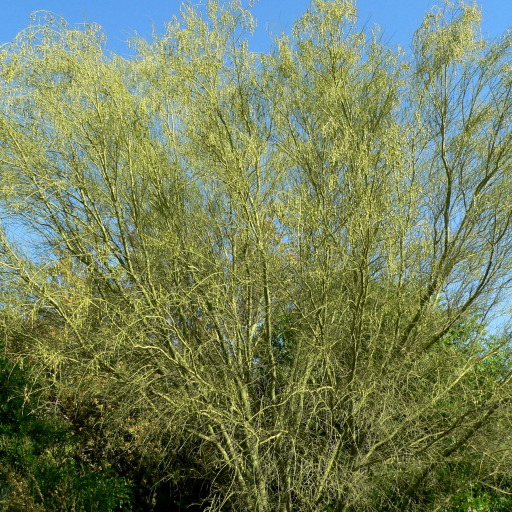
Plant Overview
Known as the "Yellow Palo Verde" or "Littleleaf Palo Verde," this sculptural desert survivor is a true icon of the Sonoran Desert. Its name, Palo Verde, translates from Spanish to "Green Stick," referencing its most striking feature: vibrant lime-green bark that actually performs photosynthesis. In late spring, the tree transforms into a glowing golden cloud of pale yellow blossoms, providing a vital feast for native bees and pollinators.
🔍 How to Identify
- 🟢 The Bark: Smooth, yellowish-green bark covers the entire tree, from the trunk to the smallest twigs, allowing it to grow even when it has no leaves.
- 🍃 Tiny Foliage: The species name microphylla means "small leaf." It produces microscopic, oval-shaped leaflets that are often shed during dry periods to conserve moisture.
- 🌼 Pale Blooms: Features clusters of delicate, pale-yellow flowers. If you look closely, one petal (the "banner" petal) is usually white or cream-colored.
- 🌵 Thorny Tips: The branches are stiff and intricate, with the smaller twigs ending in sharp, spine-like points.
🏡 In Your Garden
- ⛰️ Drainage is King: Unlike its cousin, the Blue Palo Verde, the Yellow Palo Verde prefers rocky slopes and "foothills." In a garden setting, it needs exceptionally well-draining soil and will struggle in heavy clay or low spots where water collects.
- ☀️ Drought Strategy: This tree is a master of "drought-deciduous" behavior. It will drop its leaves at the first sign of heat or water stress. Don't worry—this is a survival tactic, not a sign of death! The green bark keeps the tree fed until the rains return.
- ✂️ Slow & Steady: It is much slower growing and more compact than other Palo Verde species, making it an excellent choice for smaller xeriscape gardens or as a focal "living sculpture."
⚠️ Safety & Toxicity
- ✅ Non-Toxic: Parkinsonia microphylla is not known to be poisonous to humans, dogs, cats, or livestock.
- ⚔️ Physical Hazard: The main safety concern is its "armored" nature. The sharp, pointed branch tips can cause scratches or puncture wounds. It is best planted away from walkways, play areas, or narrow paths where people might brush against it.
✨ Fun Fact
Because its leaves are so tiny and drop off so quickly, the Yellow Palo Verde conducts up to 75% of its photosynthesis through its green bark! This allows the tree to produce energy during the blistering desert summer while keeping its "pores" closed to prevent water loss.

Detailed Care Instructions
Growing Parkinsonia microphylla, commonly known as the Littleleaf Palo Verde, can be a rewarding endeavor due to its striking green bark, delicate leaves, and yellow blossoms. Here's a step-by-step guide to help you successfully grow this drought-tolerant tree:
1. Seed Collection and Preparation:
- Timing: Collect seeds in late summer to early fall when the seed pods have dried on the tree.
- Cleaning: Remove seeds from the pods and let them dry if needed.
- Scarification: Since these seeds have a hard outer coat, gently scarify them by nicking the surface with a file or soaking them in warm water for 24 hours to aid germination.
2. Choosing a Planting Site:
- Sunlight: Select a location that receives full sun, as Parkinsonia microphylla thrives in bright, direct light.
- Soil: Opt for well-draining soil. Sandy or rocky soil types are ideal. It can tolerate poor soil, but good drainage is essential to prevent root rot.
- Space: Ensure enough space for the tree to grow, as it can reach up to 20 feet in height and spread.
3. Planting:
- Timing: The best time to plant seeds or young trees is in the early spring.
- Sowing Seeds: Plant the scarified seeds about 1 inch deep in the soil.
- Transplanting Seedlings: If you start with seedlings, dig a hole twice the width of the root ball. Place the seedling in the hole, ensuring the top of the root ball is level with the soil surface. Fill the hole with soil and gently tamp it down.
4. Watering:
- Establishment Phase: Water the newly planted seeds or seedlings thoroughly. Continue to water regularly, but allow the soil to dry out between watering sessions. This helps establish a deep root system.
- Established Trees: Once established, Parkinsonia microphylla requires minimal watering. It is highly drought-tolerant and can usually survive on natural rainfall.
5. Mulching:
- Apply a layer of mulch around the base of the plant to retain moisture, suppress weeds, and regulate soil temperature. Keep the mulch a few inches away from the trunk.
6. Fertilization:
- Generally, Parkinsonia microphylla does not need additional fertilization if planted in its native, nutrient-poor soils. However, if desired, a balanced, slow-release fertilizer can be applied during the growing season.
7. Pruning:
- Minimal pruning is needed. Remove any dead, damaged, or diseased branches, as well as any suckers that may emerge from the base. This can be done during late winter or early spring before new growth starts.
8. Pest and Disease Management:
- Parkinsonia microphylla is relatively pest-resistant. Occasionally, you may need to check for aphids or other common pests. Generally, they don't suffer from severe diseases.
9. Protection:
- In areas with the risk of frost, protect young plants with frost cloth or a similar covering during cold snaps.
By following these guidelines, you can successfully grow Parkinsonia microphylla and enjoy the natural beauty and benefits it brings. Remember that patience is key—it may take a few years for the tree to become fully established and start producing its characteristic flowers.
Watering Parkinsonia microphylla, a desert-adapted plant, requires careful attention to avoid overwatering while ensuring the plant still receives adequate moisture. These are the key steps and considerations:
- Initial Planting:
- When first planted, this species will need more consistent watering to help establish its root system. Water deeply and thoroughly during the first growing season.
- Watering frequency should be adjusted based on climate and soil type, with more frequent watering in sandy soils and less in heavier clay soils.
- When first planted, this species will need more consistent watering to help establish its root system. Water deeply and thoroughly during the first growing season.
- Watering Schedule:
- Establishment Period (First Year): Water the plant deeply once a week during its first growing season. Monitor the soil moisture and reduce the frequency if it rains.
- After Establishment: Once established (typically after one year), reduce watering. For mature plants, water every two to three weeks during the growing season (spring to early summer) and less frequently during the dormant season (late summer to winter).
- Establishment Period (First Year): Water the plant deeply once a week during its first growing season. Monitor the soil moisture and reduce the frequency if it rains.
- Soil and Drainage:
- Ensure the plant is in well-drained soil. It is highly adapted to desert conditions and prefers sandy or gritty soil types that do not retain water for long periods.
- Avoid heavy clay soils or amend them with sand or gravel to improve drainage.
- Ensure the plant is in well-drained soil. It is highly adapted to desert conditions and prefers sandy or gritty soil types that do not retain water for long periods.
- Watering Technique:
- Water deeply to encourage the development of deep roots. Surface watering can promote shallow root systems that are less drought-tolerant.
- Use a slow and steady flow of water to allow it to penetrate deeply. Drip irrigation or a soaker hose is ideal as it delivers water directly to the root zone with minimal runoff.
- Water deeply to encourage the development of deep roots. Surface watering can promote shallow root systems that are less drought-tolerant.
- Seasonal Adjustments:
- During the cooler, dormant periods of the year, significantly reduce watering. The plant has low water needs during this time and overwatering can lead to root rot or other issues.
- In extremely hot and dry conditions, additional watering might be necessary, but always let the soil dry out thoroughly before watering again.
- During the cooler, dormant periods of the year, significantly reduce watering. The plant has low water needs during this time and overwatering can lead to root rot or other issues.
- Monitoring:
- Check the soil moisture regularly. The top few inches of soil should be allowed to dry out between watering.
- Watch for signs of overwatering such as yellowing leaves and root rot or underwatering such as wilting and leaf drop.
By adhering to these practices and adjustments based on the plant’s specific environment, you can promote a healthy and thriving Parkinsonia microphylla.
- Check the soil moisture regularly. The top few inches of soil should be allowed to dry out between watering.
Here's how you can fertilize Parkinsonia microphylla:
- Timing: Fertilize during the growing season, typically from late winter to early summer. Avoid fertilizing in late summer or fall, as this can promote new growth that might not harden off before winter.
- Type of Fertilizer: Use a balanced, slow-release granular fertilizer with an N-P-K ratio around 10-10-10 or 14-14-14. Organic options, like compost or well-rotted manure, can also be beneficial.
- Application:
- For granular fertilizer, evenly spread it around the base of the plant, extending out to the drip line (the area under the outermost branches).
- Water the area thoroughly after application to help the fertilizer soak into the soil.
- Follow the dosage instructions on the fertilizer packaging, as over-fertilizing can harm the plant.
- For granular fertilizer, evenly spread it around the base of the plant, extending out to the drip line (the area under the outermost branches).
- Frequency: Typically, fertilize once in early spring and then again in early summer. Avoid over-fertilizing, as these plants are well-adapted to nutrient-poor soils.
- Monitoring: Keep an eye on the plant’s growth and overall health. Yellowing leaves or poor growth might indicate over-fertilization or the need for additional nutrients.
- Soil Testing: If you're unsure about nutrient levels or soil pH, consider getting a soil test. This can help tailor your fertilization approach more accurately to your soil’s needs.
By following these steps, you can support the healthy growth of Parkinsonia microphylla with appropriate fertilization.
Parkinsonia microphylla thrives best in well-drained soil conditions suitable for arid environments. Here are specific details regarding the ideal soil composition for this plant:
- Soil Type:
- Sandy Loam: A mix of sand, silt, and a little clay is preferable. Sandy loam provides excellent drainage while retaining necessary nutrients.
- Gravelly Soil: This type of soil also promotes good drainage, crucial for preventing root rot in arid-adapted plants.
- Sandy Loam: A mix of sand, silt, and a little clay is preferable. Sandy loam provides excellent drainage while retaining necessary nutrients.
- pH Level:
- The soil should be slightly alkaline to neutral, with a pH range of 7.0 to 8.5. This range helps in nutrient absorption and overall plant health.
- The soil should be slightly alkaline to neutral, with a pH range of 7.0 to 8.5. This range helps in nutrient absorption and overall plant health.
- Drainage:
- Proper drainage is vital. Avoid heavy clay soils that retain water, as this can lead to root diseases, particularly in plants adapted to low-water environments.
- Proper drainage is vital. Avoid heavy clay soils that retain water, as this can lead to root diseases, particularly in plants adapted to low-water environments.
- Nutrient Content:
- While Parkinsonia microphylla is not particularly demanding in terms of fertility, moderate organic content can support its growth. Adding a small amount of decomposed organic matter or compost can be beneficial, but over-fertilizing should be avoided.
- While Parkinsonia microphylla is not particularly demanding in terms of fertility, moderate organic content can support its growth. Adding a small amount of decomposed organic matter or compost can be beneficial, but over-fertilizing should be avoided.
- Aeration:
- The soil should be loose and well-aerated to promote healthy root systems. Compacted soil should be avoided as it can hinder root growth and water absorption.
- The soil should be loose and well-aerated to promote healthy root systems. Compacted soil should be avoided as it can hinder root growth and water absorption.
- Rock Mulch:
- In its native habitat, this species often benefits from a layer of rock mulch, which helps to retain moisture while preventing excessive water accumulation.
By ensuring these soil conditions, you can provide an optimal growing environment for Parkinsonia microphylla, helping it to thrive and display its characteristic foliage and flowers effectively.
- In its native habitat, this species often benefits from a layer of rock mulch, which helps to retain moisture while preventing excessive water accumulation.
Propagation of Parkinsonia microphylla can be accomplished through both seeds and cuttings. Here's a detailed guide on how to propagate it:
Propagating from Seeds:
- Seed Collection:
- Collect mature seeds from the plant, typically found in pods. Ensure the seeds are fully developed and have a hard, brownish color.
- Collect mature seeds from the plant, typically found in pods. Ensure the seeds are fully developed and have a hard, brownish color.
- Seed Preparation:
- Scarify the seeds: The seed coat is tough and might need to be scarified to improve germination rates. You can achieve this by lightly sanding the seed coat with fine sandpaper or nicking it with a knife. Be careful not to damage the embryo inside.
- Soak the seeds: After scarification, soak the seeds in warm water for 24 to 48 hours to hydrate them and help break dormancy.
- Scarify the seeds: The seed coat is tough and might need to be scarified to improve germination rates. You can achieve this by lightly sanding the seed coat with fine sandpaper or nicking it with a knife. Be careful not to damage the embryo inside.
- Planting:
- Use well-draining soil: A cactus or succulent mix is suitable, or you can create your own blend of sand, perlite, and potting soil.
- Plant the seeds about 1/2 inch deep in the soil.
- Water the soil lightly to settle it around the seeds.
- Use well-draining soil: A cactus or succulent mix is suitable, or you can create your own blend of sand, perlite, and potting soil.
- Germination:
- Place the pots in a warm, sunny location. Temperature around 70-85°F (21-29°C) is ideal.
- Keep the soil consistently moist but not waterlogged. Germination can take anywhere from a few days to a few weeks.
- Place the pots in a warm, sunny location. Temperature around 70-85°F (21-29°C) is ideal.
- Transplanting:
- Once seedlings are large enough to handle, and have at least a few sets of true leaves, transplant them into individual pots or directly into the ground if conditions permit.
- Choose a location with full sun and well-draining soil.
Propagating from Cuttings:
- Once seedlings are large enough to handle, and have at least a few sets of true leaves, transplant them into individual pots or directly into the ground if conditions permit.
- Cutting Selection:
- Select healthy, semi-hardwood cuttings from the plant. These should be about 4-6 inches long and taken from a mature, disease-free branch.
- Select healthy, semi-hardwood cuttings from the plant. These should be about 4-6 inches long and taken from a mature, disease-free branch.
- Preparation:
- Remove all leaves from the lower half of the cutting.
- Optionally, dip the cut end in rooting hormone to encourage root development.
- Remove all leaves from the lower half of the cutting.
- Planting:
- Plant the cutting in a pot filled with a well-draining soil mix, similar to that used for seed propagation.
- Insert the cutting about 2 inches deep into the soil.
- Plant the cutting in a pot filled with a well-draining soil mix, similar to that used for seed propagation.
- Care:
- Place the pot in a warm, shaded location initially.
- Keep the soil lightly moist but not saturated.
- After 4-6 weeks, the cuttings should develop roots. You can gently tug on the cutting to check if it is anchored by roots.
- Place the pot in a warm, shaded location initially.
- Transplanting:
- Once well-rooted, gradually acclimate the new plants to full sunlight.
- Transplant them into larger pots or into the ground in a sunny, well-draining area.
By following these steps, you can successfully propagate Parkinsonia microphylla and enjoy the growth of new plants.
- Once well-rooted, gradually acclimate the new plants to full sunlight.








