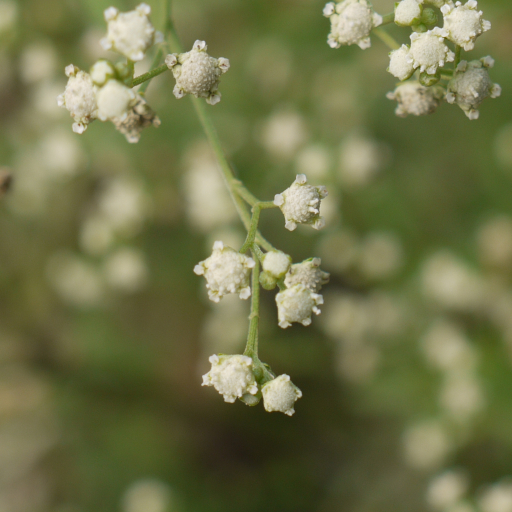
Plant Overview
Known as the "Whitetop Weed" or "Carrot Grass," this plant is a notorious globetrotter with a bit of a villainous reputation. While its clusters of tiny white flowers look like delicate lace, it is often referred to as "Famine Weed" because of its aggressive ability to invade crop fields and native bushland. Originally from the American tropics, it has now spread to almost every corner of the globe.
🔍 How to Identify
- 🌿 The Foliage: The leaves are pale green and deeply lobed, bearing a striking resemblance to carrot leaves or ragweed. They are covered in fine, soft hairs that give the plant a slightly greyish tint.
- 🌼 The Flowers: It produces masses of small, creamy-white flower heads (about 4-5mm across). If you look closely, each flower has five distinct corners, making it look like a tiny, fuzzy star.
- 📏 The Stem: The plant grows upright and branched, featuring a tough, grooved stem with longitudinal lines. As it matures, the base of the stem can become quite woody.
🏡 In Your Garden
- 🚫 An Unwanted Guest: You won't find this plant in a nursery; it usually arrives uninvited in contaminated soil, birdseed, or hay. Because it thrives in disturbed ground, it is often the first thing to grow after a patch of soil has been cleared.
- 🧪 Chemical Warfare: Parthenium is "allelopathic," meaning it releases specialized chemicals into the soil from its roots. These chemicals act like a natural herbicide, killing off or stunting the growth of neighboring plants so it can have the space all to itself.
⚠️ Safety & Toxicity
- 🚨 Severe Allergen: This plant is a major health hazard for many people. The pollen and the hairs on the leaves contain "parthenin," which causes severe respiratory issues and "Parthenium dermatitis"—a painful, itchy skin rash.
- 🐾 Toxic to Animals: It is highly toxic to livestock, particularly cattle and horses, and can taint the milk or meat of animals that graze on it. Keep pets away, and if you must remove it from your garden, always wear long sleeves, gloves, and a face mask to avoid inhaling the pollen.
✨ Fun Fact
Parthenium is a master of survival; a single, healthy plant can produce up to 25,000 seeds in its short lifetime. These seeds are so hardy they can survive in the soil for years, just waiting for a drop of rain to trigger a massive takeover!

Detailed Care Instructions
To grow Parthenium hysterophorus plant, follow these steps:
- Obtain seeds or seedlings: You can purchase Parthenium hysterophorus seeds or young plants from a local nursery or online store.
- Choose a suitable location: Parthenium hysterophorus requires full sun to partial shade. Select a location that receives at least 4-6 hours of direct sunlight each day.
- Prepare the soil: The plant prefers well-draining, fertile soil. Prior to planting, loosen the soil and remove any weeds or rocks. You can also add organic matter like compost or well-rotted manure to improve soil fertility.
- Sow the seeds or plant the seedlings: If you have seeds, scatter them lightly on the prepared soil, ensuring they are not buried too deeply. For seedlings, dig holes slightly larger than the root ball and gently place them in the holes, firming the soil around them.
- Water regularly: Parthenium hysterophorus plants require regular watering, especially during the initial establishment period. Water deeply but avoid overwatering, as it can lead to root rot.
- Provide adequate space: Space the plants about 12-18 inches apart to allow for proper growth and air circulation.
- Mulch the soil: Apply a layer of organic mulch around the plants to help retain soil moisture, suppress weed growth, and regulate soil temperature.
- Prune regularly: Parthenium hysterophorus can become invasive if left uncontrolled. Regularly prune back the plant to prevent it from spreading and maintain its shape. Dispose of the pruned material properly to prevent its accidental spread.
- Fertilize as needed: Monitor the plant for any nutrient deficiencies and apply a balanced, slow-release fertilizer according to the package instructions. Generally, a balanced fertilizer with an N-P-K ratio of 10-10-10 or similar will suffice.
- Monitor for pests and diseases: Keep an eye out for common pests and diseases that may affect Parthenium hysterophorus, such as aphids, powdery mildew, or rust. Treat with appropriate organic or chemical control methods if necessary.
Remember to check local regulations and invasive species listings before planting Parthenium hysterophorus, as it can be invasive in certain regions.

Place in a bright room that is sun drenched almost all day. Or directly in a south-facing window.

Parthenium Hysterophorus plant should be watered regularly, but not overwatered as it can lead to root rot. Before watering, check the soil to ensure it is damp but not waterlogged. Water the plant at the base, making sure the water reaches the roots. Avoid getting water on the leaves as it can encourage fungal growth. During the winter months, reduce watering to prevent the soil from becoming too moist. It is important to provide good drainage for the plant, either by using well-draining soil or adding perlite or sand to the soil mix.
To fertilize this plant, use a balanced fertilizer with equal amounts of nitrogen, phosphorous, and potassium. Apply the fertilizer once a month during the growing season, starting in early spring and ending in early fall. Be careful not to over-fertilize, as this can harm the plant. Water the plant well before and after fertilizing.
The ideal soil to use for this plant should be well-draining with a slightly acidic pH level. It should also be rich in nutrients and organic matter, such as compost, to support healthy growth and development. Additionally, the soil should not be compacted, as this can limit the plant's ability to absorb water and nutrients. It is best to avoid using soil that is contaminated with pollutants or heavy metals, as this can negatively impact the plant's health and potentially harm human health if consumed or handled. Regular watering and fertilization can also help maintain optimal soil conditions and support healthy growth.
To propagate this plant, first identify a mature healthy plant and select a stem that has not yet flowered. Using a sharp knife or scissors, cut the stem at a 45-degree angle. Remove any leaves from the bottom half of the stem and dip it into a rooting hormone powder. Plant the stem cutting in a pot of well-draining soil and water thoroughly. Place the pot in a location with indirect sunlight and mist the cutting daily to keep the soil moist. After a few weeks, roots should begin to form and new growth will emerge from the stem cutting. Once the cutting has established roots, it can be transplanted to a larger pot or into the ground.








