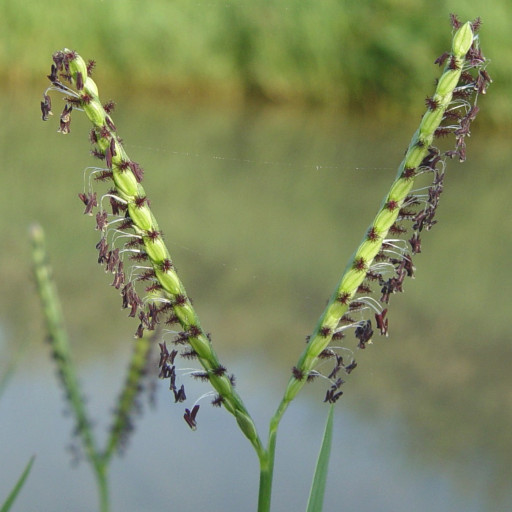
Plant Overview
Often called "Water Couch" or "Knotgrass," this resilient traveler is a master of the shoreline and the soggy meadow. While some gardeners view its stubborn persistence as a challenge, it is a vital ecological player in preventing soil erosion along riverbanks. Its ability to "crawl" across the ground and root at every joint makes it a formidable survivor in the plant world.
🔍 How to Identify
- 🌿 Leaf Blades: The leaves are smooth, bluish-green, and taper to a sharp point. They are typically flat but can appear slightly folded near the base.
- 🌾 The "V" Spike: The most distinct feature is the flowering head, which almost always splits into exactly two branches, forming a perfect "V" shape at the top of the stem.
- 🧬 Creeping Stems: It spreads via "runners" (stolons and rhizomes) that root at every "knot" or node, creating a dense, carpet-like mat that feels springy underfoot.
🏡 In Your Garden
- 💧 Wet Feet Specialist: This grass is semi-aquatic. If you have a low-lying, soggy patch in your yard where traditional turf dies off, Knotgrass will likely flourish there without any help.
- 🧱 Natural Anchor: Because it forms such thick underground networks, it is an excellent choice for stabilizing pond edges or slopes that are prone to washing away during heavy rain.
- ✂️ Hard to Evict: If you decide to remove it, beware: its "knotty" nature means that even a tiny fragment of a stem left in the soil can regenerate into a full-sized plant.
⚠️ Safety & Toxicity
- 🐾 Pet Friendly: The grass itself is non-toxic to cats, dogs, and horses. It is often used as forage for livestock.
- 🍄 Fungal Watch: In very humid conditions, the seed heads can occasionally be infected by Claviceps (ergot) fungi. While the plant is safe, you should prevent pets or livestock from eating blackened or sticky-looking seed spikes.
- 🧒 Kid Safe: It is perfectly safe for children to play on, though its thick mats can occasionally become a trip hazard for small feet.
✨ Fun Fact
Knotgrass is a "halophyte," meaning it is incredibly salt-tolerant. It can actually survive being temporarily submerged in brackish or salty coastal waters, a feat that would kill most common lawn grasses in a matter of hours!

Detailed Care Instructions
To grow Paspalum Distichum, also known as water paspalum or knotgrass, follow these steps:
- Climate and soil requirements: Paspalum Distichum grows best in tropical or subtropical regions, with temperatures between 70°F to 95°F (21°C to 35°C). It prefers wet or marshy areas, as it is a water-loving plant. The soil should be rich in organic matter and have good drainage.
- Seeds and propagation: You can obtain Paspalum Distichum seeds from a reputable seed supplier or collect them from established plants. Soak the seeds in water for 24 hours before sowing.
- Planting: Start by preparing the planting area. Clear any existing weeds or grass and make sure the soil is loose and well-drained. If necessary, improve the soil quality by adding organic matter such as compost. Create furrows or trenches about 1/2 inch deep and sow the seeds evenly along the furrows, spacing them about 1 inch apart.
- Watering: After sowing the seeds, maintain a consistently moist environment. This can be achieved by regular watering or by planting the Paspalum Distichum seeds in a waterlogged area, such as along the banks of a pond or lake. Ensure that the water level does not submerge the seeds completely.
- Light requirements: Paspalum Distichum prefers full sun but can tolerate some shade. Ensure the planting area receives at least 6 hours of direct sunlight per day.
- Maintenance: Keep the planting area free of weeds that might compete with the Paspalum Distichum for nutrients and moisture. Regularly check for pests and diseases, and take appropriate measures if necessary.
- Harvesting: Depending on the purpose of growing Paspalum Distichum, you can allow it to grow to maturity and produce seeds or trim it to a desired height for ornamental purposes.
Remember that Paspalum Distichum is a vigorous grower, and excessive growth can become invasive in certain areas. If you're not growing it in a controlled environment, such as a landscape or garden, make sure to monitor its growth to prevent it from spreading uncontrollably.

Place in a bright room that is sun drenched almost all day. Or directly in a south-facing window.

To properly water this plant, you should aim to keep the soil evenly moist without allowing it to become waterlogged. This can be achieved by watering deeply once or twice per week, depending on weather conditions and the moisture level of the soil. It is important to water at the base of the plant, rather than from above, to avoid wetting the foliage and potentially causing disease. In addition, it is recommended to use a watering can or soaker hose for more precise, targeted watering rather than a sprinkler. Monitoring the soil moisture level and adjusting watering frequency as needed is key to the plant's health and growth.
To fertilize this plant, apply a balanced fertilizer with equal parts nitrogen, phosphorous, and potassium in the ratio of 1:1:1. Apply the fertilizer in spring or early summer, when the plant is actively growing. Use a rate of approximately 1 tablespoon of fertilizer per square foot of plant area. Water the fertilizer in thoroughly after application. Repeat the fertilization process every 6-8 weeks during the growing season.
Paspalum Distichum plant requires soil that has a neutral to slightly acidic pH level, with good drainage capability to prevent waterlogging and excessive moisture accumulation. The soil should be rich in organic matter, with a high nutrient value, and free from contaminants or pollutants. It should also have good aeration characteristics, allowing sufficient air circulation to the roots. A sandy loam soil type with high water-holding capacity is ideal for growing this plant. Additionally, regular monitoring of the soil moisture content is essential as the plant requires a consistent level of moisture in the soil. Adding fertilizers or organic amendments can enhance the soil quality and boost the plant's growth rate.
Propagation of this plant can be accomplished through several methods, including seed propagation, division of established clumps, and stem cuttings. For seed propagation, the seeds can be sown in well-draining soil in a warm, moist location. Alternatively, established clumps of the plant can be divided into smaller sections and planted in a new location. Stem cuttings can also be taken from the plant and propagated in water or soil. It is important to keep the cuttings moist and warm until new roots and shoots begin to form. With proper care and attention, these methods can result in successful propagation of the Paspalum Distichum plant.








