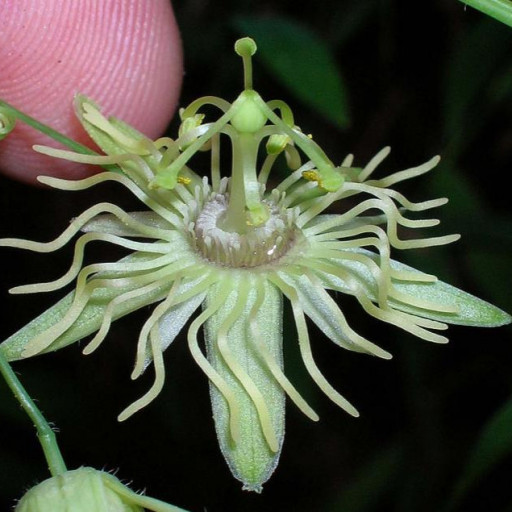
Plant Overview
Often called the Yellow Passionflower, Passiflora lutea is the subtle, understated relative of the more flamboyant tropical passion vines. While its flowers are smaller and more delicate than its "showy" cousins, its pale lime-colored blooms have an intricate, geometric beauty that rewards those who look closely. Native to the woodlands of North America, it acts as a vital bridge for local biodiversity, especially for those seeking to support native pollinators.
🔍 How to Identify
- 🍃 The Foliage: Look for distinctive three-lobed leaves that are often broader than they are long, featuring smooth edges and a somewhat blunt, rounded shape at the tips.
- 🌼 The Bloom: The flowers are dainty (about the size of a quarter) and feature a unique fringe of thread-like filaments in shades of pale yellow or chartreuse, appearing from early summer to fall.
- 🌀 Growth Habit: This is a slender, herbaceous climber that uses thin, wiry tendrils to hoist itself up fences, shrubs, or nearby trellises without becoming overly aggressive.
🏡 In Your Garden
- 🦋 Butterfly Buffet: This plant is a primary host for several beautiful butterflies, including the Gulf Fritillary and the Zebra Longwing. Don't be alarmed if you see caterpillars munching the leaves—it’s a sign your garden is a thriving habitat!
- 🌳 The Shy Climber: Unlike many sun-loving passionflowers, Passiflora lutea thrives in the dappled light of woodland edges. It is an excellent choice for those tricky "part-shade" spots in your yard where other flowering vines might refuse to bloom.
- 🌱 Root Resilience: Once established, it develops a deep root system that helps it return year after year, even after a hard freeze, though it can be slow to emerge in the spring.
⚠️ Safety & Toxicity
- 🚫 Inedible Fruit: While some species of passionfruit are famous for their juice, the small, dark purple-black berries of this native vine are not considered edible for humans and may cause digestive distress.
- 🐾 Pet Caution: The foliage contains cyanogenic glycosides, which can be toxic to dogs, cats, and livestock if consumed in significant quantities. It is best treated as an ornamental plant only.
✨ Fun Fact
Despite its delicate, tropical appearance, Passiflora lutea is one of the hardiest passionflowers in existence. It is the northernmost species of its genus, capable of surviving chilly winters as far north as Pennsylvania and Illinois by retreating into its roots until the warmth of summer returns!

Detailed Care Instructions
To grow a Passiflora Lutea plant, also known as the Yellow Passionflower, follow these steps:
- Choose a suitable location: Select a spot that receives full sun or partial shade during the day. The Yellow Passionflower can tolerate a wide range of soils but prefers well-draining, fertile soil.
- Planting: Dig a hole that is slightly larger than the root ball of the plant. Place the Passiflora Lutea plant in the hole and backfill it with soil, ensuring that the top of the root ball is level with the soil surface. Gently pat down the soil to stabilize the plant.
- Watering: Water the plant thoroughly after planting and continue to water regularly to keep the soil consistently moist. However, ensure that the soil is not waterlogged as excessive moisture can cause root rot.
- Mulching: Apply a layer of organic mulch around the base of the plant to help retain moisture, suppress weed growth, and regulate soil temperature.
- Fertilizing: Fertilize the plant with a balanced, slow-release fertilizer in spring and mid-summer to provide essential nutrients. Follow the manufacturer's instructions for the specific fertilizer you are using.
- Pruning: Passiflora Lutea generally requires minimal pruning. However, you can prune lightly after the flowering period to remove any dead or damaged growth and to maintain a desired shape.
- Support: Install a trellis, arbor, or other support structure near the plant to facilitate its climbing habit. The Yellow Passionflower is a vigorous climber that can grow up to 15 feet in height, so providing support is important for its growth.
- Pest and disease control: Monitor the plant regularly for any signs of pests or diseases, such as aphids, scale insects, or fungal infections. Treat any issues promptly using appropriate organic or chemical control methods.
- Propagation: Passiflora Lutea can be propagated through seed or by taking stem cuttings. Collect ripe seeds from the fruit and sow them in a well-draining seed-starting mix. Keep the soil consistently moist until germination occurs. Stem cuttings can be taken in spring or summer and rooted in a moist growing medium.
- Overwintering: In areas with frost or cold winters, protect the Passiflora Lutea during the winter months by applying a layer of mulch around the base of the plant and covering it with burlap or a frost cloth.
With proper care and maintenance, your Passiflora Lutea plant should grow, flower, and produce attractive, yellow fruits.

Place in a bright room that is sun drenched almost all day. Or directly in a south-facing window.

In order to water Passiflora Lutea properly, you should first assess the moisture level of the soil by inserting your finger about an inch deep into the soil. If the soil is dry at that depth, it is time to water. When watering, be sure to give the plant enough water to saturate the soil, but avoid over-watering as this can lead to root rot. It is also important to allow the soil to dry out a bit between watering to prevent waterlogged roots. Finally, it is best to water the plant in the morning to avoid potential fungal growth overnight.
To properly fertilize this plant, apply a balanced fertilizer during the growing season. Use a slow-release fertilizer and apply it in small quantities throughout the summer months. Be sure not to over-fertilize as this can damage the plant. It is important to water the plant well before and after fertilizing to ensure the nutrients are properly absorbed. Remember to follow the manufacturer's instructions carefully and avoid fertilizing during the dormant period.
Passiflora Lutea prefers a well-draining soil that is rich in nutrients. A soil with high organic matter content is ideal for this plant as it helps retain moisture while also providing nutrients for the roots. The pH level of the soil should be slightly acidic to neutral, ranging from 5.5 to 7.0. This plant can grow in sandy, clay or loamy soils, but it prefers a mix of all three. The soil should be moist but not waterlogged, as this can lead to root rot. Adding perlite or vermiculite to the soil can improve drainage and aeration. It is also recommended to fertilize the plant regularly with a balanced fertilizer to ensure healthy growth and blooming.
Passiflora Lutea plant can be propagated by taking stem cuttings from a mature and healthy plant. The stem cuttings should be about 4-6 inches in length and should have at least two or three nodes. The cuttings should be taken in the early spring, just before new growth appears.
After taking the cuttings, remove the leaves from the lower half of the stem and dip the cut end in rooting hormone powder. Then, plant the cuttings in a well-draining, moist potting mix, and place them in a warm, humid place to encourage rooting.
It is important to keep the soil consistently moist until the cuttings have rooted and developed new growth. Once the new growth appears, gradually ease the cuttings into more light and less humidity to acclimate them to their new environment.
Propagation by seed is also possible, but it can take longer and is less reliable than propagation by stem cuttings. To propagate by seed, harvest the ripe fruit and soak the seeds in water for 24 hours. Sow the seeds in a well-draining potting mix and keep them moist and warm until they germinate.








