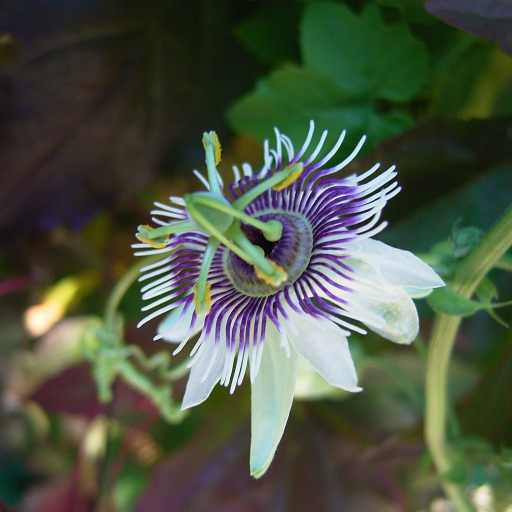
Plant Overview
Often called the Woodland Passionflower or the Mulberry-leaf Passionflower, Passiflora morifolia is a delicate, fast-growing vine that brings a touch of the South American rainforest to your home. Unlike its larger, flashier cousins, this species is loved for its dainty, intricate flowers and its unique foliage that mimics the shape of a mulberry leaf. In folklore, passionflowers are often associated with peace and the "Passion of the Christ," but to a gardener, this plant is simply a vigorous climber that loves to reach for the sky.
🔍 How to Identify
- 🍃 The Foliage: Its leaves are soft, hairy, and usually have three distinct lobes, bearing a striking resemblance to the leaves of a mulberry tree (Morus), which gives the plant its name.
- 🌸 The Bloom: The flowers are small—about an inch wide—featuring white petals and a stunning "crown" of filaments striped with purple and blue.
- 🍇 The Fruit: After flowering, it produces small, spherical berries that turn a deep, dark purple or black when ripe, looking much like wild grapes.
🏡 In Your Garden
- 🧗 The Climber: This plant is a "leaner" and a "leaper." It uses its curly tendrils to hitch a ride on trellises, fences, or neighboring shrubs. It needs a support structure to prevent it from becoming a tangled ground cover.
- 🦋 Wildlife Magnet: It is a vital host plant for several butterfly species, including the Gulf Fritillary. If you see tiny orange caterpillars munching on the leaves, don’t reach for the pesticide—you’re hosting a future butterfly sanctuary!
- 💧 Thirst for Humidity: While it’s quite hardy, it hates dry air. If growing indoors, a pebble tray or a regular misting will keep the foliage from browning at the edges.
⚠️ Safety & Toxicity
- 🐾 Status: Generally considered toxic to pets and humans if ingested in large quantities.
- 🤢 Details: Like many members of the Passiflora genus, the leaves and unripe fruit can contain cyanogenic glycosides. Keep this vine out of reach of curious cats, dogs, and toddlers who might be tempted by the grape-like berries.
✨ Fun Fact
- 🧬 Self-Starter: Unlike many other passionflowers that require a partner for pollination, Passiflora morifolia is often self-fertile, meaning a single plant can produce seeds and berries all on its own!

Detailed Care Instructions
To grow Passiflora Morifolia (also known as banana passionfruit), you can follow these steps:
- Obtain seeds or plant. You can either purchase Passiflora Morifolia seeds online or at a local nursery. Alternatively, you can propagate the plant from cuttings or division.
- Prepare the soil. Choose a well-draining soil mix that is rich in organic matter. Banana passionfruit prefers slightly acidic soil with a pH range of 6.0-6.5. Ensure the soil is loosened and free from weeds.
- Sow the seeds or plant the cutting/division. If starting from seeds, soak them in warm water overnight before sowing. Plant the seeds 1/4 inch deep in the prepared soil or place the cutting/division into the ground.
- Provide proper light conditions. Banana passionfruit enjoys full sun to partial shade. Ensure the plant receives at least 6-8 hours of direct sunlight daily.
- Watering and moisture. Keep the soil consistently moist but not waterlogged. Regularly water the plant, especially during dry periods or in summer. However, avoid over-watering as it may lead to root rot.
- Mulching. Apply a layer of organic mulch around the base of the plant to retain moisture and suppress weeds.
- Fertilization. Feed the Passiflora Morifolia plant with a balanced fertilizer once every month during the growing season (spring and summer). Follow the instructions on the fertilizer package for the correct dosage.
- Provide support. Banana passionfruit is a vigorous vine that may require support as it grows. Install trellises, fences, or other sturdy structures for the plant to climb and sprawl. This will also help to promote better air circulation.
- Pruning. Trim the plant to maintain its shape and to remove any dead, damaged, or diseased branches. Pruning can be done in early spring before new growth begins.
- Pest and disease control. Monitor the plant regularly for any signs of pests or diseases. Common issues may include aphids, whiteflies, or powdery mildew. Use organic pest control methods or consult with a local gardening expert if needed.
- Harvest the fruit. Depending on the specific Passiflora Morifolia variety, the fruit may start to ripen within 4-6 months after planting. Harvest the banana passionfruit when the skin turns yellow or orange and it feels slightly soft to the touch. Cut the fruit from the vine with a sharp knife or pruners.
Remember to research and understand the specific needs of the Passiflora Morifolia variety you are growing, as some variations may have specific requirements.

Place in a bright room that is sun drenched almost all day. Or directly in a south-facing window.

Passiflora Morifolia plants require regular and consistent watering to ensure healthy growth. The sufficient amount of water required by the plant will depend on the climate and humidity in its growing environment. Generally, Passiflora Morifolia requires more water in the summer months when temperatures are higher and the air is drier. To determine when the plant needs to be watered, check the soil around the base of the plant regularly. If the soil feels dry to the touch, it is time to water. When watering the plant, ensure that the water is evenly distributed around the base of the plant and that the water is reaching the roots. Avoid overwatering the plant, as this can lead to waterlogged soil and ultimately damage the roots. In addition, it is recommended to provide drainage holes in the container or pot where the Passiflora Morifolia is planted to prevent water from accumulating and causing root rot.
To fertilize this plant, you should use a well-balanced fertilizer with equal amounts of nitrogen, phosphorus, and potassium. You can apply the fertilizer every two weeks during the growing season, and reduce the frequency to once a month during the winter months. Dilute the fertilizer to half strength and sprinkle it around the base of the plant, being careful not to get any on the leaves. Water thoroughly after fertilizing to help the nutrients reach the roots. Additionally, you can use organic fertilizers such as fish emulsion or compost tea alternatively.
The recommended soil for Passiflora Morifolia is a well-draining, neutral to slightly acidic soil with plenty of organic matter. A mixture of peat moss, perlite, and vermiculite or a commercial potting soil designed for acid-loving plants can be used. The soil should have good moisture retention but not be waterlogged as the plant is susceptible to root rot. The addition of sand or grit can improve drainage. The plant does not require heavy fertilization, and regular applications of a balanced fertilizer during the growing season should suffice.
To propagate this specific plant, you will need to start by collecting seeds. Once you have the seeds, you will need to soak them in water for several hours to help soften the seed coat and improve germination rates. After soaking, you can plant the seeds in a well-draining potting mix and cover with a thin layer of soil. Keep the soil moist, but not waterlogged, and provide bright, indirect light.
As the seedlings emerge, you can transplant them into individual pots and continue to care for them as they grow. Alternatively, you can propagate this plant from stem cuttings. To do so, take a 6-8 inch cutting from a healthy, mature plant, making sure that the cutting has at least one leaf and a node. Remove any leaves that would be below the soil and dip the cut end of the stem into rooting hormone. Plant the cutting in a well-draining potting mix, cover with plastic to create a mini greenhouse, and keep the soil moist and in bright, indirect light.
With proper care, both seedlings and stem cuttings will grow into mature plants that can be enjoyed for years to come.








