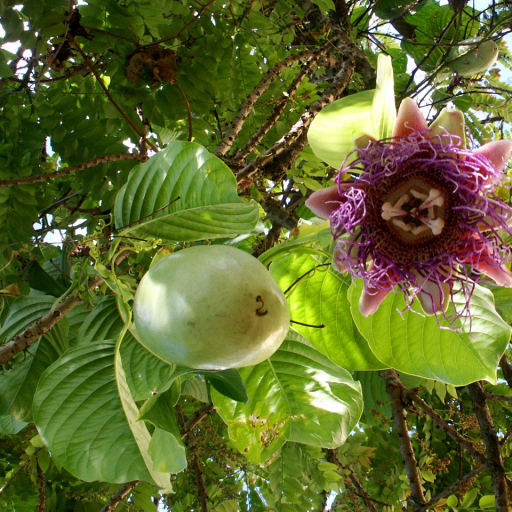
Plant Overview
Known as the Giant Granadilla, this vine is the undisputed titan of the passionflower family. While most passionfruits are the size of an egg, this species produces fruit as large as a melon. With its square-angled stems and massive, intricate blooms, it’s a tropical showstopper that looks like it stepped straight out of a botanical fairy tale.
🔍 How to Identify
- 🟥 Square Stems: Unlike its round-stemmed cousins, the stems are distinctly four-angled and "winged," giving the plant its species name quadrangularis.
- 🌸 Ornate Blooms: The flowers are massive, reaching up to 5 inches across, featuring a crown of wavy, purple-and-white striped filaments that look like tiny sea anemones.
- 🍃 Broad Foliage: The leaves are large, glossy, and heart-shaped, lacking the deep lobes found on most other passion vines.
🏡 In Your Garden
- 🏗️ Heavyweight Climber: Because the fruit can grow up to 12 inches long and weigh several pounds, this vine requires a very sturdy pergola or fence. A flimsy trellis will likely collapse under the weight of a mature harvest.
- 💧 Thirsty & Hungry: This is a high-energy plant. It thrives in humid, tropical conditions and needs consistent moisture and rich organic compost to fuel its rapid growth and massive fruit production.
⚠️ Safety & Toxicity
- 🟢 Safe Fruit, Cautious Foliage: The fully ripe fruit pulp is edible and delicious, often used in juices and desserts.
- 🐾 Pet Warning: Like many members of the Passiflora genus, the leaves and roots contain cyanogenic glycosides. While bitter, they can be toxic to dogs, cats, and livestock if consumed in large quantities.
✨ Fun Fact
In some tropical regions, the Giant Granadilla is known as the "Vegetable Marrow." While most people wait for the fruit to ripen for its sweet pulp, the unripened green fruit is often boiled and eaten as a savory vegetable, similar to a squash or gourd!

Detailed Care Instructions
To grow Passiflora quadrangularis, also known as giant granadilla or barbadine, follow these steps:
- Climate: Ensure you live in a suitable climate for growing Passiflora quadrangularis. It prefers tropical to subtropical regions with temperatures between 20-30°C (68-86°F).
- Soil: Use well-draining soil with a pH range of 6.0 to 7.5. Amend the soil with compost or organic matter to improve its fertility.
- Planting: Select a sunny location for planting. Dig a hole that is twice the size of the plant's root ball. Place the plant in the hole, backfill with soil, and water well. Space multiple plants at least 10 feet apart, as they can be invasive.
- Support: As Passiflora quadrangularis is a climbing vine, provide sturdy support for it to grow on, such as a trellis, arbor, or fence. The plant can grow up to 30 feet in length.
- Watering: Water the plant regularly, keeping the soil moist but not waterlogged. During the growing season, water deeply once or twice a week, adjusting the frequency based on the weather conditions.
- Fertilization: Apply a balanced fertilizer high in phosphorus (such as a 10-10-10 or 14-14-14 ratio) every six to eight weeks during the growing season to promote healthy growth.
- Pruning: Prune the plant to shape it and control its growth. Remove any dead or diseased branches. Additionally, trimming it back in late winter or early spring can help stimulate new growth.
- Pollination: Passiflora quadrangularis requires cross-pollination to set fruit. Encourage pollinators like bees and butterflies to visit your garden by planting other flowering plants nearby.
- Pest and disease control: Keep an eye out for pests like aphids, spider mites, and whiteflies. Use organic insecticides or horticultural oils to control infestations if necessary. Prevent diseases by ensuring good air circulation around the plant and avoiding overwatering.
- Harvesting: The fruit of Passiflora quadrangularis can take 80-100 days to ripen. Harvest the fruit when it turns yellow and starts to soften. Some varieties may also fall off naturally when ripe.
Following these steps should help you successfully grow Passiflora quadrangularis. Remember to be patient, as the plant can take a few years to establish and start producing fruit.

Place in a bright room that is sun drenched almost all day. Or directly in a south-facing window.

To water this particular plant, begin by checking the soil moisture level. Insert your finger into the soil, about an inch deep. If the soil feels dry, it is time to water the plant. However, if the soil is still moist, wait a day or two before watering again. When watering, avoid getting water on the leaves and flowers as they are delicate and can easily bruise or become damaged. Use room temperature water, and water thoroughly until the excess drains out of the bottom of the pot. It is important not to let Passiflora Quadrangularis dry out completely, but also to avoid overwatering as this can lead to root rot. Aim to keep the soil evenly moist, but not waterlogged.
To fertilize this plant, use a general-purpose fertilizer and apply it every two weeks during the growing season. Dilute the fertilizer to half strength and water the plant thoroughly after fertilizing to prevent root burn. Avoid over-fertilizing, which can lead to excessive growth and weak stems. Instead, use a slow-release fertilizer or organic compost to provide nutrients gradually over time.
Passiflora Quadrangularis plant prefers a well-draining soil mix that is slightly acidic to neutral in pH. The soil should have good structure and be able to hold some moisture but not remain waterlogged, as this can lead to root rot. A blend of peat moss, perlite, and vermiculite can make an ideal growing medium. Compost or other organic matter can also help to add nutrients to the soil. It is important to avoid using heavy soils or those that are too sandy, as they can dry out too quickly or retain too much moisture, respectively. Regular watering and fertilization can also help to sustain healthy plant growth.
To propagate this plant, take a cutting of a section of stem that has nodes and leaves. Remove the lower leaves and dip the cut end in rooting hormone. Plant the cutting in a pot filled with moist soil and keep it in a warm, humid place with indirect light. Water the cutting regularly, making sure the soil does not become too wet or too dry. Over time, the cutting will develop roots and can be transplanted to a larger pot or into the ground.








