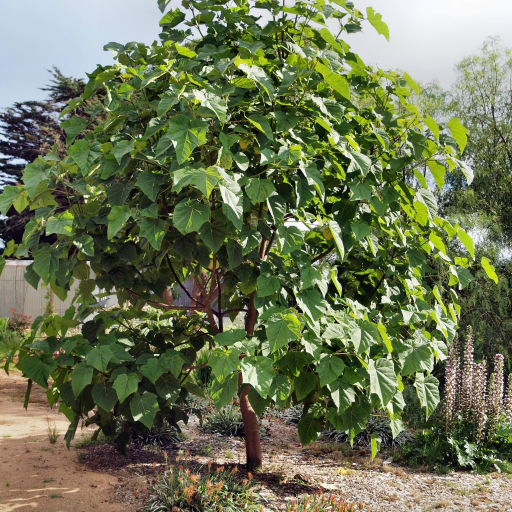
Plant Overview
Known as the "Sapphire Dragon Tree," this fast-growing marvel hails from the misty forests of Taiwan. It is famous for its breathtaking spring display, where leafless branches are completely smothered in fragrant, lavender-hued blossoms. While it grows at an astonishing speed, it carries an air of ancient elegance that has inspired East Asian art and folklore for centuries.
🔍 How to Identify
- 🪻 The Blooms: Large, bell-shaped flowers in shades of pale violet or sapphire blue. They grow in upright, conical clusters and appear in mid-spring before the leaves emerge.
- 🍃 The Foliage: Massive, heart-shaped (cordate) leaves that can reach up to 12 inches across. They are soft to the touch, covered in a fine, velvety down.
- 🪵 The Bark: The trunk is relatively smooth and grey-brown, developing light vertical furrows as the tree reaches its impressive mature height.
🏡 In Your Garden
- 🚀 Fast-Track Growth: This tree is a "pioneer species," meaning it grows incredibly quickly. Because it develops a deep, stubborn taproot early on, it hates being transplanted; pick its forever home carefully.
- 🌬️ Wind Shelter: Because those giant leaves act like sails, the branches can be prone to breakage in high winds. Plant it in a spot that offers some protection from heavy gusts to keep the canopy intact.
- ☀️ Sun Seeker: To produce that iconic "sapphire" cloud of flowers, the tree requires full sun. In shade, it may become "leggy" and focus on leaf production rather than blooming.
⚠️ Safety & Toxicity
- ✅ Status: Generally non-toxic.
- 🐾 Details: The Sapphire Dragon Tree is considered safe for humans, dogs, and cats. However, the large leaves and heavy flower drop can create a slippery surface on patios or "suffocate" smaller ground-cover plants if not cleared.
✨ Fun Fact
In many East Asian traditions, a Paulownia tree was planted when a daughter was born. Because the tree grows so rapidly, it would be mature enough by her wedding day to be harvested and crafted into a beautiful dowry chest for her new home.

Detailed Care Instructions
Growing Paulownia Kawakamii plants requires proper planning and care. Here is a step-by-step guide to help you grow them effectively:
- Choose the right location: Find a sunny spot in your garden with well-draining soil. Paulownia Kawakamii plants thrive in full sun exposure, although they can tolerate partial shade.
- Prepare the soil: Ensure that the soil is fertile, loamy, and well-drained. If needed, amend the soil with compost or organic matter to improve its quality. Paulownia plants prefer a slightly acidic to neutral pH level (around 5.5 to 7).
- Planting: Choose healthy, young Paulownia Kawakamii saplings from a reputable nursery. Spring or early summer is the best time to plant them. Dig a hole slightly larger than the container size, place the sapling in the hole, and fill it with soil. Gently firm the soil around the base of the plant, leaving the crown slightly above the soil level.
- Mulching: Apply a thick layer of organic mulch around the base of the plant to retain moisture, suppress weeds, and regulate soil temperature. Leave a small gap around the main stem to prevent it from rotting.
- Watering: Paulownias need regular watering, especially during dry periods. Water deeply, allowing the soil to be thoroughly soaked. However, ensure that the soil does not become waterlogged as this can harm the plant's roots.
- Pruning and training: Paulownia Kawakamii plants grow rapidly and benefit from regular pruning. To promote a strong and well-structured canopy, prune the tree during its dormant season, removing any damaged, diseased, or crossing branches. Training the tree's shape in its early years will also help promote a desirable growth pattern.
- Fertilization: Apply a balanced or slow-release fertilizer in early spring or late winter to provide the necessary nutrients for healthy growth. Follow the instructions on the fertilizer packaging for proper dosage.
- Protection from extreme weather: Young Paulownia Kawakamii plants may require protection from frost or strong winds. Consider providing temporary shelter or windbreaks until the plant has become established.
- Pest and disease management: Paulownias are generally resistant to pests and diseases. However, occasionally they can be affected by common garden pests like aphids or caterpillars. Regular inspection and appropriate pest management practices, such as using organic insecticides or beneficial insects, can help keep these pests in check.
- Harvesting: Paulownia Kawakamii plants can take about 7-10 years to reach maturity for timber production. Harvesting time varies, but typically it occurs in early spring before the tree starts to regrow. If you are growing the plant for ornamental purposes, no harvesting is required.
Remember that Paulownia Kawakamii is an invasive species in some regions. Ensure it is suitable for your area and comply with local regulations before planting.

Place in a bright room that is sun drenched almost all day. Or directly in a south-facing window.

Watering a Paulownia Kawakamii plant requires careful consideration of its specific needs. Here are some details on how to water it effectively:
1. Understand the plant's water requirements: Paulownia Kawakamii plants prefer moist but well-draining soil. They generally thrive in soil that is evenly moist, neither too dry nor saturated.
2. Optimal watering schedule: Water the plant only when the top few inches of soil feel dry to the touch. Stick your finger into the soil to test the moisture level. Avoid overwatering, as this can lead to root rot and other problems.
3. Watering method: Use room temperature or lukewarm water to avoid shocking the plant. Slowly and evenly pour water onto the soil around the base of the plant, allowing it to penetrate the root zone. Avoid getting water directly on the foliage as it can cause diseases and damage.
4. Deep watering: When watering, ensure that the water reaches the deeper roots by applying enough water to soak the soil to the root level. This encourages the roots to grow deep, making the plant more resilient to drought.
5. Avoid waterlogging: Ensure the plant's container or the ground it is planted in has adequate drainage holes to prevent waterlogging. Stagnant water can lead to root decay and disease. If the water pools at the surface or is slow to drain, adjust the watering routine or improve the drainage system.
6. Consider weather conditions: Adjust the watering frequency based on the ambient temperature, humidity, and rainfall. During hot and dry weather, the plant may require more frequent watering, while in cooler or rainy periods, reduce the watering frequency to avoid over-saturation.
7. Mulching to retain moisture: Apply a layer of organic mulch around the base of the plant, such as wood chips or compost, to help retain soil moisture and prevent evaporation. Mulching also helps regulate soil temperature and inhibits weed growth.
Remember, while watering is essential for plant growth, it is equally important to avoid overwatering, which can harm the Paulownia Kawakamii plant. Monitoring the soil moisture regularly and adjusting the watering routine accordingly is key to maintaining the plant's health and vitality.
Here are the fertilizing instructions for the Paulownia Kawakamii plant:
- Use a well-balanced, slow-release fertilizer that is specifically formulated for trees.
- Apply the fertilizer during the early spring or early summer when the plant is actively growing.
- Follow the instructions on the fertilizer packaging to determine the correct amount to use for your plant's size and age.
- Spread the fertilizer evenly around the root zone of the plant, keeping it away from the trunk to avoid burning.
- Gently work the fertilizer into the soil surface using a garden fork or rake.
- Water the plant thoroughly after applying the fertilizer to help it absorb the nutrients.
- Avoid over-fertilizing, as this can lead to excessive growth and weaken the plant's structure.
- Repeat the fertilization process once or twice a year, depending on the plant's needs and the specific fertilizer used.
Remember to always read and follow the specific instructions provided by the fertilizer manufacturer, as different products may have slightly different recommendations.
When choosing soil for the Paulownia Kawakamii plant, it is important to consider its specific growth requirements. This plant flourishes in well-draining soil that retains moisture while also allowing excess water to flow away easily. The recommended soil type for Paulownia Kawakamii should loamy, with a slightly acidic to neutral pH level.
The ideal soil composition includes a mixture of organic matter such as compost, which improves soil structure, increases nutrient availability, and enhances water retention. This organic matter also helps to promote healthy root growth and overall plant vigor. Adding aged manure or leaf mold can further enrich the soil and provide essential nutrients.
Additionally, it is beneficial to incorporate coarse sand or perlite into the soil mix. This helps to increase drainage and prevent waterlogging, which can lead to root rot.
While the Paulownia Kawakamii plant is adaptable to different soil conditions, sandy soil should be avoided as it tends to drain quickly and may not retain sufficient moisture. Similarly, heavy clay soils can impede adequate drainage, leading to waterlogged roots.
Regularly amending and replenishing the soil with organic matter, such as compost, is key to maintaining ideal soil conditions for long-term plant health and sustainable growth.
Paulownia Kawakamii is a deciduous tree that can be propagated through various methods such as seed germination, stem cuttings, and tissue culture. Here is a detailed description of how to propagate Paulownia Kawakamii without mentioning its common names:
- Seed Germination:
a. Collect mature fruits from the tree.
b. Remove the seeds from the fruits.
c. Soak the seeds in water overnight to soften the hard outer shell.
d. Stratify the seeds by placing them in a plastic bag with moist peat moss or vermiculite for 30-90 days at a temperature of around 40°F (4°C).
e. After stratification, sow the seeds in individual pots or seed trays filled with well-draining potting soil.
f. Place the pots or trays in a warm and sunny location, keeping the soil moist but not waterlogged.
g. The seeds should germinate within 2-4 weeks, after which they can be transplanted into larger containers or directly into the ground.
- Stem Cuttings:
a. Take stem cuttings from a healthy Paulownia Kawakamii tree during the dormant season (late winter/early spring).
b. Choose young, vigorous shoots that are about 6-8 inches long.
c. Using a sharp, clean pruner, make a diagonal cut at the base of the cutting, just below a leaf node.
d. Remove the lower leaves, leaving only a few at the top of the cutting.
e. Dip the lower end of the cutting into a rooting hormone to encourage root development.
f. Plant the cutting in a pot filled with a well-draining rooting medium, such as a mix of peat moss and perlite.
g. Place the pot in a warm and humid environment, preferably under a propagating dome or inside a plastic bag.
h. Keep the soil moist and mist the cutting regularly to maintain humidity.
i. After a few weeks, the cutting should develop roots. At this stage, it can be transplanted into a larger container or directly into the ground.
- Tissue Culture:
a. Sterilize a small piece of tissue (such as leaf or stem) from a healthy Paulownia Kawakamii tree.
b. Place the sterilized tissue in a sterile growth medium containing nutrients and plant hormones.
c. Allow the tissue to grow and multiply in a controlled laboratory environment.
d. Once the tissue has developed sufficient mass, it can be transferred into a new container with fresh growth medium.
e. Continue transferring the tissue to larger containers as it grows, until it forms individual plantlets.
f. These plantlets can be hardened off and acclimatized to environmental conditions before being transplanted into the desired location.
It is important to note that propagating Paulownia Kawakamii may require specific knowledge and equipment, especially when using the tissue culture method. Hence, it is recommended to seek guidance from experienced horticulturists or consult relevant resources for more detailed instructions.








