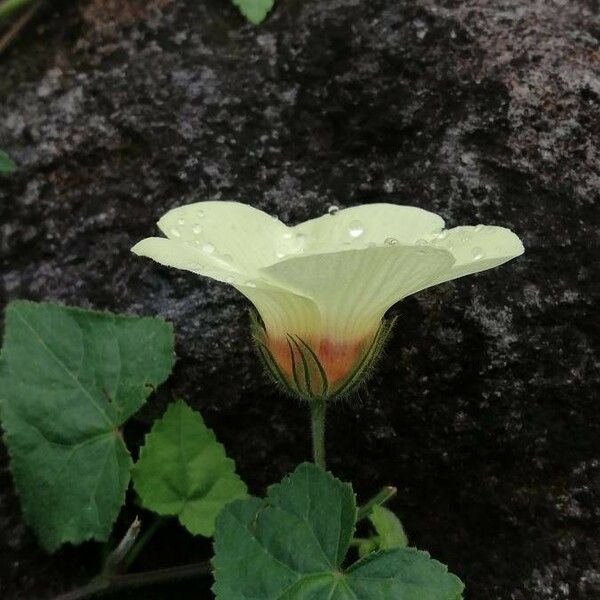
Plant Overview
Often called the Prostrate Pavonia or Rosita de la Sierra, this charming ground-hugger looks like a miniature Hibiscus that decided to take a nap on the forest floor. Native to the sun-drenched regions of Central and South America, it is prized for its ability to create a "carpet of stars" with its striking, dark-eyed blooms. It is a resilient survivor that brings a touch of wild, tropical elegance to rocky terrains and garden borders.
🔍 How to Identify
- 🌸 The "Bulls-eye" Bloom: It features delicate, five-petaled flowers that are usually creamy yellow or pale orange, punctuated by a deep, contrasting burgundy or purple "eye" at the center.
- 🍃 Arrowhead Foliage: The leaves are typically heart-shaped or arrow-shaped (sagittate) with slightly serrated edges and a soft, velvety texture provided by fine hairs.
- 🌱 Creeping Stems: Unlike its upright relatives, this plant has long, trailing stems that spread horizontally, often forming a dense mat as they crawl across the soil.
🏡 In Your Garden
- 🌞 Sun Seeker: This plant thrives in bright, direct light. If placed in too much shade, it will become "leggy," stretching its stems and producing significantly fewer flowers.
- 🪨 Rock Garden Star: Because of its prostrate growth habit and drought tolerance, it is a perfect candidate for rockeries or cascading over the edges of hanging baskets where its stems can "spill" naturally.
- 🦋 Pollinator Magnet: The open shape of the flower and the high-contrast center act as a literal landing pad for bees and small butterflies, making it a great choice for biodiversity.
⚠️ Safety & Toxicity
- 🐾 Pet Friendly: Pavonia cancellata is generally considered non-toxic to dogs, cats, and horses, making it a safe choice for low-level garden beds where pets might roam.
- 👶 Gentle Touch: While not poisonous, the fine hairs on the leaves and stems can occasionally cause very mild skin irritation for children or adults with highly sensitive skin if handled excessively.
✨ Fun Fact
The specific epithet cancellata comes from the Latin word for "latticed" or "gridded." This refers to the intricate, cage-like appearance of the bractlets that wrap around the base of the flower bud, looking like a tiny, green ornamental fence!

Detailed Care Instructions
Pavonia Cancellata, also known as Ruby Glow, is a tropical plant that is native to Mexico and Central America. It is commonly grown as a houseplant due to its attractive foliage and bright red flowers. Here are some tips on how to grow and care for Pavonia Cancellata:
- Light: Pavonia Cancellata prefers bright, indirect light. Place it near a window where it can receive plenty of light without direct sunlight.
- Temperature: This plant thrives in temperatures between 65-80°F (18-27°C). Avoid placing it in drafty areas or near air vents.
- Watering: Water your Pavonia Cancellata when the top inch of soil feels dry to the touch. Be sure to water the plant thoroughly, allowing the water to drain out of the bottom of the pot.
- Humidity: Ruby Glow prefers high humidity levels. You can increase humidity by misting the plant regularly or placing a humidifier nearby.
- Soil: Use a well-draining potting mix that is rich in organic matter. A mix that contains peat moss, perlite, and vermiculite works well for Pavonia Cancellata.
- Fertilizing: Feed your plant with a balanced liquid fertilizer every 4-6 weeks during the growing season (spring and summer). Be sure to follow the instructions on the fertilizer package.
- Pruning: Trim off any yellow or dead leaves to encourage new growth. You can also pinch back the tips of the stems to promote bushier growth.
- Repotting: Repot your Pavonia Cancellata every 2-3 years, or when it outgrows its current container. Choose a slightly larger pot with drainage holes to prevent root rot.
With proper care and attention, your Pavonia Cancellata plant should thrive and reward you with its beautiful foliage and blooms.

Place in a bright room that is sun drenched almost all day. Or directly in a south-facing window.

To water this plant, it is important to wait until the soil has dried out slightly before watering again. Check the soil by sticking your finger about 2 inches into the soil and feeling for moisture. If it feels dry, water the plant until water runs out of the drainage hole at the bottom of the pot. Avoid getting water on the leaves as this can encourage fungal growth. Watering should be reduced in the winter months when the plant is not actively growing.
To fertilize Pavonia cancellata, you can use a balanced fertilizer with an N-P-K ratio of 10-10-10 or a fertilizer specifically designed for flowering plants. Apply the fertilizer every 4-6 weeks during the growing season, which is typically spring and summer. Be sure to follow the instructions on the fertilizer packaging for proper dosage and application method. Water the plant thoroughly after fertilizing to help the nutrients penetrate the soil and reach the plant's roots. Avoid over-fertilizing, as this can lead to nutrient burn and damage to the plant.
For optimal growth and health, Pavonia Cancellata plant requires a well-draining soil that is rich in organic matter. The ideal soil pH range for this plant is between 5.5 and 7.5. The soil should be moist but not waterlogged, as excessive moisture can lead to root rot and other plant diseases. A mixture of equal parts peat moss, vermiculite, and perlite is often recommended as a suitable soil mix for Pavonia Cancellata plant. It is also advisable to add a slow-release fertilizer to the soil during planting or before the growing season to provide the necessary nutrients for healthy growth and development.
To propagate Pavonia Cancellata plant, you can start by taking stem cuttings from a healthy, mature plant. Use sharp, clean scissors or shears to cut a 4-6 inch piece of stem just below a leaf node. Remove any lower leaves on the cutting to prevent rotting and promote root growth.
Next, dip the cut end of the stem into a rooting hormone to encourage root development. Plant the cutting into a small pot filled with well-draining soil, such as a mixture of peat moss and perlite. Water the cutting thoroughly and place the pot in a warm, bright location with indirect sunlight.
Keep the soil consistently moist, but not waterlogged, and mist the cutting regularly to keep humidity levels high. Within a few weeks, roots should begin to form, indicating that the cutting has successfully taken root. At this point, you can transplant the rooted cutting into a larger pot with regular potting soil and continue to care for it as you would a mature Pavonia Cancellata plant.








