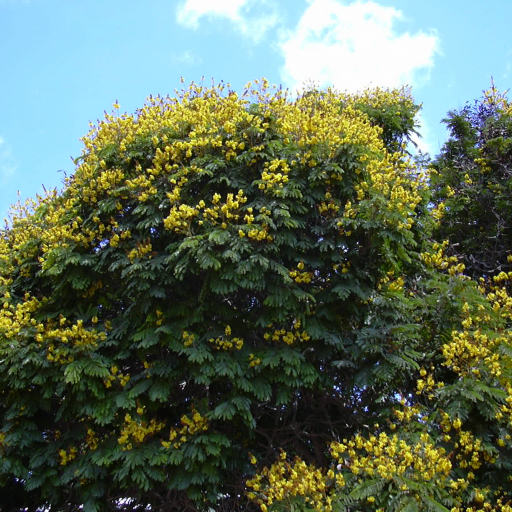
Plant Overview
Known as the "Yellow Flame Tree" or "Copperpod," this tropical giant is a favorite among urban landscapers for its dramatic umbrella-shaped canopy and its ability to transform a street into a golden corridor. Native to Southeast Asia and Northern Australia, it is often celebrated in poetry and art for the way it carpets the ground in a vibrant yellow "snow" of fallen petals. It is a tree that embodies the warmth of the tropics, offering deep shade and a spectacular seasonal show.
🔍 How to Identify
- 🌼 The Blooms: Large, upright clusters of bright yellow flowers with crinkled petals that look like delicate crepe paper.
- 🍃 The Foliage: Large, feathery, fern-like leaves (bipinnate) that provide a soft, airy texture to its massive crown.
- 🍂 The Pods: Flat, woody seed pods that transition from a purplish-green to a deep, rusty copper-brown, giving the tree its "Copperpod" nickname.
- 🪵 The Bark: Generally smooth and greyish-brown, though it can become slightly fissured as the tree reaches its impressive mature height.
🏡 In Your Garden
- 🌳 Space Requirements: This is a "legacy tree" that needs plenty of room to spread its wings; it’s best suited for large gardens or as a standalone focal point.
- 🌤️ Sun & Wind: It thrives in full sun and is remarkably wind-resistant, making it an excellent choice for coastal regions or areas prone to seasonal storms.
- 💧 Drought Tolerance: Once established, it is incredibly hardy and can survive long dry spells, though it will drop more leaves to conserve energy during a drought.
- 🪴 Soil Preference: It isn't picky about soil quality but demands good drainage; it dislikes "wet feet," which can weaken its impressive root system.
⚠️ Safety & Toxicity
- 🟢 General Safety: The Yellow Flame Tree is generally considered non-toxic to humans and is widely planted in public parks and schoolyards.
- 🐾 For Pets: While not listed as a major toxin, the woody seed pods can be a choking hazard for dogs who like to chew on sticks, and the bark contains tannins that might cause mild stomach upset if ingested in large quantities.
- 🧹 Maintenance Note: While safe, be aware that the falling flowers and pods can be messy on driveways and may temporarily stain light-colored stone or car paint.
✨ Fun Fact
🎨 In Indonesia, the bark of this tree is a secret ingredient in the traditional Batik industry. It is used to create a rich, warm brown dye known as "soga," which has been used for centuries to color royal fabrics.

Detailed Care Instructions
| Humidity | Normal |
| Lighting | Full Sun |
| Difficulty | Medium |
| Hibernation | Cold Period |
| Temperature | 27°C - 36°C |
| Hardiness Zones | 10 - 12 |
To grow Peltophorum pterocarpum, also known as the Copperpod tree, follow these steps:
- Climate and soil: Ensure you live in a tropical or subtropical climate with temperatures above 10°C (50°F) and mild winters. The plant thrives in well-draining soil with a pH ranging from slightly acidic to slightly alkaline.
- Sunlight: Choose a location that receives full sun exposure, as Peltophorum pterocarpum requires at least six hours of direct sunlight daily to grow and bloom properly.
- Planting: Dig a hole that is slightly wider and deeper than the root ball, ensuring it is positioned at the same height as it was in the nursery pot. Backfill the hole with soil and gently firm it around the plant. Water thoroughly after planting.
- Watering: Initially, water the plant regularly to establish root growth. Once established, the Copperpod tree is drought-tolerant and requires minimal watering. However, during dry spells or extreme heat, provide supplemental watering.
- Fertilization: Apply a balanced, slow-release fertilizer during the growing season or use a liquid fertilizer every few weeks. Follow the package instructions for proper application and dosage.
- Mulching: Apply a layer of organic mulch around the base of the tree to help retain moisture, prevent weed growth, and maintain cool soil temperatures.
- Pruning: Prune the tree during winter to remove any dead, damaged, or crossing branches. Additionally, remove any water shoots or suckers that emerge from the base of the trunk.
- Pests and diseases: Monitor for common pests such as aphids, caterpillars, and leaf miners. Treat infestations with appropriate insecticides if necessary. Also, watch out for fungal diseases, and ensure adequate air circulation around the plant to prevent excessive moisture.
- Propagation: Peltophorum pterocarpum can be propagated through seeds or by hardwood cuttings. Seeds should be soaked overnight before sowing. Cuttings should be taken during late winter or early spring and treated with a rooting hormone before planting in well-draining soil.
Remember, the Copperpod tree can grow up to 50 feet tall, so it requires ample space to grow. Regularly maintain and care for the plant, and you will be rewarded with beautiful yellow flowers and a stunning tropical addition to your garden.

Place in a bright room that is sun drenched almost all day. Or directly in a south-facing window.

Peltophorum Pterocarpum plant requires regular watering to thrive, especially during warmer months. However, it is important not to overwater the plant as it can lead to root rot. To determine when to water the plant, check the top inch of soil. If it feels dry to the touch, it's time to water.
When watering, water deeply so that the water reaches the roots, but do not let the water stand in the container or root zone. Watering should be done early in the morning or late in the evening when evaporation is low. Avoid watering during the middle of the day when the sun is highest.
The plant prefers well-draining soil, so make sure the container has drainage holes to prevent water from accumulating in the roots. If the soil is not well-draining, add perlite or sand to help improve drainage.
During the winter months, the plant requires less water as it enters a dormant state. Reduce watering frequency, but still, make sure the soil remains moist.
In summary, Peltophorum Pterocarpum plant should be watered deeply, but not overwatered, and should be given well-draining soil. Watering should be done in the morning or evening and reduced during the winter months.
For best results, fertilize this plant during its active growing season, which is typically in the spring and summer months. Use a balanced fertilizer with equal amounts of nitrogen, phosphorus, and potassium, and apply according to package instructions. Be sure to water the plant thoroughly before and after fertilizing to prevent root burn. Avoid fertilizing during the plant's dormant period, which is usually in the fall and winter months.
Peltophorum Pterocarpum plant prefers well-drained soil with moderate fertility levels. The soil should be rich in organic matter and should have good water retention capacity. It is important to ensure that the soil is not too heavy or compacted, as this can lead to poor root development and reduced plant growth. Sandy loam soil with a slightly acidic to neutral pH of 6.0 to 7.5 is preferred. Soil that is too alkaline may cause nutrient deficiencies such as iron and manganese. It is recommended to use a mixture of garden soil and compost in a ratio of 3:1 for optimal growth. Adding a slow-release fertilizer during planting can also help boost the plant's growth. It is important to avoid over-fertilizing as this can damage the plant's roots and cause burning of the leaves.
Peltophorum Pterocarpum is a plant that can be propagated by seeds or cuttings. To propagate the plant by seed, the seeds should be soaked in water overnight to soften the outer coat. The seeds are then sown in a pot or tray filled with well-draining soil and covered with a light layer of soil. The pot or tray should be kept in a warm, humid area and the soil kept moist until the seeds germinate. Once the seeds germinate, they can be transplanted into individual pots and grown until they are large enough to be planted outside.
To propagate the plant by cuttings, a healthy stem of the plant should be cut with sharp, sterile pruners. The cutting should be about six inches in length and should include at least two leaf sets. The bottom leaves should be removed from the cutting and the stem should be dipped in rooting hormone. The cutting is then planted in a pot filled with well-draining soil and covered with a clear plastic bag to create a humid environment. The pot should be kept in a warm, well-lit area and the soil should be kept moist. The cutting will start to root in a few weeks and can be transplanted into individual pots until it is large enough to be planted outside.








