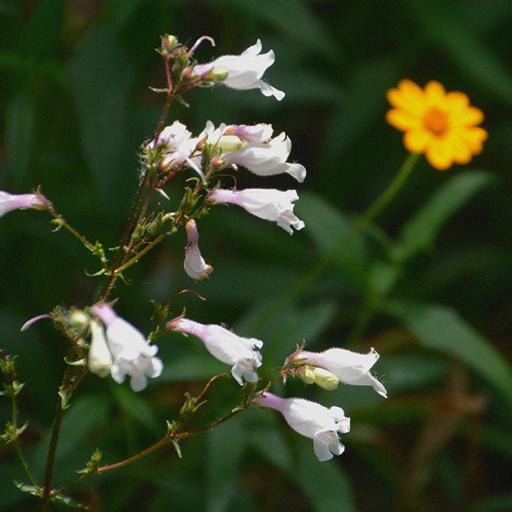
Plant Overview
Known as the Nodding Beardtongue, this wildflower is the epitome of Southern charm. Native to the sandy prairies and open woodlands of the Southeastern United States, it gets its name from the graceful, slightly drooping way its flowers hang from the stem. It is a favorite for gardeners looking to invite a bit of "wild meadow" elegance into their landscapes.
🔍 How to Identify
- 🌸 The "Bearded" Tongue: Look inside the bell-shaped bloom to find a sterile stamen covered in tiny, golden-yellow hairs. This "fuzzy tongue" is the signature of the Penstemon family.
- 🔔 Trumpet Blooms: The flowers are narrow tubes that flare out into five lobes. They are usually milky white, though they often blush with a delicate, pale lavender or pink tint.
- 🍃 Lance-Shaped Leaves: The plant features slender, pointed leaves that grow in pairs directly opposite one another along a tall, thin stem that can reach up to 2 feet in height.
🏡 In Your Garden
- 🏜️ Drainage is King: This species naturally thrives in sandy, loose soil. It is highly sensitive to "wet feet," so if your garden has heavy clay, be sure to amend it with grit or plant it on a slope to prevent root rot.
- 🐝 Pollinator Magnet: The tubular flowers are specifically designed for long-tongued bees and hummingbirds. The "beard" inside the flower acts as a perfect landing pad for insects as they reach for the nectar hidden deep within.
- 🌤️ Lax Habit: Its name laxiflorus refers to its "loose" or "relaxed" flowering habit. Unlike some stiff, upright garden plants, this one has a swaying, airy presence that looks best when planted in groups.
⚠️ Safety & Toxicity
- ✅ Non-Toxic: Penstemon laxiflorus is generally considered safe and non-toxic for humans, dogs, and cats.
- 🌱 Mistaken Identity: While safe, always be careful not to confuse it with wild Foxglove (Digitalis), which has a similar tall spike of bell-shaped flowers but is highly toxic if ingested.
✨ Fun Fact
The genus name Penstemon comes from the Greek words for "five" and "stamen." While most of its botanical relatives have only four stamens, this rebel plant has a fifth one—the "beardtongue"—which produces no pollen and exists solely to look fuzzy and attract bees!

Detailed Care Instructions
To grow Penstemon Laxiflorus, also known as Rocky Mountain Penstemon, follow these steps:
- Choose the right location: Penstemon Laxiflorus thrives in full sun or partial shade. Ensure the chosen spot receives at least six hours of direct sunlight daily.
- Prepare the soil: Penstemon Laxiflorus prefers well-draining soil. If your soil is heavy clay, it's a good idea to amend it with compost or organic matter to improve drainage.
- Planting: Dig a hole slightly larger than the root ball of the plant. Place the plant in the hole, making sure the top of the root ball is level or slightly higher than the surrounding soil. Backfill the hole and gently tamp the soil around the plant.
- Watering: After planting, give the Penstemon Laxiflorus a thorough watering. During the establishment period, water regularly to keep the soil evenly moist but not waterlogged. Once established, it is a relatively drought-tolerant plant. Water deeply but infrequently, allowing the soil to dry slightly before the next watering.
- Mulching: Apply a thin layer of organic mulch around the plant to help retain moisture, regulate soil temperature, and control weed growth. Avoid placing the mulch directly against the stems of the plant.
- Fertilizing: Penstemon Laxiflorus generally does not require heavy fertilization. However, you can apply a balanced slow-release or organic fertilizer in early spring to provide a gentle nutrient boost.
- Pruning: After the flowering period, cut back the flower stalks to promote a more compact and tidy appearance. Additionally, you can trim back any dead or damaged foliage as needed.
- Winter care: Penstemon Laxiflorus is a hardy perennial that can withstand cold temperatures. However, a layer of mulch around the base of the plant can offer added protection during harsh winter conditions.
- Propagation: Penstemon Laxiflorus can be propagated through division or by collecting seeds. Division is best done in early spring or fall, and seeds can be collected in late summer or early fall.
By following these guidelines, you can successfully grow Penstemon Laxiflorus for an attractive addition to your garden.

Place in a bright room that is sun drenched almost all day. Or directly in a south-facing window.

Penstemon Laxiflorus is a plant that requires adequate watering for optimal growth and health. To water this plant, it is important to ensure that the soil is evenly moist. This can be achieved by watering the plant deeply, allowing the water to penetrate the soil to a depth of at least 6 inches. It is important to avoid overwatering the plant, as this can lead to root rot and other problems.
To water Penstemon Laxiflorus, start by checking the soil moisture level. Insert your finger into the soil to a depth of 1-2 inches. If the soil feels dry to the touch, it is time to water the plant. If the soil feels moist, wait a few more days before checking again.
When you are ready to water the plant, use a watering can or a hose with a gentle spray nozzle. Water the plant until the soil is thoroughly moistened, making sure to water the base of the plant and the surrounding soil. Avoid getting water on the leaves, as this can promote disease and fungal growth.
During periods of dry weather or high heat, Penstemon Laxiflorus may require more frequent watering. Be sure to monitor the soil moisture level regularly to prevent over or underwatering. With proper care and attention, your Penstemon Laxiflorus plant will thrive and provide beautiful blooms for years to come.
- Choose a balanced fertilizer that has equal amounts of nitrogen, phosphorus, and potassium.
- Apply the fertilizer during the plant's growing season, typically spring and early summer.
- Sprinkle the fertilizer around the base of the plant, avoiding contact with the foliage.
- Water the plant thoroughly after fertilizing to help the nutrients reach the roots.
- Avoid over-fertilizing, as this can lead to excessive growth and weaken the plant.
Penstemon Laxiflorus plant prefers well-drained soil that is rich in nutrients and organic matter. The ideal soil pH ranges from slightly acidic to neutral. It can tolerate some drought but performs best in consistently moist soil. As a native plant, it is adapted to specific soil types that are common in its natural habitat. It is recommended to use soil that closely resembles the native soil type in which it grows.
There are several ways to propagate this plant. One common method is to take stem cuttings from healthy parent plants during the early spring season. Select an actively growing stem that is about six inches long and free of any diseases or pests. Use a sharp, sterilized blade to cut the stem just below a node (the point where leaves attach to the stem).
Remove the lower leaves, leaving only the top two or three leaves intact. Dip the cut end of the stem into rooting hormone powder and plant it about two inches deep in a well-draining potting mix. Water the cutting thoroughly, cover it with a plastic bag or dome, and place it in a bright, indirect light location.
Keep the soil moist but not overly wet and mist the cutting regularly to maintain high humidity. After about four to six weeks, check for signs of root growth by gently tugging at the base of the stem. If it resists, roots have formed, and you can slowly acclimate the new plant to outdoor conditions.
Alternatively, you can propagate Penstemon Laxiflorus through division. Dig up the parent plant in early spring or fall when it is not flowering and gently separate the root ball into smaller sections, making sure each division has a healthy section of roots and foliage. Replant each section in well-draining soil and water regularly until established.








