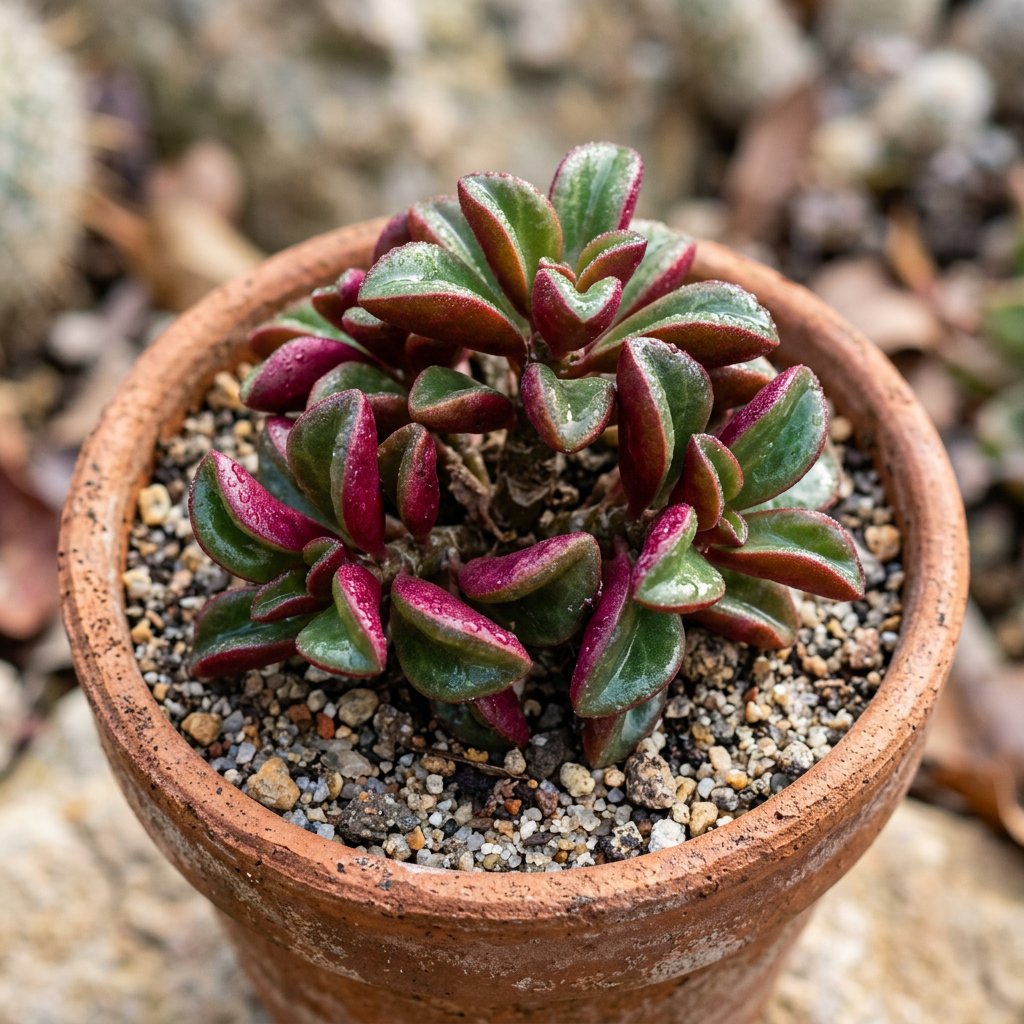
Plant Overview
Often called the "Ruby Glow," this stunning succulent-like plant hails from the rocky cliffs of Ecuador. It looks less like a typical Peperomia and more like a collection of tiny, crimson canoes drifting in a sea of green. It is a slow-growing favorite for indoor gardeners who love "architectural" plants that provide high visual impact without taking up much space.
🔍 How to Identify
- 🍃 Leaf Shape: The leaves are thick, fleshy, and shaped like a boat or a "V," with a distinct fold down the center.
- 🔴 The Ruby Glow: The undersides and stems are a striking, deep burgundy or wine-red, which contrasts sharply with the green tops.
- 🪟 Epidermal Windows: The green section on the top of the leaf is actually a translucent "window" designed to capture and filter sunlight deep into the plant’s tissues.
🏡 In Your Garden
- 🏜️ Succulent Sensibilities: Unlike its thin-leaved tropical cousins, P. graveolens behaves like a desert plant. It stores significant water in its leaves, meaning it prefers its soil to dry out almost completely before it asks for another drink.
- ☀️ Light & Color: To maintain that vibrant red "glow," it needs bright, indirect light. In low-light conditions, the plant will "stretch" (etiolate), becoming leggy and losing its compact, jewel-like appearance.
- 🪨 Breathable Roots: It has a very small, delicate root system. It thrives best in a gritty, cactus-leaning potting mix that allows for plenty of oxygen; heavy, wet soil is its quickest enemy.
⚠️ Safety & Toxicity
- 🐾 Pet Friendly: This plant is considered non-toxic to cats, dogs, and horses, making it a safe choice for households with curious furry friends.
- 🤏 Brittle Texture: While safe to touch, the leaves are quite brittle. They can snap off easily if the plant is placed in a high-traffic area where it might be bumped.
✨ Fun Fact
- 👃 A Smelly Secret: The species name graveolens literally translates to "strong-smelling." While the leaves are scentless, the plant's tiny, yellowish-green flower spikes (which look like little rat tails) emit a distinct, musty odor that many find surprisingly unpleasant!

Detailed Care Instructions
| Soil Ph | 6-6.6 |
| Humidity | Dry |
| Lighting | Full Sun |
| Soil Type | Loamy, Medium Moisture, Well-Draining |
| Difficulty | Medium |
| Plant Type | Herbaceous Perennial |
| Hibernation | Cold Period |
| Mature Size | Up To 10″ Tall |
| Native Area | Ecuador |
| Temperature | 18°C - 25°C |
| Sun Exposure | Indirect Bright Sunlight |
| Hardiness Zones | 10-11 |
To grow Peperomia Graveolens (commonly known as Ruby Glow or Ruby Pepper), follow these steps:
- Choose the right pot: Select a small-sized pot that has good drainage holes. Peperomia Graveolens grows well in small pots as it likes to be root-bound.
- Potting mix: Use a well-draining potting mix that consists of perlite, peat moss, and sand. You can also add some organic matter like compost for added nutrients.
- Propagation: You can start growing Peperomia Graveolens either by stem cuttings or by leaf cuttings. For stem cuttings, take a 3-4 inch stem with at least one node from a mature plant. For leaf cuttings, select healthy leaves and cut them neatly along the veins. Allow the cuttings to dry for a few hours to form calluses.
- Planting: Once the cuttings have formed calluses, plant them in the prepared potting mix. Make a small hole in the soil and place the cutting or leaf in it, burying only the node or the base of the leaf. Gently press the soil around the cutting to secure it.
- Placement: Place the pot in a bright location with indirect sunlight. Avoid direct sunlight as it can scorch the leaves. Peperomias prefer temperatures between 65-75°F (18-24°C).
- Watering: Water your Peperomia Graveolens moderately and only when the top two inches of soil are dry to touch. Avoid overwatering as it can lead to root rot.
- Humidity: Peperomia Graveolens prefers moderate to high humidity. You can increase humidity by placing a tray filled with water near the plant or by misting the plant regularly.
- Fertilizing: Feed your Peperomia Graveolens with a balanced houseplant fertilizer once a month during the growing season (spring and summer). Follow the instructions on the fertilizer packaging for the correct dilution ratio.
- Pruning: Trim any leggy or damaged stems to encourage bushier growth. Pinching off the tips of the stems can also promote branching.
- Repotting: Peperomia Graveolens likes to be root-bound, so repotting is usually done only when the plant becomes too crowded in its pot. Repotting should be done during the spring season.
By following these steps, you can successfully grow and care for your Peperomia Graveolens plant.

Place in a bright room that is sun drenched almost all day. Or directly in a south-facing window.

To water this plant, wait until the top inch of soil is dry before watering thoroughly, allowing excess water to drain out of the bottom of the pot. Avoid letting the plant sit in standing water, as this can lead to root rot. Water less frequently during the winter months, when the plant is in a period of dormancy. Additionally, make sure to use a well-draining soil mix and provide moderate to bright indirect light for optimal growth.
To properly fertilize this plant, use a slow-release fertilizer with equal amounts of nitrogen, phosphorus, and potassium. Apply the fertilizer every two months during the growing season, and reduce the amount during the winter months. Be careful not to over-fertilize, as this can cause damage to the roots. Water the plant thoroughly before and after applying the fertilizer.
Peperomia Graveolens plant thrives in a well-draining and nutrient-rich soil. It is recommended to use a soil mix that is light, airy, and retains moisture but does not become waterlogged. A mixture of organic compost, perlite, and peat moss is ideal for this plant. The soil should be slightly acidic with a pH range of 5.5 to 6.5. It is also important to ensure that the soil is free of any pathogens or pests that may harm the plant. A regular application of fertilizer can also help the plant grow healthy and strong.
To propagate this plant, first prepare a potting mix that is well-draining and slightly moist. Then, take a stem cutting of the plant, making sure it has at least one leaf node. Trim any excess leaves or stems from the cutting, leaving only a few leaves at the top. Dip the end of the cutting into rooting hormone powder and then plant it into the potting mix. Water the cutting and place it in a bright, but indirect sunlit area. Be sure to keep the soil moist and not let it dry out completely. After a few weeks, the cutting should begin to root. You can check by gently tugging on the cutting. Once it has fully rooted, you can transplant it into a new pot with fresh potting mix.
Common pests of the ruby glow include Mealybugs, fungus gnats. Make a habit of checking your ruby glow frequently for pests so that any infestations can be caught and managed early.








