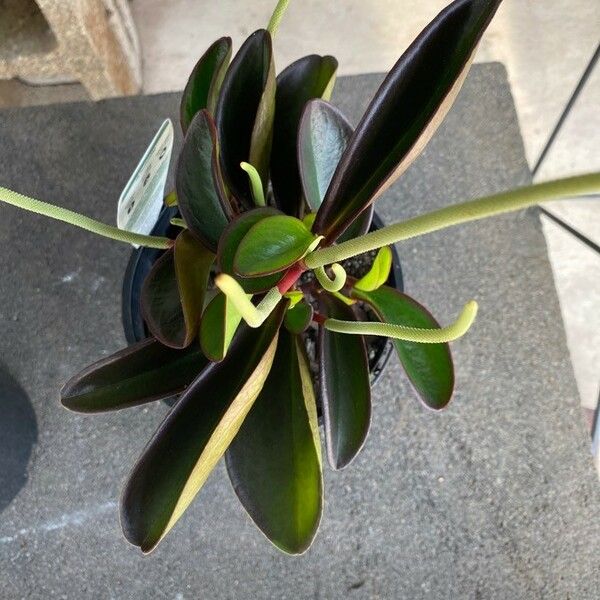
Plant Overview
Known for its petite, teardrop-shaped leaves, Peperomia variifolia is a South American gem that feels more like a succulent than a traditional leafy houseplant. Often called the "Teardrop Peperomia," it is a favorite for terrarium enthusiasts and apartment dwellers who want a low-maintenance companion with a sophisticated, deep-toned color palette.
🔍 How to Identify
- 🍃 Leaf Shape: Small, thick, teardrop-shaped leaves that feel firm and waxy to the touch, almost like a succulent.
- 🎨 Color Contrast: The foliage is a rich, deep emerald green on the surface, while the undersides often feature a surprising reddish or pale-brown tint.
- 🎋 Stem Structure: Sturdy, reddish-tinted stems that grow upright when young but will begin to trail gracefully as they mature and gain length.
🏡 In Your Garden
- 💧 The "Succulent" Secret: Because this plant stores water in its fleshy leaves, it is extremely sensitive to overwatering. It thrives on "neglect" and prefers its soil to dry out almost completely; if the roots stay damp for too long, the plant will quickly drop leaves as a distress signal.
- 🌤️ Indirect Inhabitant: In the wild, it grows on the shaded floor of tropical forests. In your home, it prefers bright, filtered light. Avoid direct afternoon sun, which can "bleach" the deep green color or cause unsightly brown scorch marks on the leaves.
⚠️ Safety & Toxicity
- ✅ Pet Friendly: Peperomia variifolia is non-toxic to cats, dogs, and horses, making it an excellent choice for "pet parents" who want to green up their space without worry.
- 👶 Child Safe: It is also non-toxic to humans. While it isn't meant for snacking, it won't cause harm if a curious toddler takes a nibble or touches the leaves.
✨ Fun Fact
Peperomias are part of the Piperaceae family, which means they are distant cousins to the plants that produce black pepper! While variifolia doesn't produce spice, its unique "rat-tail" flower spikes are a hallmark of this diverse and ancient botanical family.

Detailed Care Instructions

Place in a window with dappled sun or a spot in the middle of a room. Or directly in a window facing west or east.

To water this plant, fill a watering can with room temperature water and allow it to sit for 24 to 48 hours to let the chlorine and other chemicals evaporate. Then, water the plant until water begins to drain out of the drainage holes in the pot. Allow the soil to partially dry out before watering again, as this plant does not tolerate waterlogged soil. Avoid getting water on the leaves as this can lead to leaf spotting and rot.
Without the need of fertilizer, these plants can thrive and bloom. If a plant requires fertilization, it will display indicators of nutrient insufficiency, such as yellowing leaves. It is safe to apply slightly diluted fertilizers in these circumstances. Over fertilizing, on the other hand, should be avoided because excess nutrients might cause plant mortality. Slow-release fertilizers are therefore advised for these plants.
Peperomia Variifolia prefers a well-draining soil mix that is rich in nutrients and organic matter. The ideal soil should have a pH range of 6.0 to 7.0. A good mix can be made up of humus, peat moss, perlite, and coarse sand to provide a balanced nutrient content and good water retention and drainage. The soil should not be too compact to prevent root rot. Additionally, it is important to avoid overwatering the plant to ensure that the soil doesn't become soggy with poor drainage.








