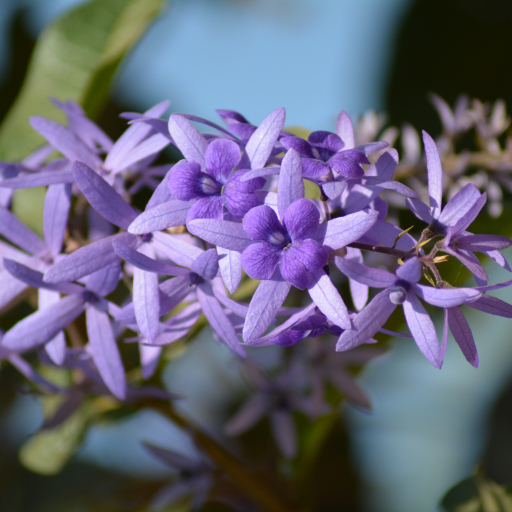
Plant Overview
Often called the "Queen’s Wreath" or "Sandpaper Vine," this tropical beauty is frequently mistaken for the temperate Wisteria due to its spectacular drooping clusters of purple flowers. Native to Central America and Mexico, it is a vigorous woody climber that can transform a plain fence into a royal display of violet hues. Its nickname, "Sandpaper Vine," comes from its uniquely textured, leathery leaves that feel surprisingly rough to the touch.
🔍 How to Identify
- 💜 The Flowers: It produces long, cascading clusters (racemes) of star-shaped flowers. Each bloom features a small, dark purple flower sitting atop a lighter lavender, five-pointed star-shaped calyx.
- 🍃 The Foliage: The elliptical leaves are stiff and incredibly abrasive. If you rub your finger across them, they feel exactly like fine-grit sandpaper.
- 🪜 Growth Habit: This is a "twining" vine, meaning it climbs by wrapping its woody stems around supports like pillars, trellises, or nearby trees.
🏡 In Your Garden
- 🏗️ Support is Key: Because the vine becomes heavy and woody as it matures, it requires a very sturdy structure. Avoid flimsy plastic trellises; opt for wood, metal, or a solid pergola to let it flourish.
- ☀️ Sun for Blooms: While it can survive in partial shade, the "Queen" will only give you her best performance in full sun. The more light it receives, the more intense the purple display will be.
- ✂️ Pruning Strategy: It responds well to pruning. You can keep it as a tight shrub or even train it into a "standard" (a small, free-standing tree) if you provide a central stake for the first few years.
⚠️ Safety & Toxicity
- ✅ Status: Generally considered non-toxic and safe for home gardens.
- 🐾 Pets & Kids: There are no widely reported cases of toxicity for cats, dogs, or horses. However, the rough texture of the leaves may cause minor skin irritation or "paper cuts" if handled roughly by curious toddlers or pets.
✨ Fun Fact
The darker purple "true" flowers are actually quite short-lived and drop off quickly. However, the lighter lavender star-shaped sepals remain on the vine for several weeks, eventually turning a pale greyish-green, which gives the plant an incredibly long "blooming" season!

Detailed Care Instructions
| Lighting | Full Sun |
| Hardiness Zones | 9B - 11 |
To grow Petrea Volubilis, also known as the Queen's Wreath or Purple Wreath Vine, follow these steps:
- Climate and sun exposure: Ensure that your climate is suitable for growing Petrea Volubilis. It thrives in tropical and subtropical regions and prefers full sun or partial shade.
- Soil preparation: Prepare well-draining soil with good organic content. Petrea Volubilis prefers slightly acidic to neutral soil.
- Planting: Choose a location with ample space for the plant to climb and spread. Plant your Petrea Volubilis vine in the ground, keeping adequate distance from other plants or structures. Alternatively, you can grow it in a large container if you have limited space.
- Watering: Water the plant regularly, keeping the soil evenly moist but not waterlogged. Avoid allowing the soil to dry out completely between waterings.
- Fertilizing: Apply a balanced slow-release fertilizer during the warmer months to promote healthy growth. Follow the package instructions for proper dosage.
- Pruning: After the blooming period, prune the plant to remove any dead or damaged branches. This will help maintain the shape and encourage more flowers in the next season.
- Trellis or support: Provide a sturdy trellis, arbor, or other support structure for the vine to cling to and climb. As the Petrea Volubilis grows, gently guide the stems towards the support to encourage upward growth.
- Pests and diseases: Monitor the plant for pests such as aphids, spider mites, or mealybugs. Treat any infestations promptly using appropriate organic or chemical pesticides. Ensure good air circulation around the plant to prevent common fungal diseases.
- Propagation: You can propagate Petrea Volubilis through stem cuttings or layering. Take cuttings during the growing season, remove the lower leaves, and place them in well-draining soil or a rooting medium. Keep the cuttings moist until roots develop. Layering can be done by bending a low-growing branch and burying a portion of it in the soil to encourage root development.
- Winter care (if applicable): In regions with cold winters, provide protection to the plant during freezing temperatures. Mulch around the base of the plant to insulate the roots and consider covering it with a frost cloth.
By following these guidelines and providing proper care, your Petrea Volubilis plant should thrive, producing beautiful purple clusters of flowers and adding elegance to your garden.

Place in a bright room that is sun drenched almost all day. Or directly in a south-facing window.

The plant needs to be watered regularly, but not excessively. It is important to ensure that the soil is not dry before watering. The best way to check if the plant needs water is to stick your finger in the soil. If it feels dry, then it needs to be watered.
When watering the Petrea Volubilis plant, it is important to not expose the leaves to water. The plant prefers to be watered at the base, as this will ensure that the roots receive the water they need to grow properly.
Furthermore, the plant needs to be placed in a spot with good drainage. This will prevent the plant from sitting in standing water, which can lead to root rot. It is recommended to use a pot with drainage holes or to plant the Petrea Volubilis in well-draining soil.
Lastly, it is important to avoid over-watering the plant. Too much water can cause the roots to rot and can lead to other issues with the plant. It is better to water the Petrea Volubilis plant less often than to over-water it.
To fertilize this plant, use a balanced fertilizer with equal amounts of nitrogen, phosphorus, and potassium. Apply the fertilizer during the growing season, once every two weeks. Make sure not to over-fertilize, as this can damage the plant and cause leaf burn. Additionally, water the plant well before and after fertilizing to prevent fertilizer burn. A slow-release fertilizer can be used as an alternative to frequent applications.
The ideal soil for the plant should have good drainage to prevent waterlogging, while also retaining some moisture. The soil should be slightly acidic to neutral with a pH range of 6.0 - 7.0 and rich in organic matter. A combination of sand, loam, and peat moss mixed in equal parts would be suitable for this plant. Avoid using heavy clay soils as they can lead to poor drainage. Additionally, the soil should be well-aerated to allow the plant's roots to grow properly. Adding nitrogen-rich fertilizer to the soil during the growing season can promote healthy growth and development of the plant.
To propagate the plant currently being referred to, one can take stem cuttings of about 4-6 inches in length from a healthy and established parent plant. The cuttings should be taken in the early morning or late evening hours to prevent water loss through evaporation. The bottom one-third of the stem should be stripped of all leaves and cut at an angle.
The cuttings can either be directly planted in a well-draining, fertile soil mix or allowed to root in water before being transplanted. If rooting in water, the cuttings should be placed in a jar filled with water and kept in a bright, indirect light until roots appear. Once roots have developed, the cuttings can be transplanted to soil.
The newly propagated plants should be kept in a warm, humid environment for a few weeks to prevent wilting or dehydration, and until they have established a strong root system. Regular watering and misting can help create the necessary conditions for the plant to grow strong and healthy.








