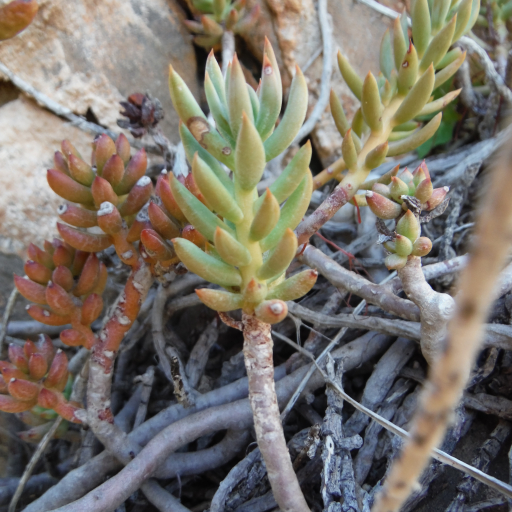
Plant Overview
Often called the Pale Stonecrop, this Mediterranean native is a master of survival in the harshest conditions. Its name, sediforme, hints at its resemblance to the common Sedum, but this plant is far tougher than your average garden succulent. In ancient times, people across southern Europe often planted these on stone walls and rooftops, believing their resilience could protect a home from lightning and fire.
🔍 How to Identify
- 🌵 Foliage Shape: The leaves are thick, fleshy, and lance-shaped, ending in a pointed tip. They are arranged in a tight, overlapping spiral around the stem, resembling a miniature spruce branch.
- 🎨 Glaucous Color: The plant is most recognizable by its distinct pale blue-grey or "sea-foam" green hue. This is caused by a powdery waxy coating that helps the plant reflect intense sunlight.
- 🌼 Starry Blooms: In mid-to-late summer, it sends up tall, sturdy stalks topped with clusters of pale yellow, star-shaped flowers that are a magnet for local pollinators.
🏡 In Your Garden
- ☀️ Sunscreen Specialist: This plant thrives in "death-valley" heat. The bluish wax on its leaves acts like a natural SPF; the more sun it receives, the more intense and beautiful its coloration becomes.
- 🪨 The Rock Specialist: It truly hates "wet feet." If you plant it in rich, heavy potting soil, it may rot. It is at its happiest when tucked into rock crevices, gravel gardens, or sandy slopes where water drains away instantly.
- ✂️ Easy Propagation: It is a "social" plant that loves to spread. Any leaf or stem that falls onto the soil will likely sprout its own roots, making it incredibly easy to share with fellow hobbyists.
⚠️ Safety & Toxicity
- ✅ Generally Safe: The Pale Stonecrop is considered non-toxic to humans and common household pets like cats and dogs.
- 👅 Mild Irritant: While not poisonous, the leaves contain a bitter sap that can cause a mild stomach ache if ingested in large quantities. It is always best to keep it out of reach of curious toddlers or nibbling pets to avoid digestive upset.
✨ Fun Fact
To survive the scorching Mediterranean sun without drying out, the Pale Stonecrop uses CAM photosynthesis. This means it actually "holds its breath" during the hot day and only opens its pores to breathe at night when the air is cool and moist!

Detailed Care Instructions
To grow Petrosedum Sediforme (also known as Stonecrop or Sedum album), you can follow these steps:
- Choose a suitable location: Petrosedum Sediforme prefers full sun to partial shade. Select a spot that receives at least 6 hours of direct sunlight per day.
- Prepare the soil: Ensure that the soil is well-draining and has good fertility. Amend the soil with organic matter, such as compost, to improve its structure and nutrient content.
- Propagation: Petrosedum Sediforme can be propagated from stem cuttings or division. If using stem cuttings, allow them to dry for a few days before planting. If using division, carefully separate the plant into smaller sections, ensuring that each section has some roots attached.
- Planting: Dig a hole or a trench that is slightly wider and deeper than the plant's root system. Place the plant in the hole/trench and cover the roots with soil, gently firming it around the base of the plant. Space the plants about 6-12 inches apart to allow for their spreading habit.
- Watering: Initially, water the plant thoroughly after planting to settle the soil and ensure good root contact. Afterward, Petrosedum Sediforme is quite drought-tolerant and only requires occasional watering. Water deeply but infrequently, allowing the soil to dry out between waterings.
- Mulching: Apply a layer of organic mulch, such as wood chips or straw, around the base of the plant. Mulching helps retain moisture, suppresses weed growth, and moderates soil temperature.
- Fertilizing: Petrosedum Sediforme generally doesn't require much fertilization. However, if you notice poor growth or pale leaves, you can provide a balanced, slow-release fertilizer in spring.
- Maintenance: Petrosedum Sediforme is relatively low-maintenance. Remove any dead or damaged foliage as needed. In early spring, you can also prune back any leggygrowth to encourage more compact plant growth.
- Propagate and expand: Over time, Petrosedum Sediforme will spread by producing offsets or new plants. You can allow these offsets to grow and establish new clumps or gently separate them for planting in different areas.
- Winter care: Petrosedum Sediforme is hardy and can withstand cold temperatures down to USDA zone 3. However, if you live in an area with harsh winters, it may benefit from some winter protection. A layer of mulch or straw can be applied around the base of the plant to insulate it from extreme cold and temperature fluctuations.
Remember to also check for any specific care requirements or recommendations for your specific region, as they may slightly vary based on local conditions.

Place in a bright room that is sun drenched almost all day. Or directly in a south-facing window.

Petrosedum Sediforme is a succulent plant that requires moderate watering. It is important not to overwater as this can lead to rotting of the roots and other parts of the plant. The best approach is to allow the soil to dry out completely in between watering. This will depend on the type of soil, the size of the pot, and the amount of light and temperature the plant is exposed to. To water, use a watering can or a spray bottle to gently moisten the soil around the base of the plant. Make sure not to get water on the leaves or stems as this can cause damage. Additionally, it is important to avoid watering the plant during its dormancy period, typically during the winter months. Instead, wait until the plant resumes growth in the spring before watering again.
To properly fertilize Petrosedum Sediforme, you can follow these instructions:
- Choose a balanced, water-soluble fertilizer: Select a fertilizer with an N-P-K ratio of 10-10-10 or 20-20-20, which indicates the percentage of nitrogen, phosphorus, and potassium in the fertilizer.
- Dilute the fertilizer: Follow the instructions on the fertilizer package to dilute it. Typically, you will mix 1 tablespoon of fertilizer in 1 gallon (4 liters) of water.
- Apply the fertilizer: Pour the diluted fertilizer around the base of the plant, avoiding direct contact with the leaves. Make sure to saturate the soil.
- Timing and frequency: Fertilize Petrosedum Sediforme once a month during the growing season. This could be spring through early fall for most sedums. Reduce or halt fertilization during winter when the plant is dormant.
- Watering after fertilization: After applying the fertilizer, give the plant a thorough watering to help distribute the nutrients throughout the soil. Ensure proper drainage to prevent waterlogging.
- Monitor the plant's response: Observe the plant's overall health and growth. If you notice excessive foliage but limited flowering or stunted growth, reduce the frequency of fertilization. Conversely, if the plant appears weak or has pale leaves, consider increasing the frequency moderately.
Remember that it is generally recommended to under-fertilize rather than over-fertilize sedums, as excessive nutrients can lead to leggy growth or even damage to the plant. Always follow the instructions on the fertilizer packaging and adjust the fertilization regimen based on your specific plant's needs.
When growing the Petrosedum Sediforme plant, it is important to use well-draining soil that is able to retain moisture. The soil should have good aeration and be able to hold onto nutrients for the plant to absorb. A mixture of sandy soil and peat moss can be used to create the ideal soil consistency. Additionally, adding perlite to the mixture can help improve drainage and prevent waterlogging. It is important to avoid using heavy clay soils or soil that is overly rich in nutrients, as this can lead to root rot and other issues. The pH of the soil should be slightly acidic to neutral (around 6.0-7.0) for optimal growth. It is also recommended to use a fertilizer specifically formulated for succulent plants to provide the necessary nutrients without overfeeding.
Petrosedum Sediforme is a popular succulent plant that can be propagated through various methods. Here is the detail on how you can propagate this plant:
- Leaf propagation: Select a healthy leaf from the parent plant. Gently twist it off, ensuring that there is a clean break including the leaf base. Allow the leaf to callus over for a few days to prevent rotting.
- Once the leaf is callused, prepare a well-draining potting mix suitable for succulents. This typically consists of cactus soil, perlite, and coarse sand in equal parts.
- Place the callused end of the leaf into the potting mix, burying it slightly. Avoid burying the entire leaf, as this can lead to rotting. Place the pot in a warm and bright location, but avoid direct sunlight.
- Mist the soil lightly with water, keeping it slightly moist but not overly wet to prevent rot. Mist the leaf occasionally to maintain humidity around it.
- After a few weeks, tiny plantlets will start to form at the base of the leaf. These are new plantlets that are developing roots.
- Wait for the plantlets to grow and develop a cluster of roots. Once they are about half an inch long, gently separate them from the parent leaf and plant them individually in small pots. Be careful not to damage the delicate roots during this process.
- Continue to care for the newly propagated plants by providing them with adequate sunlight, well-drained soil, and occasional watering. Over time, they will grow into mature plants.
Note: Propagation success may vary, and it is common for not all leaf cuttings to successfully produce new plants. However, with proper care and patience, you can increase your chances of successful propagation.
Common pests of the pale stonecrop include Mealybugs, aphids. Make a habit of checking your pale stonecrop frequently for pests so that any infestations can be caught and managed early.








