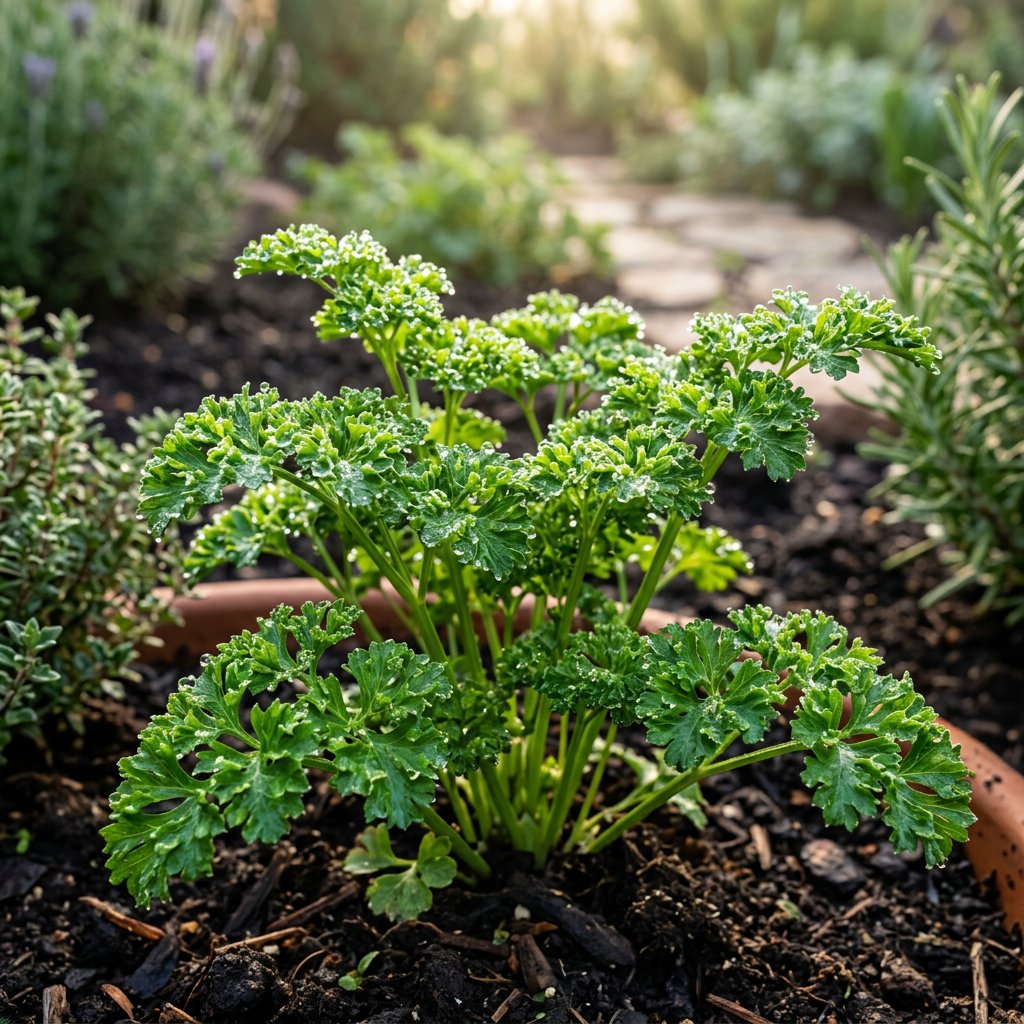
Plant Overview
Commonly known as Garden Parsley, Petroselinum crispum is far more than just a decorative garnish on a dinner plate. This Mediterranean native was once woven into wreaths for victors at the Isthmian Games in Ancient Greece and was even associated with Persephone, the Queen of the Underworld. Today, it is celebrated globally as a culinary powerhouse, packed with vitamins and a refreshing, peppery flavor that brightens almost any dish.
🔍 How to Identify
- 🌿 Foliage Variety: Depending on the cultivar, the leaves are either tightly ruffled and "curly" or broad, flat, and deeply serrated (Italian parsley). Both varieties are a vibrant, glossy forest green.
- 🌼 Flowering Umbels: As a biennial, it spends its first year growing leaves and its second year producing tall stalks topped with flat, lace-like clusters of tiny yellow-green flowers.
- 🌱 Growth Habit: It grows in a compact, bushy rosette. If you crush a leaf between your fingers, it should release a distinct, fresh, and slightly earthy aroma.
🏡 In Your Garden
- 🥕 The Taproot Secret: Parsley develops a long, sensitive taproot. Because of this, it notoriously hates being transplanted once established. It is best to sow seeds directly into their permanent home or move nursery starts very gently.
- 🦋 A Butterfly Buffet: Don’t be alarmed if you see striped caterpillars munching on the leaves! Parsley is a primary host plant for the Black Swallowtail butterfly. Many gardeners plant "extra" just to support these beautiful pollinators.
- ✂️ Harvesting Strategy: Always harvest the outer stalks first, cutting them near the base of the plant. This encourages the center to continue producing new, tender growth throughout the season.
⚠️ Safety & Toxicity
- ✅ Human Status: Perfectly safe and highly nutritious for human consumption, though pregnant women should avoid medicinal quantities (concentrated oils/seeds).
- 🐾 Pet Warning: While safe for humans, parsley contains furanocoumarins which can be toxic to cats, dogs, and horses in large amounts, potentially causing photosensitivity (skin reactions to sunlight).
- 🌿 The Look-Alike: Be careful when foraging in the wild; young parsley can sometimes be confused with Fool’s Parsley (Aethusa cynapium) or Poison Hemlock, both of which are highly toxic. Stick to your garden-grown herbs!
✨ Fun Fact
In Ancient Rome, party-goers would wear sprigs of parsley around their necks or in their hair. They believed the herb’s potent scent could absorb the fumes of wine, preventing them from getting too drunk and masking the smell of garlic on their breath.

Detailed Care Instructions
To grow Petroselinum Crispum, commonly known as parsley, follow these steps:
- Choose a suitable location: Parsley grows best in a cool, partly shaded spot in your garden. It can also be grown indoors on a windowsill or in a container.
- Prepare the soil: Parsley prefers well-draining soil rich in organic matter. Add compost or well-rotted manure to the soil to improve its fertility and drainage.
- Sow the seeds: Parsley seeds are slow to germinate, so it's best to soak them in warm water for 24 hours before planting. Sow the seeds directly into the soil or start them indoors in seed trays and transplant later. Plant the seeds about 1/4 inch deep and space them 6-8 inches apart.
- Watering: Keep the soil consistently moist but not waterlogged. Water the plants thoroughly whenever the top inch of soil feels dry. Avoid overwatering, as parsley does not tolerate soggy or waterlogged conditions.
- Provide sunlight: Parsley thrives in partial shade to full sun. If growing indoors, place the pots in a sunny location such as a south-facing window or use artificial grow lights to provide at least 6-8 hours of sunlight per day.
- Fertilization: Apply a balanced fertilizer or compost every few weeks to promote healthy growth. Organic fertilizers like fish emulsion or seaweed extract work well for parsley.
- Pruning and harvesting: As the parsley grows, pinch off any flower buds that appear to prolong the plant's lifespan. Harvest the outer leaves whenever needed by cutting them from the outside of the plant, leaving the center leaves intact. Regular harvesting will encourage the plant to produce more foliage.
- Winter protection: In colder regions, parsley is usually grown as an annual. However, it can survive mild winters if provided with some protection like a layer of mulch or a cold frame.
Remember that patience is key with parsley as it can take several weeks to germinate and establish. With proper care, you should be able to grow a thriving parsley plant and enjoy its fresh leaves for culinary purposes.

Place in a bright room that is sun drenched almost all day. Or directly in a south-facing window.

To water this plant, you should aim to keep the soil consistently moist, but not waterlogged. It is best to wait until the top inch or so of the soil has dried out before watering the plant again. When watering, do so slowly and evenly, making sure the water reaches the roots without splashing too much on the leaves. Avoid letting the plant sit in standing water, as this can cause root rot. It can be helpful to use a well-draining soil mix and a pot with drainage holes to aid in proper drainage.
To fertilize the Petroselinum Crispum plant, follow these instructions:
- Choose a balanced, water-soluble fertilizer suitable for herbs or vegetables.
- Dilute the fertilizer according to the instructions on the package. Use half of the recommended dosage to prevent over-fertilizing.
- Water the plant thoroughly before applying fertilizer. This helps prevent root burn.
- Apply the diluted fertilizer around the base of the plant, avoiding direct contact with the leaves or stems.
- Use a watering can or a drip irrigation system to evenly distribute the fertilizer.
- Repeat the fertilization process every 4-6 weeks during the growing season, typically from spring to early autumn.
- Monitor the plant for any signs of nutrient deficiency or excess, such as yellowing leaves or stunted growth. Adjust the fertilization schedule accordingly.
Remember, it's essential to follow the specific instructions provided on the fertilizer packaging, as different brands may vary in their application rates.
The soil that is suitable for the plant in question is a slightly acidic to neutral, nutrient-rich soil that is well-draining. The soil should be able to hold moisture but not become waterlogged. A mixture of loam, sand, and organic matter such as compost is recommended for best results. Ensure that the soil is loose to encourage root development and allow for proper air circulation. Additionally, the soil should be free of contaminants such as chemicals and pollutants, as the plant is sensitive to these.
One method of propagating this plant is by taking stem cuttings. Using a sharp, sterile knife or scissors, take a cutting from a healthy and mature stem of the plant. The cutting should be around 4-6 inches in length, and ideally should have at least two nodes or leaves on it.
Remove the leaves from the lower portion of the cutting, leaving just the top few leaves intact. Dip the cut end of the stem into a rooting hormone powder, if desired, to encourage root growth.
Prepare a pot or container with well-draining soil, and make a small hole in the center. Place the cutting into the hole and gently press the soil around it, ensuring that the stem is stable and secure.
Water the soil lightly, being careful not to waterlog the cutting or soil. Cover the pot or container with a clear plastic bag or cover to maintain humidity and help the cutting retain moisture.
Place the pot or container in an area with bright, indirect light and maintain a consistent temperature between 70-75°F. Keep the soil moist but not saturated, and remove the plastic cover once the cutting begins to develop new growth, usually within a few weeks.
Continue to care for the cutting as it grows, gradually acclimating it to more sunlight and increasing watering as needed. Once it has grown into a mature plant, it can be transplanted into a larger container or into the ground.
Common pests of the parsley include Spider mites, fungus gnats, aphids, thrips, whiteflies. Make a habit of checking your parsley frequently for pests so that any infestations can be caught and managed early.








