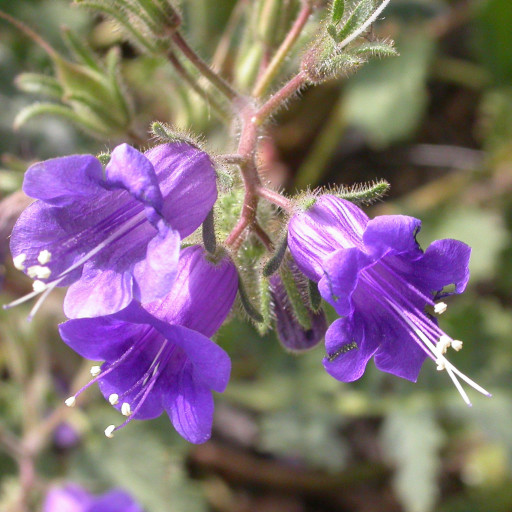
Plant Overview
Known as the "Desert Bluebell," this California native is famous for having some of the most intense, royal blue flowers in the botanical world. It is a hardy annual that turns arid landscapes into carpets of cobalt every spring, earning it a reputation as a "super bloom" superstar. In local lore, these bright bells are seen as tiny, resilient beacons of life that thrive where other plants wither.
🔍 How to Identify
- 💙 True Blue Flowers: Deep, bell-shaped blooms with five rounded lobes. They often feature bright white anthers that look like tiny glowing sparks inside the blue "cup."
- 🌿 Crinkly Foliage: The leaves are heart-shaped or oval with scalloped (toothed) edges. They usually appear dusty or grey-green, sometimes with a subtle reddish tint.
- 🪵 Reddish Stems: The plant grows on brittle, hairy stems that provide a striking color contrast against the dark green leaves and electric blue flowers.
🏡 In Your Garden
- 🏜️ The Desert Specialist: Because it originates from the Mojave and Sonoran deserts, it craves sandy, perfectly draining soil. If its "feet" stay wet in heavy clay, the plant will likely rot. It is built for drought and heat.
- 🐝 Pollinator Magnet: This is a premier choice for a "bee garden." Its nectar is highly accessible, and you will frequently see native bees and butterflies swarming the patches during its peak spring bloom.
- 🚫 Transplant Trouble: Like many desert annuals, it grows a delicate taproot quickly. It hates being moved once it has sprouted, so it is best to sow seeds directly into the soil rather than starting them in pots.
⚠️ Safety & Toxicity
- 🖐️ Skin Irritant: Use caution when weeding or thinning these plants. Phacelia species are covered in glandular hairs that contain oil (geranylhydroquinone) which can cause contact dermatitis—a red, itchy rash similar to poison ivy—in sensitive individuals.
- 🐾 Pet Safety: While not generally considered deadly if nibbled, those same stinging hairs can irritate a pet's muzzle or paws. It is best placed in the middle of a flower bed where it won't be brushed against frequently.
✨ Fun Fact
While many "blue" flowers are actually shades of violet or lilac, the Desert Bluebell contains a high concentration of the pigment delphinidin, making it one of the few plants in the world to produce a "true" electric blue that almost looks fluorescent under the desert sun.

Detailed Care Instructions
| Humidity | Normal |
| Lighting | Shade |
| Toxicity | Poisonous |
| Difficulty | Easy |
| Hibernation | Cold Period |
| Temperature | Min 10°C |
| Hardiness Zones | 3 - 10 |
To grow Phacelia Campanularia, also known as the California bluebell, you can follow these steps:
- Start by selecting a suitable location for planting. Phacelia Campanularia prefers full sun to partial shade, so choose an area that gets at least 6-8 hours of direct sunlight per day.
- Prepare the soil by removing any weeds or debris and loosening it with a garden fork or tiller. Phacelia Campanularia prefers well-draining soil, so you may need to amend heavy clay soil with organic matter or sand to improve drainage.
- Sow the seeds directly into the prepared soil. You can scatter the seeds lightly or plant them in rows, spacing them about 6-12 inches apart. The ideal time for sowing depends on your growing zone, but generally, it should be done in early spring after the last frost.
- Gently press the seeds into the soil but avoid burying them too deep. Phacelia Campanularia seeds need light to germinate, so a light layer of soil or compost over the top should be sufficient.
- Water the area thoroughly after sowing to ensure the soil is evenly moist. Continue to keep the soil moist but not waterlogged throughout the growing season. Morning or early evening watering is generally best to avoid excess evaporation.
- Once the seedlings emerge, thin them to maintain the desired spacing. For Phacelia Campanularia, a spacing of about 6-12 inches between plants will allow them to grow and spread comfortably.
- Phacelia Campanularia generally does not require much additional care. However, you can apply a balanced, slow-release fertilizer if desired, following the manufacturer's instructions. Monitor the plants for any signs of pests or diseases and take appropriate measures if needed, such as using organic pest control methods.
- Enjoy the beautiful blue bell-shaped flowers that will appear in mid to late spring. Phacelia Campanularia is a pollinator-friendly plant, attracting bees, butterflies, and other beneficial insects to your garden.
By following these steps, you can successfully grow Phacelia Campanularia and enjoy its vibrant blooms in your garden.

Place in a bright room that is sun drenched almost all day. Or directly in a south-facing window.

To properly water this plant, it is important to take note of its growing environment and soil type. This will determine the frequency and amount of water needed. Generally, the soil should be moist but not waterlogged, and it should never completely dry out.
To water, gently pour water around the base of the plant until the soil is moist, taking care not to splash water on the foliage. A good rule of thumb is to water deeply once a week, but adjust based on the specific needs of your plant and its growing conditions.
It is also important to water during the cooler parts of the day, such as early morning or late afternoon, to reduce the risk of evaporation and leaf scorching. Regularly checking the soil moisture level using a soil moisture meter or by testing the soil with your finger can also help ensure proper watering.
In summary, water this plant to keep the soil moist but not waterlogged, adjust watering frequency based on specific needs, water deeply once a week, and water during the cooler parts of the day while avoiding getting water on the foliage.
-Apply a balanced fertilizer with equal amounts of nitrogen, phosphorus and potassium.
-Fertilize the plant once a week during the growing season.
-Avoid fertilizing the plant during its dormant period.
-Use a water-soluble fertilizer and dilute according to package instructions.
-Fertilize the plant in the morning or evening, avoiding hot temperatures.
-Be careful not to over-fertilize as it can harm the plant.
The recommended soil for the plant with the scientific name Phacelia campanularia is well-draining, loamy soil that is rich in organic matter. It prefers a slightly acidic to neutral soil pH level between 6.0-7.5. The plant can become sensitive to soil deficiencies if the soil is too sandy or heavy. Therefore, it is essential to ensure that there is sufficient water retention in the soil while also allowing proper drainage. Adding perlite or vermiculite to the soil can improve aeration and drainage. Additionally, supplementation with compost and organic fertilizers can help provide essential nutrients to the plant.
To propagate this plant, start by collecting fresh seeds from mature plants. Sow the seeds in well-draining soil in a location with full sun to partial shade. Keep the soil moist but not waterlogged and be patient as germination can take up to two weeks.
Once the seedlings have emerged and developed their first true leaves, thin them out to allow sufficient space for growth. Water the plants regularly and fertilize lightly with a balanced fertilizer.
As the plants mature, they will develop their characteristic blue flowers and may even self-seed in favorable growing conditions. To propagate further, collect seeds from the mature plants and repeat the process. Alternatively, take stem cuttings and root them in water or soil, making sure to keep them moist until they have established roots.
With proper care and propagation, Phacelia Campanularia can be a beautiful and beneficial addition to any garden or landscape.








