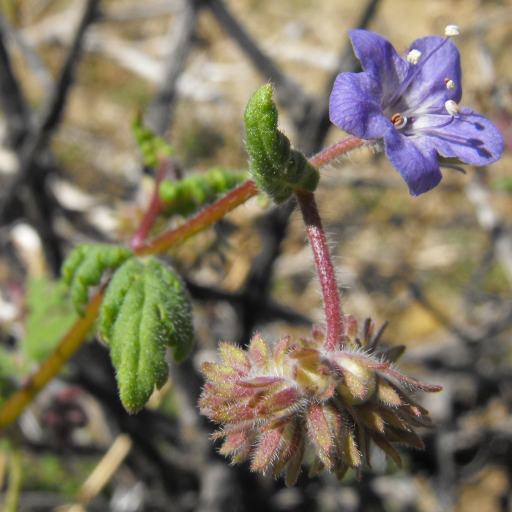
Plant Overview
Known commonly as the Wild Heliotrope or Distant Phacelia, this California native is a master of the arid landscape. Its flowers uncurl in a mesmerizing spiral, reminiscent of a scorpion’s tail, revealing delicate lavender blooms that provide a vital lifeline for native bees. While it looks soft and fern-like, this resilient plant is a survivor, painting desert washes and dry hillsides with shades of violet every spring.
🔍 How to Identify
- 🌿 Fern-like Foliage: The leaves are intricately divided and lace-like, often being mistaken for ferns or common garden weeds until the striking flowers emerge.
- 🌀 Scorpioid Cymes: The flower clusters grow on a "fiddlehead" stem that slowly uncurls as the buds open, a unique structural trait of the Phacelia genus.
- 🌸 Bell-Shaped Blooms: The small, five-petaled flowers range from pale blue to deep lavender. They feature long, delicate stamens that extend outward, giving the flower a "fuzzy" or "starry" appearance.
🏡 In Your Garden
- ☀️ Sun Seeker: This plant is an "extremophile" that thrives in the harshest conditions. It prefers sandy, well-drained soil and full sun, making it an excellent choice for rock gardens or xeric (drought-tolerant) landscaping.
- 🐝 Pollinator Magnet: If you want to support local biodiversity, this is a must-have. It produces high-quality nectar that attracts honeybees, bumblebees, and butterflies, helping to pollinate your entire garden.
- 🌱 Self-Sowing Nature: Because it is an annual, it focuses all its energy on seed production. Once established, it will often "plant itself" for the next year, returning as a pleasant surprise when the rains arrive.
⚠️ Safety & Toxicity
- 🚫 Skin Irritation: While beautiful, this plant has a hidden defense. The tiny glandular hairs on its stems and leaves contain oils that can cause contact dermatitis (a red, itchy rash) in sensitive individuals, similar to the reaction caused by poison oak.
- 🧤 Handle with Care: It is not considered toxic to pets or humans if accidentally nibbled, but the skin irritation is common. It is always best to wear gardening gloves when pruning or weeding around Phacelia.
✨ Fun Fact
The name Phacelia comes from the Greek word phakelos, meaning "bundle," which describes the way the flowers are tightly packed together on their coiled stems!

Detailed Care Instructions
To grow Phacelia distans plants, you can follow these steps:
- Climate requirements: Phacelia distans plants prefer a sunny location but can tolerate light shade. They thrive in well-drained soils and can grow in a range of soil types.
- Seed selection: Purchase Phacelia distans seeds from a reliable source. Make sure the seeds are fresh and healthy.
- Seed starting: Start the seeds indoors in late winter or early spring, about 4-6 weeks before the last expected frost. Sow the seeds on the surface of a seed tray or individual pots filled with moist, well-draining seed starting mix.
- Germination: Phacelia distans seeds require light to germinate, so do not cover them with soil. Place the tray or pots in a sunny location or under grow lights to provide adequate light. Keep the soil moist but not waterlogged.
- Transplanting: When the seedlings have developed a few sets of true leaves and all danger of frost has passed, transplant them into well-prepared garden soil or larger pots. Space them at least 12-18 inches apart to allow for their spreading growth habit.
- Watering and fertilizing: Keep the soil evenly moist but avoid overwatering, as these plants are prone to root rot. Water them deeply when the top inch of soil feels dry. Fertilize with a balanced organic fertilizer, following the package instructions, once a month during the growing season.
- Mulching: Apply a layer of organic mulch around the plants to conserve soil moisture, suppress weed growth, and provide some insulation.
- Maintenance: Phacelia distans plants are generally low maintenance. Remove any weeds that compete for nutrients and water. Pinch back the tips of the plants to encourage bushier growth.
- Pests and diseases: These plants are relatively pest and disease-free. However, keep an eye out for aphids, slugs, and snails. Treat any infestations promptly with appropriate organic pest control methods.
- Flowering and seed production: Phacelia distans plants typically bloom during the spring and summer, producing delicate lavender or purple flowers. Bees and other pollinators are attracted to the flowers. Allow some flowers to produce seeds for self-seeding or collect and save the seeds for future planting.
By following these steps, you should be able to successfully grow Phacelia distans plants in your garden or containers.

Place in a bright room that is sun drenched almost all day. Or directly in a south-facing window.

Phacelia Distans is a flowering plant that requires adequate watering to ensure healthy growth. To water this plant, you should follow a few guidelines:
1. Soil testing: Before watering the plant, check the moisture level of the soil. To do so, you can stick your finger 1-2 inches deep into the soil. If it feels dry, it’s time to water.
2. Watering method: When watering Phacelia Distans, it’s best to use a gentle stream of water to avoid damaging the plant. Use a watering can or a hose with a gentle nozzle and water the base of the plant and not the leaves.
3. Frequency: The frequency of watering depends on the climate and growing conditions. In general, the plant needs watering once or twice a week. However, if the weather is particularly hot and dry, you may need to water more often.
4. Water quantity: The amount of water you need to give to this plant depends on the size of the pot and the level of moisture in the soil. Avoid over-watering as this can cause root rot and other problems.
5. Drainage: Phacelia Distans grows best in well-draining soil to avoid waterlogging. Ensure that the pot has drainage holes to prevent water from accumulating at the bottom.
By following these watering tips, you can ensure that your Phacelia Distans plant remains healthy and vibrant.
To fertilize the unnamed plant, you should use a balanced fertilizer, such as a 10-10-10 fertilizer, applied at a rate of 1/2 pound per 100 square feet of soil every two to three months during the growing season. You should also incorporate compost or organic matter into the soil before planting to provide nutrients for the plant's growth. Avoid over-fertilizing the plant, as this can lead to excessive growth and reduced flower production. Always follow the instructions on the fertilizer label for application rates and timing.
To support the growth of the plant species, Phacelia Distans, a well-draining soil with a neutral pH level is recommended. The ideal soil should be rich in nutrients while maintaining good drainage capacity to prevent stagnant water and soil compaction. A mixture of loam, sand, and organic matter can be used to create the appropriate texture and quality of soil. The recommended soil type should be able to hold sufficient moisture for the plant's growth while ensuring adequate air circulation around the roots. Additionally, it is essential to ensure that the soil is free from pests, diseases, and weed seeds that can harm the plant.
Phacelia distans can be propagated through both seeds and stem cuttings. For propagating through seeds, one should collect the mature seeds from the plant and clean them properly. Then, sow the seeds in a well-draining soil mixture in a seed tray and keep it moist. The seeds will germinate within a few weeks and can be transplanted to the desired location once they have grown enough.
For propagating through stem cuttings, select a healthy stem from the plant and take a cutting of around 6 inches. Remove the lower leaves and dip the cut end in a rooting hormone powder. Then, plant the cutting in a pot filled with a well-draining soil mixture and keep it moist. After a few weeks, the cutting will develop roots and can be transplanted to the desired location.
Both methods of propagation require regular watering and proper care to ensure successful growth. It is important to note that Phacelia distans is an annual plant and will need to be replanted every year.








