Plant Overview
Known as the "Eye Drop Tree" or Kalimatas in its native Philippines, Phaeanthus ophthalmicus is a hidden gem of the Southeast Asian rainforests. This slender tree carries a reputation as a living pharmacy, with a name that literally points to its historical use in treating "sore eyes" (conjunctivitis). It is a member of the Custard Apple family, though its "fruits" are far less famous than its medicinal leaves.
🔍 How to Identify
- 🌸 The "Unequal" Flowers: The most striking feature is the nodding flowers. They have three tiny outer petals and three much larger, fleshy, pale-yellow inner petals that hang downward like heavy pendants.
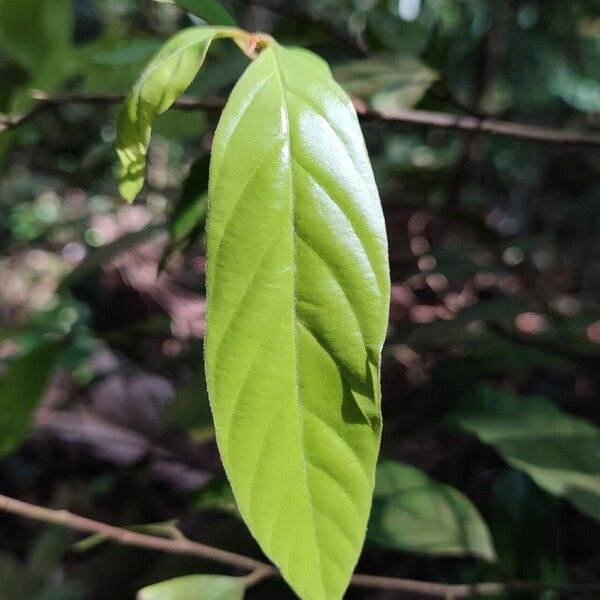
- 🍃 Elliptic Foliage: The leaves are dark green, glossy, and oblong. They grow in a distinct horizontal pattern along the branches, optimized to catch the flickering sunlight of the forest understory.
- 🍒 Clustered Carpels: After flowering, it produces small, berry-like fruits that turn from green to a dark purple or black, sitting in small clusters on a central stalk.
🏡 In Your Garden
- ☁️ The Shade Dweller: Because it originates in the deep lowland forests, this plant is "sciadophilous"—meaning it absolutely loves the shade. In a garden setting, it will scorch in direct afternoon sun; it needs the protection of taller canopy trees.
- 💦 Humid Ambience: It thrives in "heavy" air. If you live in a dry climate, this plant will struggle without regular misting or a very sheltered, damp spot near a water feature. It prefers rich, loamy soil that never fully dries out.
⚠️ Safety & Toxicity
- 🧪 Medicinal Assessment: While the leaf extracts are used in traditional medicine for eye ailments, this should never be attempted at home without professional pharmacological processing.
- 🚫 Non-Edible: Unlike its cousins (the Soursop or Custard Apple), the fruits and bark are not for consumption. They contain alkaloids that can cause nausea or allergic reactions if ingested by humans or pets.
✨ Fun Fact
- 📜 Etymology in Action: The species name ophthalmicus is derived from the Greek word ophthalmos, meaning "eye." It is one of the few plants in the world whose formal scientific name is based entirely on its specific use in folk ophthalmology!

Detailed Care Instructions








