Plant Overview
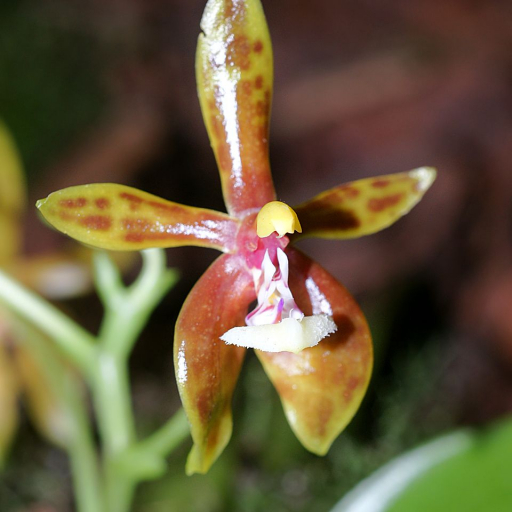
Often referred to as the "Tiger-striped Phalaenopsis," this elegant species orchid hails from the humid forests of the Eastern Himalayas and Southeast Asia. Unlike the common, large-petaled hybrids found in grocery stores, Phalaenopsis mannii is a collector's favorite for its star-shaped blooms and intricate mahogany patterns. It is a graceful epiphyte that brings a touch of the wild, tropical canopy into any indoor garden.
🔍 How to Identify
- 🐯 The Blooms: Features glossy, star-shaped flowers that are typically yellow or greenish-yellow, heavily marked with bold, reddish-brown horizontal bars or blotches.
- 🍃 The Foliage: Long, leathery, tongue-shaped leaves that are a rich, dark green. In high light, the base of the leaves may develop a subtle purple tint.
- ⚓ The Lip: A distinctive, anchor-shaped white or pale yellow "lip" (labellum) at the center of the flower, which often features delicate, hair-like fringes.
🏡 In Your Garden
- ☁️ Shadow Seeker: This orchid is a natural understory dweller. It thrives in "deep shade" compared to other orchids; if its leaves turn yellow-green, it’s likely getting too much direct sun.
- 💧 Humidity Lover: Because it grows on tree branches in the wild, it despises stagnant, dry air. It prefers high humidity and a "breathable" potting medium like coarse fir bark or being mounted directly onto a cork slab.
- 🌡️ Temperature Nuance: It is a "cool-to-intermediate" grower. It appreciates a slight drop in temperature at night to trigger its spectacular flowering season, which usually occurs in the spring.
⚠️ Safety & Toxicity
- ✅ Pet Friendly: Like most members of the Orchidaceae family, Phalaenopsis mannii is considered non-toxic to cats, dogs, and horses.
- 👶 Child Safe: It is safe for curious toddlers, though the delicate flowers are easily bruised by tiny hands, and the potting bark can be a choking hazard.
✨ Fun Fact
This species was named after Gustav Mann, a German botanist who discovered it in India in the mid-19th century. A single flower spike can produce blooms sequentially for up to three months, making it one of the longest-lasting displays in the orchid world!

Detailed Care Instructions








