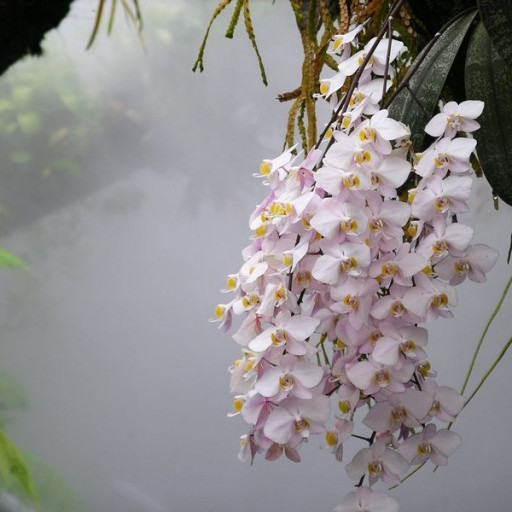
Plant Overview
Often hailed as the "Jewel of Luzon," the Phalaenopsis philippinensis is a showstopper even when it isn't in bloom. While most moth orchids are known primarily for their flowers, this Philippine native is prized for its striking, marbled foliage that looks like dappled moonlight on a forest floor. It is a sophisticated choice for indoor gardeners looking to move beyond the common grocery-store varieties.
🔍 How to Identify
- 🌸 The Bloom: It produces elegant, pristine white flowers. If you look closely at the "lip" (the center), you’ll find delicate splashes of yellow and orange-red markings.
- 🍃 Mottled Foliage: The most distinct feature is the leaves. They are thick and leathery, featuring a dark green base heavily marbled with silvery-grey patterns on top and a rich purple tint underneath.
- 🌿 Root System: It features thick, silvery-grey aerial roots that are adapted to "breath" and cling to surfaces rather than bury deep into dense soil.
🏡 In Your Garden
- 🌴 Epiphytic Nature: In the wild, this orchid grows on tree trunks in the humid rainforests of the Philippines. This means it hates "wet feet." It thrives best in a loose, airy medium like fir bark or sphagnum moss rather than traditional potting soil.
- ⛅ Light & Air: It prefers bright, indirect light—think of the filtered sun hitting a forest floor. It also requires good air circulation; a stagnant, humid corner can lead to crown rot, so a small fan nearby can work wonders.
⚠️ Safety & Toxicity
- ✅ Non-Toxic Status: This orchid is generally considered non-toxic to humans, cats, and dogs. It is one of the safer choices for households with curious pets.
- 🌱 Mild Sensitivity: While not poisonous, the sap from a broken stem might cause very minor skin irritation for people with extreme sensitivities. As with any houseplant, it’s best to keep it out of reach of nibbling toddlers to prevent choking hazards.
✨ Fun Fact
This species is a "genetic superstar" in the orchid world! Breeders frequently use Phalaenopsis philippinensis in hybridization because it is one of the few species that can pass down its beautiful mottled leaf patterns to its offspring, creating the patterned-leaf orchids we see in specialty shops today.

Detailed Care Instructions
To grow a Phalaenopsis Philippinensis (Philippine orchid), follow these steps:
- Lighting: Place the plant in a bright location with indirect sunlight. Avoid exposing it to direct sunlight, as it can scorch the leaves.
- Temperature: Phalaenopsis Philippinensis prefers average indoor temperatures between 70-85°F (21-29°C) during the day and slightly cooler temperatures of 60-65°F (15-18°C) at night.
- Humidity: These orchids thrive in high humidity. You can increase humidity by placing the pot on a tray filled with water and pebbles or using a humidifier nearby. Mist the leaves occasionally to provide additional moisture.
- Watering: Water Phalaenopsis orchids thoroughly, allowing water to run out the drainage holes of the pot. It's important not to let the roots sit in water, so empty the tray or cachepot after watering. Water the plant once a week or when the top inch of the potting medium feels dry. Adjust the frequency based on the humidity and temperature of your home.
- Potting medium: Use a well-draining orchid-specific potting medium like bark chips or sphagnum moss. Avoid using regular potting soil, as it retains too much moisture and can lead to root rot.
- Fertilization: Feed the orchid with a balanced orchid fertilizer every two weeks during the growing season (spring and summer) and every four weeks during the dormant period (fall and winter). Follow the instructions on the fertilizer package for the correct dosage.
- Air circulation: Good air circulation is vital for Phalaenopsis Philippinensis. Avoid placing it in a stagnant or overly crowded area. A small fan can be used to improve air movement if necessary.
- Repotting: Phalaenopsis orchids generally require repotting every 1-2 years. Repot the plant in fresh potting medium when the roots start to outgrow the pot or the medium becomes broken down.
- Pruning: Regularly remove dried, discolored, or dead leaves and flowers to maintain the plant's overall health and appearance.
- Dormancy period: Phalaenopsis orchids may enter a dormant phase after blooming. During this time, reduce watering frequency, lower the temperature slightly, and provide less fertilizer. This period allows the plant to rest and gather energy for future blooms.
By providing the right conditions and care, your Phalaenopsis Philippinensis should thrive and produce beautiful flowers.

Place in a window with dappled sun or a spot in the middle of a room. Or directly in a window facing west or east.

To water this plant, you must first determine the level of humidity in the air. If the humidity is low, consider using a humidifier nearby or placing a tray of water beneath the plant to maintain moisture in the air.
When it comes to watering, it is important to avoid getting water on the leaves or blooms, as this can cause damage. Instead, water the plant at the base, being careful not to let the water sit in the soil or pool around the roots.
It is not advisable to water this plant on a strict schedule, as the frequency of watering will depend on various factors such as temperature, humidity, and the condition of the soil. Instead, it is recommended to test the soil with your fingertips before watering, ensuring that the top inch of soil is dry before adding more water.
In addition, be sure to use room temperature or lukewarm water to prevent shocking the roots, and use a fertilizer designed specifically for orchids to promote healthy growth. With proper care and attention, this plant can thrive and produce stunning blooms.
To fertilize this plant, use a balanced orchid fertilizer with an N-P-K ratio of 20-20-20 or 10-10-10. Feed the plant every two weeks during active growth and every four to six weeks during the dormant period. Dilute the fertilizer to half the recommended strength and apply it to the plant's roots and foliage. Avoid getting fertilizer on the leaves or flowers as it may cause damage. Water the plant thoroughly before and after fertilizing to prevent fertilizer salt buildup in the potting mix.
Phalaenopsis Philippinensis plant requires a well-draining soil that is rich in organic matter. The soil should be slightly acidic with a pH range of 5.5-6.5. It is recommended to use a mix of bark, sphagnum moss, perlite, and charcoal to provide good drainage and aeration to the roots. The soil should also have good water-retention properties to prevent the roots from drying out. It is important to use a soil that does not compact easily and allows air to circulate to the roots. The soil should be kept moist but not waterlogged, as excessive moisture can lead to root rot. A well-draining soil will allow excess water to drain away easily, preventing waterlogging and providing optimal soil conditions for the plant to grow.
One way to propagate this plant is to take a stem cutting. Select a healthy stem that has at least one node (the point where a leaf is attached to the stem). Use a sharp and clean pair of scissors to cut the stem just below the node. Make the cut at a 45-degree angle to increase surface area for rooting.
Prepare a small pot with well-draining potting mix. Dip the cut end of the stem into rooting hormone powder (optional) and plant it in the potting mix, burying the node. Water the cutting well and cover the pot with a plastic bag to create a humid environment.
Place the pot in a bright, indirect light location with a temperature range between 70-85°F (21-29°C). Check the soil regularly and water as needed to keep it moist but not waterlogged.
Over the course of a few weeks, the cutting should start to develop new growth and roots. Once the new growth is established, you can remove the plastic bag and gradually acclimate the plant to normal growing conditions.
Another method of propagation is through division. When the plant outgrows its pot and produces multiple new growths, carefully remove the plant and gently separate the roots. Each individual growth can be potted up separately and treated as a new plant. Be sure to keep the new plants in a humid environment until they are well established.
Common pests of the phalaenopsis philippinensis include Scale insect, mealybugs, spider mites, thrips. Make a habit of checking your phalaenopsis philippinensis frequently for pests so that any infestations can be caught and managed early.







