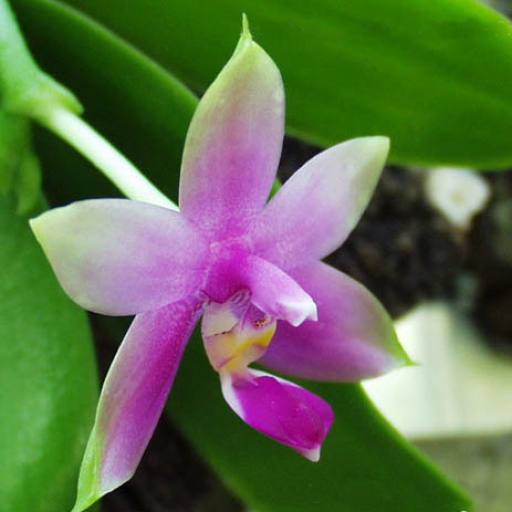
Plant Overview
Known as the "Violet Orchid," Phalaenopsis violacea is a crown jewel of the orchid world. Unlike the scentless hybrids found in most supermarkets, this species is world-famous for its powerful, spicy fragrance that can fill an entire room. Hailing from the humid, lowland forests of Southeast Asia, it is a compact beauty that brings a touch of the primitive jungle into the modern home.
🔍 How to Identify
- 🌸 Star-Shaped Blooms: Unlike the rounded "moth" shape of common orchids, these flowers are distinctly pointed and star-like, featuring a thick, waxy texture.
- 🎨 Vibrant Gradient: The petals typically display a stunning transition, fading from a lime-green or creamy white at the tips to a deep, saturated magenta or violet at the center.
- 🍃 Glossy Foliage: The leaves are broad, oval, and have a highly reflective, patent-leather sheen that makes the plant look healthy and lush even when it isn't flowering.
🏡 In Your Garden
- 🧺 The "Pendant" Habit: In the wild, this orchid grows sideways or even upside down on tree trunks to prevent water from sitting in its "throat" and causing rot. For the best results, grow it in a hanging basket or mounted on a piece of cork bark.
- 🌡️ Tropical Requirements: This is a "warm grower." It hates the cold and requires high humidity (above 60%) to thrive. It doesn't have pseudobulbs to store water, so it prefers to stay consistently moist rather than drying out completely between waterings.
⚠️ Safety & Toxicity
- ✅ Pet Friendly: This orchid is non-toxic to cats, dogs, and horses, making it a perfect choice for households with curious furry friends.
- 👶 Safe for Kids: It is entirely non-poisonous to humans. However, the waxy flowers are delicate, and the plant should be kept out of reach of toddlers to prevent damage to the slow-growing blooms.
✨ Fun Fact
- 👃 Solar Powered Perfume: Phalaenopsis violacea is the primary "ancestor" used by breeders to create scented orchids. Interestingly, the plant only releases its signature cinnamon-and-lily scent during daylight hours, using the sun’s warmth to evaporate its fragrant oils!

Detailed Care Instructions
To grow a Phalaenopsis Violacea plant, you can follow these steps:
- Choose a suitable orchid pot: Select a pot that is slightly larger than the root mass of the orchid, as Phalaenopsis orchids prefer snug pots. Ensure the pot has drainage holes.
- Pick appropriate potting medium: Phalaenopsis Orchids thrive in a well-draining orchid mix. You can use a mix of bark chips, sphagnum moss, perlite, and charcoal.
- Provide the right light: Place your orchid in a location with bright, indirect light. Phalaenopsis Orchids prefer bright, filtered light rather than direct sunlight. If you keep them indoors, a north-facing window sill is usually ideal.
- Maintain proper temperature and humidity: Phalaenopsis Violacea plants prefer moderately warm temperatures ranging from 18-25°C (65-80°F) during the day and slightly cooler temperatures at night. They also enjoy high humidity levels of around 60-70%. You can increase humidity by placing a tray of water near the plant or using a room humidifier.
- Watering: Water your Phalaenopsis violet orchid thoroughly when the potting medium feels almost dry. Avoid overwatering, as this can lead to root rot. It's better to underwater than overwater.
- Fertilize regularly: Phalaenopsis Orchids benefit from regular fertilization to promote healthy growth and bloom. Use a balanced orchid fertilizer with a ratio of 20-20-20 or a specialized orchid fertilizer. Follow the instructions on the fertilizer package for application rates and frequency.
- Repotting: Phalaenopsis Violacea plants typically require repotting every 1-2 years, or when the potting medium breaks down or becomes too compact. Repotting should be done after flowering, using fresh orchid mix.
- Maintain good air circulation: Phalaenopsis orchids enjoy good air movement around their roots and leaves. Ensure that there is sufficient airflow to prevent any bacterial or fungal diseases.
Remember, Phalaenopsis Orchids are generally low-maintenance plants, but they require consistency in their care to thrive. With appropriate growing conditions, you can enjoy the beautiful flowers of your Phalaenopsis Violacea plant.

Place in a window with dappled sun or a spot in the middle of a room. Or directly in a window facing west or east.

Phalaenopsis Violacea plant requires regular watering to keep the soil moist, but not waterlogged. One should water the plant deeply until the water starts to drain out of the drainage holes. It is essential to avoid watering the plant in excess, as it can lead to root rot and other fungal diseases. Watering the plant once or twice a week during the growing season is sufficient, depending on the temperatures and humidity levels in the environment. In the dormancy period, reduce watering to allow the plant to rest. It is advisable to use tepid water for watering, as cold water can shock the roots, and warm water can encourage bacterial growth. Additionally, avoid wetting the leaves and flowers while watering, as it can lead to fungal infections.
To fertilize this specific plant, use a water-soluble fertilizer. Dilute the fertilizer to half strength and apply every two weeks during the growing season. During the blooming season, reduce the frequency to once a month. Avoid fertilizing during dormancy. Water the plant before applying the fertilizer to prevent root burn.
Phalaenopsis Violacea plants prefer a well-draining soil mixture that is rich in organic matter, but not too heavy. It is important that the soil retains some moisture, but also has good air circulation around the roots. A mix of coarse bark, perlite, and sphagnum moss is a popular choice for these plants. It is important to avoid using regular potting soil or garden soil, as it can become too compacted and retain too much moisture, leading to root rot. The pH of the soil should be slightly acidic to neutral, around 5.5-6.5.
Step 1: Choose a healthy and mature Phalaenopsis Violacea plant with at least two strong air roots.
Step 2: Using a clean and sharp knife, cut the stem of the orchid about 5-6 inches below the bottom leaves.
Step 3: Dip the cut end of the stem in rooting hormone powder.
Step 4: Use a pot with well-draining potting soil and make a hole in the center.
Step 5: Place the stem in the hole and gently press the soil around it.
Step 6: Water the soil thoroughly, but avoid overwatering.
Step 7: Cover the top of the pot with a clear plastic bag to maintain humidity.
Step 8: Place the pot in a warm and bright location, but avoid direct sunlight.
Step 9: Remove the plastic bag once new growth appears, and mist the plant regularly to maintain moisture.
Step 10: Once the roots are established, transplant the plant into a new pot with the appropriate potting mix for Phalaenopsis Violacea.
Common pests of the violet phalaenopsis include Scale insect, mealybugs, spider mites, thrips. Make a habit of checking your violet phalaenopsis frequently for pests so that any infestations can be caught and managed early.








