Plant Overview
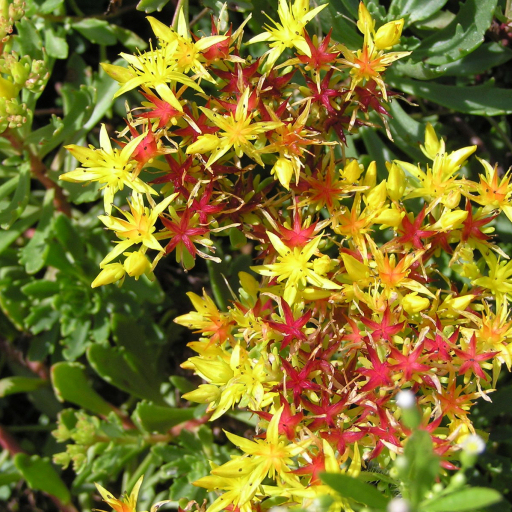
Often called the Kamchatka Stonecrop, this rugged little succulent hails from the volcanic coastlines and rocky slopes of Northeast Asia. It is a favorite for gardeners who want a "plant it and forget it" groundcover that transforms from a lush green carpet into a vibrant sea of golden stars. Known for its ability to thrive where other plants wither, it’s a true survivor of the plant world.
🔍 How to Identify
- 🍃 Toothed Foliage: Unlike many smooth-edged succulents, its spoon-shaped, fleshy leaves have distinct serrated (toothed) edges toward the tips.
- ⭐ Starry Blooms: In midsummer, it produces flat-topped clusters of bright yellow, five-petaled flowers that often transition into a deep orange or bronze as they age.
- 📏 Mat-Forming Habit: It grows in a dense, spreading mound, rarely reaching more than 6–10 inches in height, creating a thick "living rug" over the soil.
🏡 In Your Garden
- 🪨 The Drainage Rule: While it’s incredibly hardy, its "Achilles' heel" is soggy soil. It thrives in rocky, sandy, or poor soils where water moves quickly away from its shallow roots to prevent rot.
- ❄️ Winter Warrior: Unlike tropical succulents, this species is exceptionally cold-hardy. In late autumn, the foliage may take on a beautiful reddish-purple tint as it prepares for the frost, bouncing back quickly in early spring.
⚠️ Safety & Toxicity
- 🐾 Pet Safety: This plant is generally considered non-toxic to cats, dogs, and horses, making it a "worry-free" choice for low-level garden borders.
- 👅 Mild Irritation: While not considered poisonous, ingesting large quantities can lead to a mild stomach upset. The sap may also cause very slight skin irritation for individuals with extreme sensitivities.
✨ Fun Fact
🏙️ Sky-High Resident: Because of its incredible resilience to wind, intense sun, and shallow soil, Phedimus kamtschaticus is one of the most popular species used for "Green Roofs" in urban architecture, helping to cool buildings and provide habitats for pollinators high above the city streets!

Detailed Care Instructions
Here are some tips on how to grow Phedimus kamtschaticus, also known as Kamchatka stonecrop or Russian stonecrop plant:
- Sunlight: Phedimus kamtschaticus requires full sun to partial shade for optimal growth. Choose a location where the plant can receive at least six hours of direct sunlight per day.
- Soil: The plant thrives in well-draining soil. Ensure the soil is loose and fertile. You can amend heavy clay soil with organic matter, such as compost or peat moss, to improve drainage.
- Planting: Dig a hole slightly larger than the root ball and place the plant in the hole. Backfill with soil, gently firming it around the roots. Ensure the crown of the plant is level with the soil surface.
- Watering: Phedimus kamtschaticus has moderate water needs. Water the plant thoroughly after planting and during dry spells. Allow the soil to slightly dry out between waterings to prevent overwatering, which can cause root rot.
- Fertilizer: This plant typically does not require regular fertilization. However, you can apply a balanced, slow-release fertilizer in early spring to help stimulate growth.
- Pruning: Pruning is generally not necessary for Phedimus kamtschaticus, but you can remove any dead or damaged leaves and stems for aesthetic purposes.
- Propagation: Phedimus kamtschaticus can be propagated through stem cuttings or by division. Stem cuttings can be taken in spring or early summer and planted in well-draining soil. Division can be done in early spring by separating the plant's clumps and replanting them.
- Winter care: This plant is relatively cold hardy, but in regions with severe winters, it may benefit from a layer of mulch to protect the roots from frost. Mulch can also help retain moisture in the soil.
By following these steps, you should be able to successfully grow Phedimus kamtschaticus in your garden or container. Happy gardening!

Place in a bright room that is sun drenched almost all day. Or directly in a south-facing window.

To water this plant, it is important to pay attention to the soil moisture level. Before watering, check the soil moisture by sticking your finger about 1 inch into the soil. If it feels dry, it is time to water. However, if it feels moist, you can wait a few days before watering.
When watering, use room temperature water and avoid getting water on the leaves as this can cause damage. Water the soil evenly until it starts to drain out of the bottom of the pot. Allow the soil to drain completely before returning the pot to its saucer.
In general, this plant prefers moderate watering, meaning it should not be allowed to dry out completely nor should it be kept too wet. In the winter, you can reduce the amount of watering as the plant enters dormancy.
To fertilize Phedimus kamtschaticus, you can follow these instructions:
- Choose a balanced, all-purpose fertilizer with equal ratios of nitrogen (N), phosphorus (P), and potassium (K). Look for a slow-release granular fertilizer specifically formulated for succulent plants.
- Apply the fertilizer during the active growing season, which is typically in spring through summer.
- Dilute the fertilizer according to the manufacturer's instructions. Alternatively, you can use a weaker concentration than recommended, as succulents generally require lower levels of nutrients.
- Water the plant thoroughly before fertilizing, ensuring the soil is slightly moist. This helps prevent root burn or damage from the concentrated fertilizer.
- Carefully pour the diluted fertilizer solution onto the soil around the base of the plant. Avoid getting the fertilizer on the leaves or other parts of the plant.
- After fertilizing, water the plant lightly to help the nutrients penetrate the soil and reach the roots.
- Repeat the fertilization process every 2-4 weeks during the active growing season. Adjust the frequency based on the specific fertilizer's instructions.
Remember that proper watering and well-draining soil are also important factors in maintaining the health of your Phedimus kamtschaticus plant. Always observe the plant's response to determine if any adjustments to the fertilization routine are necessary.
Phedimus Kamtschaticus prefers a well-draining soil that is rich in organic matter. It is important to use a soil that has a slightly acidic to neutral pH level, between 6.0 and 7.0. The soil should also have good moisture retention without being too waterlogged or compacted. A mix of sand, loam, and peat moss would be ideal for this plant. Additionally, adding perlite to the soil mixture will aid in drainage and aeration. It is important to avoid using heavy clay soils which may retain too much moisture, leading to root rot.
Phedimus Kamtschaticus, also known as Sedum Kamtschaticum or Russian Stonecrop, is a perennial succulent plant that can be propagated through different methods. Here are the details on how to propagate this plant:
- Division: One way to propagate Phedimus Kamtschaticus is through division. To do this, dig up the mature plant from the soil during the early spring or autumn when the plant is not actively growing. Gently separate the plant into smaller clumps ensuring that each division has a good amount of healthy roots attached. Replant these divisions in separate pots or in prepared garden beds, allowing them to establish their root system.
- Stem cuttings: Another method of propagation is through stem cuttings. Take cuttings from the plant during the growing season, which is typically late spring or early summer. Look for healthy stems that are at least 2-3 inches long. Using a clean and sharp knife or shears, make a clean cut below a node (the area where leaves are attached to the stem). Remove the lower leaves, leaving a small rosette of leaves at the top. It is important to allow the cuttings to dry and callus over for a day or two before planting them. Then, plant the cuttings in a well-draining potting mix, keeping the soil slightly moist until roots develop.
- Leaf cuttings: Leaf cuttings can also be used to propagate Phedimus Kamtschaticus. Select healthy and mature leaves from the plant, ensuring that they are fully intact. Gently remove the leaves from the stem, making sure that the cut end is clean and not damaged. Allow the leaf cuttings to dry for a few days before planting. Place the cuttings in a well-draining soil mix and mist them occasionally to maintain humidity. Roots will eventually develop from the leaf cuttings, and new plants will emerge.
- Offsets: Phedimus Kamtschaticus also produces offsets, which are small daughter plants that grow around the base of the main plant. These offsets can be carefully separated from the parent plant and replanted in separate pots or garden beds. Ensure that each offset has some roots attached and plant it at the same depth as its parent plant. Water the new offsets regularly until they establish their root system.
Regardless of the propagation method chosen, it is important to provide the newly propagated plants with adequate sunlight, well-draining soil, and regular watering until they establish themselves. With proper care, these propagated Phedimus Kamtschaticus plants will grow and develop into mature, flowering succulents.








