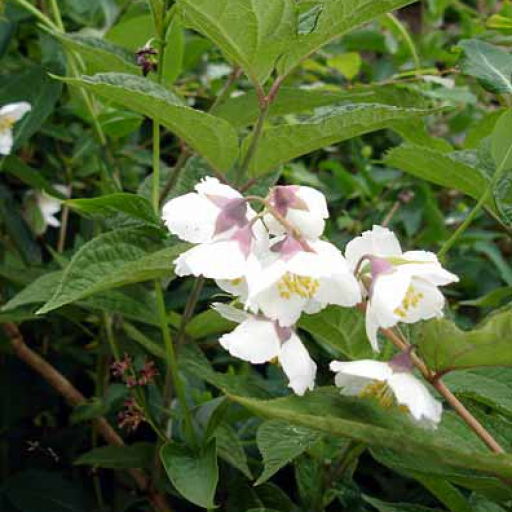
Plant Overview
Often called the Purple-cup Mock Orange, this elegant shrub hails from the high-altitude mountains of China. It is beloved by gardeners for its intoxicating scent, which mimics orange blossoms, even though the plant isn't related to citrus at all. In late spring, it transforms into a fountain of white petals, adding a touch of old-world romance and a heavy perfume to any landscape.
🔍 How to Identify
- 🌸 The Purple Calyx: The most distinct feature is the "cup" (calyx) at the base of the white petals, which glows with a deep purplish-maroon hue, providing a sharp contrast to the snowy blooms.
- 🕊️ The Flowers: Four-petaled, creamy white flowers that appear in small clusters. They are famous for their powerful, sweet fragrance that can fill an entire garden.
- 🍃 Leaf Texture: Medium-green, ovate leaves with a slightly fuzzy underside and subtly serrated edges that turn yellow in the autumn.
- 🎋 Arching Habit: The shrub grows with a graceful, fountain-like shape, with older stems featuring slightly peeling (exfoliating) bark.
🏡 In Your Garden
- 🌬️ Scent Placement: Because the fragrance is its strongest asset, plant it near a window, patio, or walkway where the "mock orange" perfume can be enjoyed on summer breezes.
- ✂️ Pruning Nuance: This plant blooms on "old wood" (stems from the previous year). To avoid cutting off next year’s flowers, prune it immediately after the blooms fade in early summer rather than in the spring.
- 🌍 Soil & Drainage: While it is quite hardy and adapts to various soil types, it is sensitive to "wet feet." Ensure your soil is well-draining to prevent root rot.
⚠️ Safety & Toxicity
- ✅ General Safety: Philadelphus purpurascens is generally considered non-toxic to humans and is not listed as a high-risk plant for common livestock like horses.
- 🐾 Pet Sensitivity: While not inherently poisonous to cats or dogs, the ingestion of any woody ornamental foliage can cause mild digestive upset. It is best kept away from curious chewers.
✨ Fun Fact
The genus name Philadelphus is derived from the Greek for "brotherly love." It was named in honor of Ptolemy II Philadelphus, a king of ancient Egypt who was a great patron of the arts and sciences.

Detailed Care Instructions
To grow Philadelphus purpurascens, also known as purple mock orange, follow these steps:
- Choose a planting location: Philadelphus purpurascens prefers full sun to partial shade. Select a spot with well-draining soil. The plant can tolerate a range of soil types but prefers moderately fertile soil.
- Prepare the soil: If the soil is heavy or clay-like, amend it with organic matter such as compost or well-rotted manure to improve drainage and fertility. Ensure that the soil pH is neutral to slightly acidic.
- Planting: Dig a hole that is wider and slightly deeper than the plant's root ball. Place the plant in the hole, ensuring that the top of the root ball is level with the surrounding soil. Backfill the hole with soil, firming it gently to eliminate air pockets.
- Watering: Water the plant thoroughly after planting to settle the soil around the roots. Afterward, water regularly, especially during periods of drought. The soil should be consistently moist but not waterlogged.
- Mulching: Apply a layer of organic mulch around the base of the plant. This will help retain moisture, suppress weed growth, and keep the roots cool.
- Pruning: Prune Philadelphus purpurascens right after blooming, typically in late spring or early summer. Remove any dead, diseased, or damaged branches. Additionally, thin out older wood to encourage new growth and maintain a pleasing shape.
- Fertilizing: In early spring, apply a balanced slow-release fertilizer according to the package instructions. This will provide the necessary nutrients for healthy growth and flowering.
- Pest and disease control: Philadelphus purpurascens is generally resistant to pests and diseases. However, it's a good practice to regularly inspect the plant for any signs of infestation or disease. If any issues are discovered, appropriate measures can be taken, such as using organic insecticides or fungicides.
- Propagation: Philadelphus purpurascens can be propagated through softwood or hardwood cuttings in early summer or late fall, respectively. Alternatively, it can also be propagated through division during the dormant season by separating the suckers that form around the base of the plant.
By following these steps, you should be able to successfully grow and care for Philadelphus purpurascens.
To water this particular plant, make sure you regularly check the moisture levels of the soil. The ideal time to water the plant is in the early morning or evening when the temperature is cooler. Water the plant at the base rather than the leaves to prevent fungal diseases. Avoid over-watering the plant as this could lead to root rot. If the plant is potted, ensure the pot has sufficient drainage holes to allow excess water to drain away.
To fertilize this plant, apply a balanced, slow-release fertilizer in the early spring or late fall. Use a ratio of 10-10-10 or 20-20-20 and apply according to the manufacturer's instructions. Be careful not to over-fertilize, as this can lead to excessive growth or damage to the roots. Water thoroughly after fertilizing to help distribute the nutrients throughout the soil.
The ideal soil for this plant would be a well-draining, loamy soil with a slightly acidic to neutral pH level. The soil should be moist but not waterlogged, and should provide good aeration to the roots. It should also be rich in nutrients, particularly nitrogen and phosphorus. Organic matter such as leaf mold or compost can be added to improve soil fertility and texture. Avoid using heavy clay soils as they can restrict root growth and drainage, which can lead to root rot. It is important to ensure that the soil is suitable for the plant's specific growing conditions in order to promote healthy growth and flowering.
To propagate this plant, select a healthy stem from the parent plant during the dormant season. This stem should be about six inches long and have at least two nodes. Using sharp pruning shears, make a clean cut just below the lowest node and remove any leaves below the upper node. Dip the cut end in rooting hormone powder and plant the stem in a container filled with a well-draining potting mix. Keep the soil moist but not waterlogged and provide indirect light. Once new growth appears, the plant can be gradually acclimated to direct sunlight. After a few weeks, the plant can be transplanted to a larger container or into the ground. Young plants should be protected from harsh weather conditions until they are well established.








