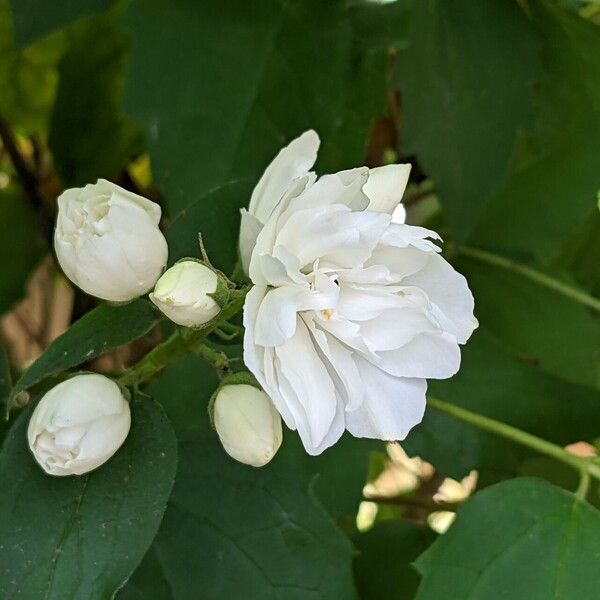
Plant Overview
The Mock Orange, specifically the 'Virginalis' hybrid, is often called the "scent of early summer." Known for its intoxicating fragrance that mimics fresh citrus blossoms, this classic shrub has been a staple in cottage gardens for over a century. It is a romantic, arching plant that transforms from a quiet green bush into a snow-white explosion of petals every June.
🔍 How to Identify
- 🌼 The Flowers: Produces dense clusters of "double" or "semi-double" snowy white blooms. Unlike the single-petaled wild varieties, 'Virginalis' looks almost like a miniature white rose or gardenia.
- 🍃 The Foliage: Features oval, medium-green leaves with a slightly rough texture and pointed tips. They grow in an "opposite" arrangement (pairs facing each other) along the stems.
- 🪵 The Bark: On older branches, the bark has a distinctive habit of peeling or "exfoliating" in thin, papery flakes, revealing a warmer tan color underneath.
🏡 In Your Garden
- ✂️ The Pruning Puzzle: This shrub blooms on "old wood" (stems produced the previous year). If you prune it in winter, you’ll accidentally cut off all the flower buds! Always wait to shape the plant until immediately after the flowers have faded in mid-summer.
- 🌬️ Scent Placement: To get the most out of this plant, tuck it near a patio, a window, or a high-traffic walkway. The heavy, sweet perfume is most intense in the late afternoon and evening when the air is still.
⚠️ Safety & Toxicity
- 🐾 Pet Safety: Good news for pet owners—Philadelphus is generally considered non-toxic to dogs, cats, and horses. It is a much safer aromatic choice for the garden than "True Lilies."
- 👶 Kid-Friendly: There are no known toxicities for humans, though the leaves are not edible and may cause minor stomach upset if ingested in large quantities by curious toddlers.
✨ Fun Fact
👑 The genus name Philadelphus translates from Greek to "brotherly love." It was named in honor of Ptolemy II Philadelphus, an ancient King of Egypt who was a famous patron of the arts and sciences!

Detailed Care Instructions
To grow Philadelphus × Virginalis, commonly known as mock orange, you can follow these steps:
- Select a suitable location: Choose a location that gets full sun to partial shade. The plant prefers well-draining soil but can tolerate a range of soil types.
- Planting: Dig a hole that is twice as wide and just as deep as the plant's root ball. Place the plant in the hole and backfill with soil, gently firming it around the roots. Ensure that the plant is level with the surrounding soil.
- Watering: Water the plant deeply after planting to establish its roots. After that, water regularly, especially during dry spells or if the plant shows signs of wilting. Avoid overwatering, as it can lead to root rot.
- Mulching: Apply a layer of organic mulch, such as wood chips or bark, around the base of the plant. This will help conserve moisture, suppress weeds, and regulate soil temperature.
- Pruning: Prune mock orange immediately after flowering to shape the plant and maintain its size. Remove any dead, damaged, or crossing branches. This will encourage vigorous growth and more abundant blooms.
- Fertilizing: Apply a balanced granular fertilizer in early spring before new growth appears. Follow the manufacturer's instructions for the appropriate dosage and method of application.
- Pest and disease control: Monitor the plant for common pests like aphids or powdery mildew. If necessary, treat with appropriate insecticides or fungicides following the instructions on the product label.
- Winter protection: Philadelphus × Virginalis is generally hardy and can withstand cold temperatures. However, in areas with severe winters, consider protecting the plant with a layer of mulch or burlap to insulate it against freezing temperatures.
By following these steps, you should be able to successfully grow and enjoy the fragrant blooms of your Philadelphus × Virginalis plant.
To water Philadelphus × Virginalis effectively, follow these guidelines:
- Identify the specific plant species in question by considering its physical characteristics, such as its overall height, shape, and texture, as well as its leaves, flowers, and stems.
- Observe the environmental conditions in which the Philadelphus × Virginalis is growing. Take note of factors such as sunlight exposure, temperature range, and soil type to determine the watering needs of the plant.
- Provide an appropriate amount of water based on the plant's specific requirements. Ensure that the soil is moist but not waterlogged, as excessive moisture can lead to root rot or other water-related issues.
- Consider the plant's growth stage and adjust watering accordingly. Newly planted Philadelphus × Virginalis may require more frequent watering to establish their root systems, while mature plants may need less frequent watering once they are established.
- Use a watering method that allows for thorough penetration and absorption by the roots. This can be achieved by watering at the base of the plant, rather than overhead, to minimize leaf wetness and potential fungal diseases.
- Monitor the soil moisture regularly. Check the moisture level by inserting your finger about an inch deep into the soil. If it feels dry at that depth, it may be time to water. However, if the soil feels moist or if rain has recently occurred, hold off on watering until the soil dries out.
- Consider the weather conditions and adjust the watering schedule accordingly. During periods of prolonged drought or intense heat, you may need to increase the frequency and duration of watering to compensate for increased evaporation.
- Water consistently but be mindful not to overwater, as this can lead to root suffocation and other issues. Proper drainage is essential, so ensure that the container or planting area allows excess water to escape or the soil's structure promotes drainage.
- Mulching around the base of the Philadelphus × Virginalis plant can help retain moisture in the soil, reduce weed growth, and regulate temperature. Apply a layer of organic mulch, such as wood chips or bark, but leave some space around the base of the plant to prevent stem rot.
- Regularly inspect the plant for signs of stress or inadequate watering, such as wilted or yellowing leaves. Adjust your watering practices accordingly to provide the necessary hydration.
Remember that the information provided here is generic and should be adapted to the specific requirements of the Philadelphus × Virginalis plant you are growing.
To properly fertilize this plant, follow these instructions:
- Choose a balanced fertilizer with an N-P-K (nitrogen-phosphorus-potassium) ratio of 10-10-10 or a similar formulation.
- During the spring or early summer, apply the fertilizer to the soil around the base of the plant.
- Read and follow the recommended application rate on the fertilizer packaging, as different fertilizers may have varying application rates.
- Use a hand trowel or garden fork to gently scratch the fertilizer into the topsoil.
- Water the plant thoroughly after fertilizing to help the nutrients penetrate the soil.
- Water the plant regularly throughout the growing season to maintain optimal growth and nutrient uptake.
- Repeat the fertilization process annually in the early spring or according to the specific fertilizer manufacturer's recommendations.
Note: It's always advisable to check and follow any guidelines provided by the specific plant cultivar or consult local horticultural experts for region-specific recommendations.
The ideal soil for Philadelphus × Virginalis plants is a well-drained loamy soil. It should be slightly acidic to neutral in pH, with a range of 5.5 to 7.5 being suitable for healthy growth. The soil should retain moisture but not become waterlogged, as excessive moisture can lead to root rot.
To provide optimal conditions for the plant, the soil should be rich in organic matter. This can be achieved by incorporating compost or well-rotted manure into the soil before planting. Organic matter improves soil structure, increases water holding capacity, and provides essential nutrients.
Avoid heavy clay soils that tend to retain too much water, as this can suffocate the plant's roots. Similarly, sandy soils may drain too quickly, leading to insufficient moisture retention. Amending these soils with organic matter can help improve their fertility and moisture-retaining properties.
Proper drainage is crucial for the health of this plant, as it dislikes standing water. To ensure good drainage, consider planting the Philadelphus × Virginalis on a slightly elevated spot or in raised beds. Additionally, avoid over-watering the plant, especially during periods of heavy rainfall or if the soil is already moist.
Regularly monitoring the moisture levels in the soil and adjusting watering accordingly is beneficial. Mulching around the base of the plant with organic materials, such as bark chips or straw, helps to maintain soil moisture, regulate temperature, and suppress weed growth.
Remember to conduct soil tests periodically to evaluate the nutrient content and pH of the soil. Based on the results, adjustments can be made by adding fertilizers or soil amendments tailored to the plant's specific requirements.
By selecting the right soil and maintaining proper care, you can provide a suitable environment for the Philadelphus × Virginalis plant to thrive and showcase its beautiful foliage and blossoms.
To propagate Philadelphus × Virginalis, you can utilize various methods such as softwood stem cuttings, hardwood cuttings, division, or layering. Here's a detailed explanation of each method:
- Softwood stem cuttings: This method is typically done in late spring or early summer when the plant's new growth is flexible but not excessively tender. Follow these steps:
a. Select a healthy, non-flowering stem from the parent plant.
b. Cut a 4-6 inch section of the stem just below a leaf node.
c. Remove the lower leaves, leaving only a few sets of upper leaves intact.
d. Dip the cut end into a rooting hormone powder or gel to enhance root development.
e. Plant the cutting in a well-draining soil mix, ensuring at least half of its length is buried.
f. Place the cutting in a sheltered location with indirect sunlight and consistent moisture.
g. After roots develop (usually in a few weeks to a couple of months), transplant the cutting to a larger container or desired location.
- Hardwood cuttings: This method is best employed during the dormant period (late fall to early spring) when the woody tissue is mature. Here's what to do:
a. Collect hardwood cuttings from a healthy and well-established plant, choosing straight shoots.
b. Cut 8-12 inch sections, ensuring there are at least three bud nodes on each cutting.
c. Dip the base of the cuttings in a rooting hormone.
d. Insert the cuttings 2-3 inches deep in a pot or directly in the ground.
e. Keep the soil moist but not waterlogged.
f. Overwinter the cuttings in a sheltered area, protecting them from frost and extreme cold.
g. In the following spring, check for root development, and transplant the rooted cuttings to their final growing location.
- Division: This method is suitable for mature Philadelphus × Virginalis plants that have formed clumps. Here are the steps:
a. Dig up the parent plant carefully, trying not to damage the roots.
b. Use a sharp and clean gardening tool to divide the clump into smaller sections.
c. Each division should have an adequate amount of roots and shoots.
d. Replant each division in prepared soil at the same depth as the parent plant.
e. Water them thoroughly and provide regular care until they establish.
- Layering: This method works well with flexible stems that can be easily brought to the ground. Here's how to do it:
a. Locate a low-growing, healthy stem that can be bent towards the soil.
b. Bury a section of the stem about 4-6 inches deep in a prepared trench or pot.
c. Keep the buried section in contact with the soil using stakes or U-shaped pins.
d. Water the soil regularly to maintain moisture.
e. After a year or so, the layered stem should develop roots.
f. Cut the stem from the parent plant and transplant the new rooted Philadelphus × Virginalis to its desired location.
By employing these propagation methods, you can expand your Philadelphus × Virginalis collection and enjoy the beauty of this plant without solely relying on its common names.








