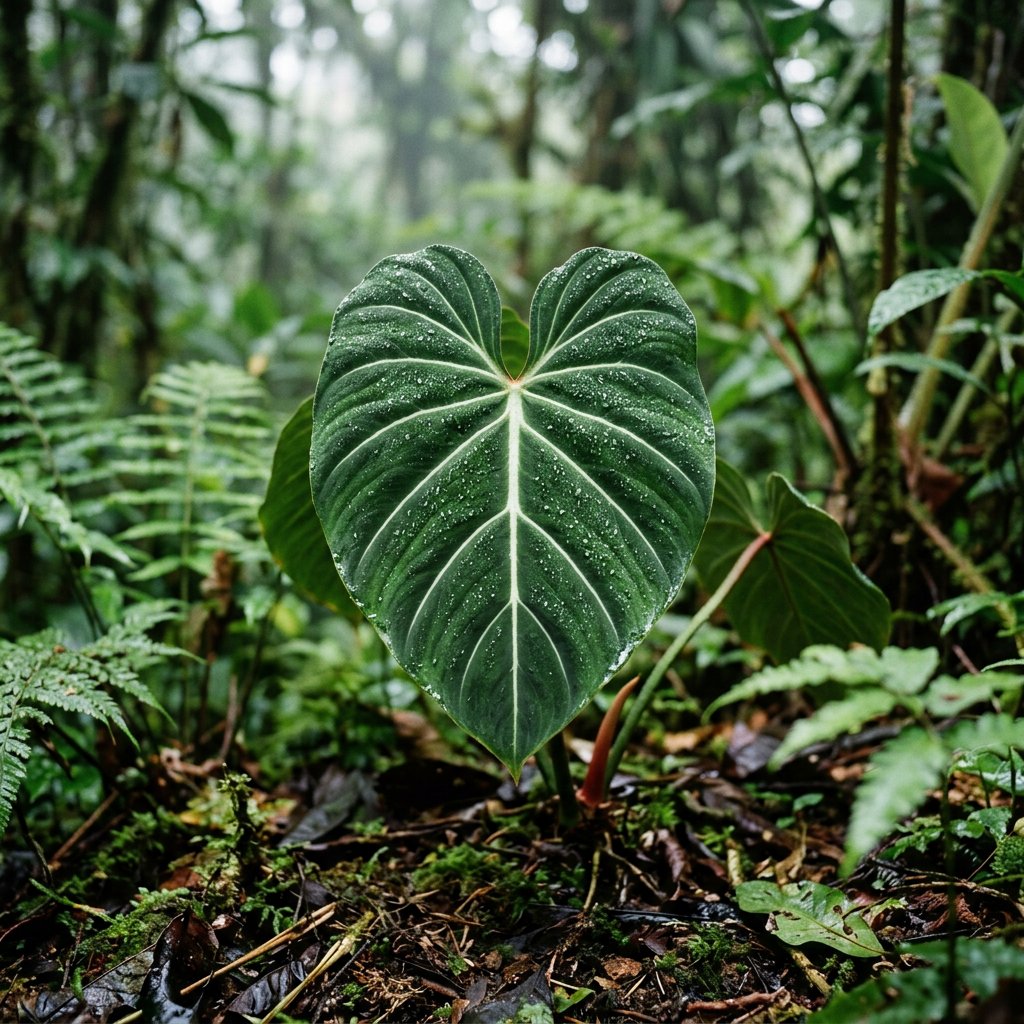
Plant Overview
Often called the "Velvet Heart," the Philodendron gloriosum is the undisputed crown jewel of many indoor jungles. Hailing from the humid rainforests of Colombia, this terrestrial crawler is famous for its massive, heart-shaped leaves that feel like soft emerald suede. Unlike many of its climbing cousins, this plant prefers to stay grounded, slowly creeping across the forest floor with regal grace.
🔍 How to Identify
- 🍃 Leaf Texture: Deep green leaves with a distinct velvety, matte finish that catches the light and invites touch.
- 🦴 Prominent Veining: Striking white to pale-pink veins radiate from the center to the edges, creating a high-contrast "skeleton" pattern.
- 🪵 Crawling Rhizome: A thick, horizontal green stem (rhizome) that grows along the surface of the soil rather than climbing upward.
🏡 In Your Garden
- 📦 Space to Roam: Because this species is a "crawler," it thrives best in long, rectangular planter boxes rather than deep, round pots. This allows the rhizome to stay in contact with the soil as it travels.
- 💧 The Shallow Secret: To prevent "rhizome rot," the main thick stem should never be buried deep in the dirt. It prefers to sit right on top of the substrate, with only the roots reaching down.
- ☁️ Humidity over Water: It craves high humidity (60%+) to keep its large leaves from browning at the edges, but it hates "wet feet." Well-draining, chunky soil is a must to keep it happy.
⚠️ Safety & Toxicity
- 🐾 Toxic to Pets: Like most members of the Araceae family, it contains insoluble calcium oxalate crystals.
- 👄 Irritation: If leaves or stems are chewed, it can cause immediate stinging and swelling of the mouth, tongue, and throat. It should be kept out of reach of curious cats, dogs, and toddlers.
✨ Fun Fact
✨ The name "gloriosum" isn't just a marketing trick—it’s the official botanical name, meaning "glorious." While it stays relatively compact in a pot, in the wild, a single leaf can grow to be over 3 feet wide!

Detailed Care Instructions
| Soil Ph | Neutral, Alkaline |
| Humidity | Normal |
| Lighting | Part Sun |
| Toxicity | Toxic |
| Soil Type | Loamy, Moist But Well-Draining |
| Difficulty | Medium |
| Plant Type | Evergreen Shrub |
| Native Area | South America |
| Temperature | 18°C - 35°C |
| Sun Exposure | Partial Sun |
| Hardiness Zones | 9-11 |
To grow a Philodendron Gloriosum plant, follow these steps:
- Choose the right location: Philodendron Gloriosum prefers bright, indirect light. Place it near a window where it can receive filtered sunlight. Avoid exposing it to direct sunlight, as it can burn the leaves.
- Provide the right temperature and humidity: This plant thrives in temperatures between 65-85°F (18-29°C). Keep it away from drafts or extreme temperature fluctuations. Additionally, Philodendron Gloriosum prefers a humid environment. You can increase humidity by placing a tray filled with water near the plant or using a humidifier.
- Select a suitable pot and soil: Choose a well-draining pot that allows excess water to flow out. Philodendron Gloriosum prefers a moist but not soggy soil. Use a well-draining potting mix that retains some moisture, like a mixture of peat moss, perlite, and orchid bark.
- Watering: Water the plant when the top inch of the soil feels dry to the touch. Water thoroughly, allowing the excess water to drain out. Avoid overwatering or letting the plant sit in standing water, as it can lead to root rot.
- Fertilizing: Feed the plant with a balanced, water-soluble fertilizer every 2-4 weeks during the growing season (spring and summer). Dilute the fertilizer to half strength as directed on the packaging.
- Pruning and maintenance: Trim off any yellow or dead leaves to maintain the plant's health and appearance. You can also prune the plant to control its size and shape.
- Propagation: Philodendron Gloriosum can be propagated through stem cuttings. Select a healthy stem with several leaves and cut it just below a node. Place the cutting in a vase of water or a moist potting mix until roots develop, then transplant it into a new pot.
Remember to regularly check the plant for pests such as spider mites or mealybugs. If you notice any, treat them with an appropriate insecticide or clean the leaves with a mild soapy water solution.
By following these steps, you can successfully grow and care for a Philodendron Gloriosum plant.

Place in a window with dappled sun or a spot in the middle of a room. Or directly in a window facing west or east.

To properly water this plant, it is important to wait until the top inch of soil feels dry before watering. When watering, slowly pour water onto the soil around the base of the plant, being careful not to get water on the leaves. Allow any excess water to drain out of the pot and do not leave standing water in the saucer beneath the pot. During the growing season, it may be necessary to water more frequently than during the dormant season. It is also important to ensure that the plant is not exposed to extreme temperature changes or drafts.
To fertilize this plant, use a balanced liquid fertilizer during the growing season every two weeks. Take care to dilute the fertilizer to half strength before application. Reduce fertilization during the winter months when the plant is not actively growing. Only fertilize the plant when the top inch of soil is dry to the touch, and avoid fertilizing newly transplanted or young plants.
When choosing soil for this particular plant, it is recommended to use a well-draining soil mix. This may include a combination of materials such as peat moss, perlite, and vermiculite. Additionally, it is important to ensure that the soil is not too compacted as this can hinder root development. The soil pH should also be slightly acidic to neutral (between 5.5-7.5). It is also recommended to use a pot with drainage holes to prevent water from pooling around the roots. Overall, the goal is to create a soil mixture that will provide adequate drainage and aeration while still retaining moisture for the plant.
To propagate a particular type of plant, one can start by selecting a healthy parent plant with strong and vibrant foliage. Take a sharp and sterile pair of scissors and cut off a healthy stem from the parent plant just below a node, which is the point on the stem where leaves emerge.
Then, remove the lower leaves from the stem, leaving only a few leaves at the top. Make sure that there are at least one or two nodes remaining on the stem. Dip the cut end of the stem into rooting hormone powder, which will encourage root growth, and place it into a pot filled with a well-draining soil mix. Lightly press the soil around the stem to hold it in place.
Water the cutting thoroughly, making sure the soil is evenly moist. Cover the pot with a clear plastic bag, creating a mini greenhouse environment for the cutting. Place the pot in a bright, indirect location, avoiding direct sunlight.
Monitor the soil moisture and keep it moist but not waterlogged. After a few weeks, gently tug on the stem to feel for resistance, indicating that roots are forming. Once roots have developed, remove the plastic bag and treat the plant as you would its parent plant.
It's important to note that propagation times vary depending on the plant species and environmental conditions.
Common pests of the leri include Mealybugs, spider mites, thrips. Make a habit of checking your leri frequently for pests so that any infestations can be caught and managed early.








